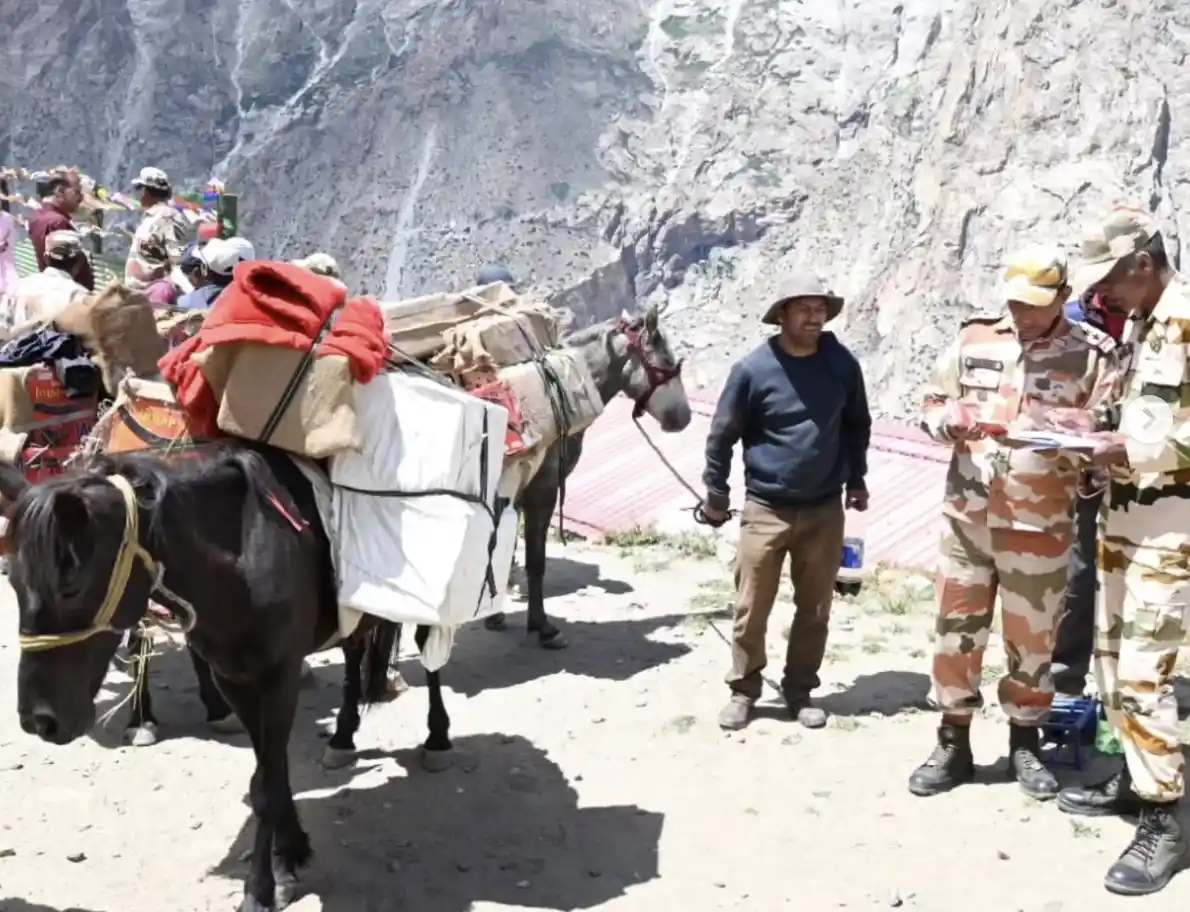
In the words of Himachal Pradesh revenue minister Jagat Singh Negi, “Borders may close, and trade routes may fall silent, but history can’t be erased. It rather waits to be rediscovered. Shipki La stands as a reminder that ancient ties can outlast modern disruptions.”
Negi, an MLA from Kinnaur, Himachal Pradesh’s high-altitude tribal district that shares borders with the Tibetan Autonomous Region of China, last week flagged off a batch of 16 traders, mostly locals from border villages, to mark the revival of Indo-China trade after a gap of 6 years through Shipki La, a treacherous pass at an elevation of 3,930 meters.
Shipki La is a centuries-old trans-Himalayan trade corridor that remained part of the ancient Silk Route, linking India with Tibet. The trade is based on an old barter system—goods for goods exchange, even in an era of digital payments and global commerce. This makes Shipki La one of the world’s few living examples of a traditional trading practice.
“For us, Shipki La is more than a commercial route, as it symbolises an enduring civilisational tie, a cultural exchange, and a shared Himalayan connection our forefathers practised for decades,” says Hishey Negi, president of the Kinnaur Indo-China Traders’ Association, an umbrella body that facilitates the trade.
Traditionally, the traders carried agricultural produce, woollen textiles, spices, rice, dry fruits, and handicrafts to Tibet, returning with wool, pashmina, salt, borax, horses, and other commodities. The goods were carried on mules and even manually, as there is no motorable connectivity, even now.
After India’s independence, border trade continued under bilateral arrangements until it was suspended following the 1962 Sino-Indian War. The trade was resumed in 1994 under a border trade agreement, making Shipki La one of three officially designated India-China border trading points, alongside Lipulekh Pass in Uttarakhand and Nathu La in Sikkim.
But after the Covid-19 pandemic, the trade was stopped in 2020, though the seasonal trade continues through Nathu La. It is only on August 1, 2026
For Pasang Cheering, a trader from Dubling, one of the 16 traders who crossed over to China for trade, “I sold everything I had taken on two mules. It was quite a meaningful trip as I got a good deal to get some quality stuff in exchange. The only problem we traders faced was the imposition of IGST by the customs officials. This should be withdrawn,” he demands.A similar sentiment was also expressed by other traders, who have raised the demand for withdrawal of the IGST to sustain the trade and ensure that it remains commercially viable.
“Indeed, the trade via Shipki La is not very lucrative, and volume is also not so high. I will certainly write to the Himachal Pradesh government so that the matter is taken up with the Union Ministry of Commerce at the appropriate level. The trade is also a means of livelihood for the border villagers, and they are very eager,” says Deputy Commissioner, Kinnaur, Amit Kumar Sharma.
The Kinnaur Indo-China Trade Association has now also submitted a memorandum to the district administration informing them that no registered trader will undertake border trade with China through Shipki La until the IGST imposed on the items approved for Shipki La route trade is exempted, in line with the exemption already granted from customs duty.
Hishey Negi, its president, said the customs duty was exempted under Government of India Notification No. 38/96-Customs dated July 23, 1996, to encourage and sustain traditional border trade; the imposition of IGST has substantially increased the financial burden on traders.
“Considering the limited value of trade, difficult terrain, transportation by mules, short trading season, and the socio-economic objective of this border trade, the levy of IGST makes the trade commercially unviable. Moreover, the trade has a limited period of six months, till November 30 each year, due to upcoming winter snowfall,” Negi maintained.
The objective of the government has always been to strengthen border areas, generate employment, preserve traditional trade practices, and improve the economic well-being of people residing in remote frontier regions. Even Prime Minister Narendra Modi’s vibrant village project and opening of border areas of Kinnaur to tourists have raised hopes for strengthening economic activities to boost locals’ incomes.
“There is a strong cultural affinity among traders on both sides of the border. Many belong to second- and third-generation trading families who have known each other for decades,” said Cheering.
India and China, located in the southern and eastern parts of Asia, respectively, are major developing nations with significant influence in South Asian and global politics. Initially, they had a cordial relationship and brotherly bond, but border conflicts and tensions have led to the fragmentation of ties.
Official data show that bilateral trade through Shipki La peaked at Rs 9.72 crore in 2015. It stood at Rs 7.32 crore in 2014, remained robust at Rs 8.59 crore in 2016, but gradually declined to Rs 3.05 crore by 2019, the last full trading season before the route was shut due to the COVID-19 pandemic in 2020.