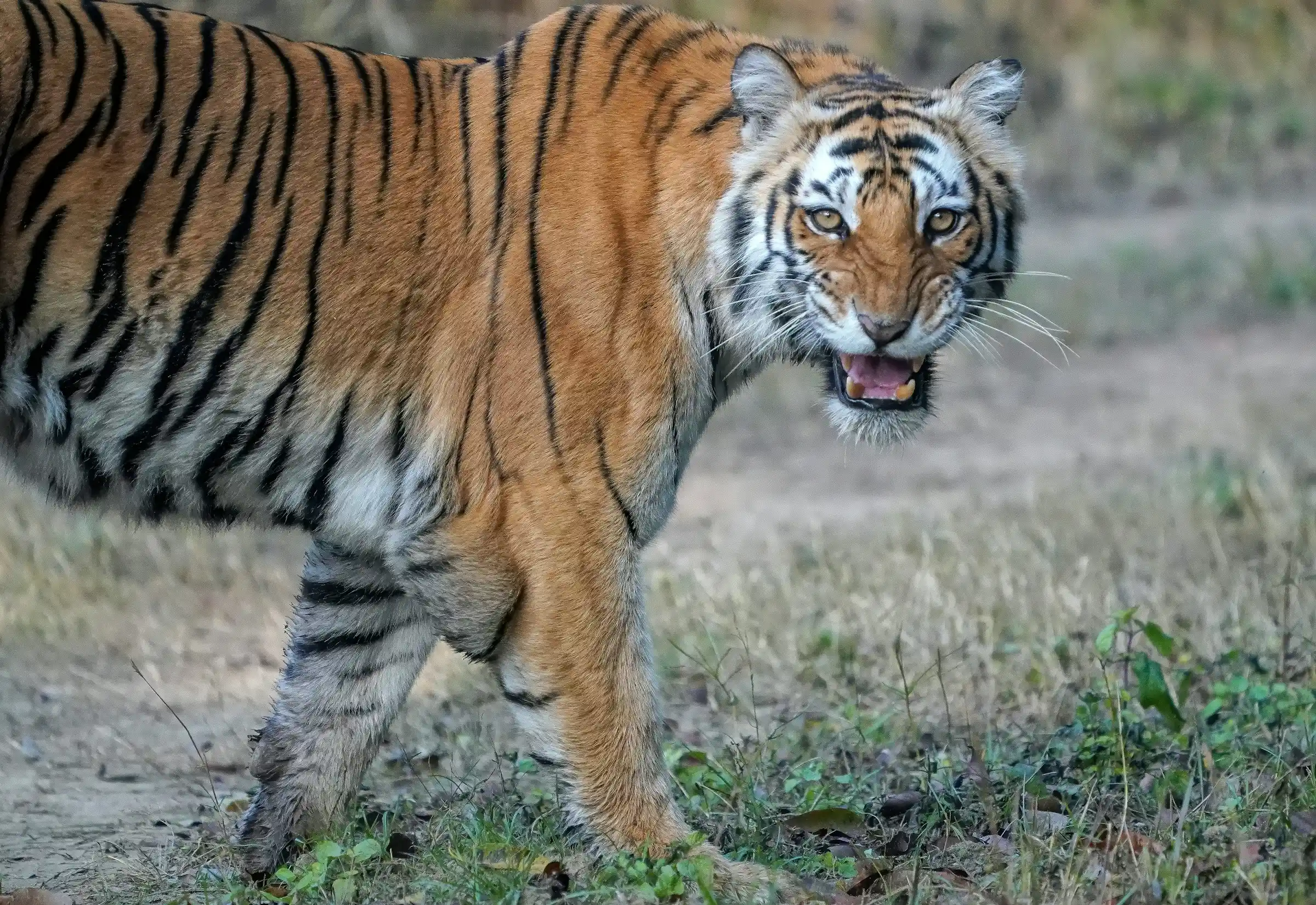
“Tyger! Tyger! burning bright,
In the forests of the night;
What immortal hand or eye,
Could frame thy fearful symmetry?”
Sadly, the king of the Indian forest, the mount of Goddess Durga, is endangered today in his own realm.
The campaign to save him began with great fanfare at Corbett National Park more than half a century ago—a sanctuary named after the legendary hunter of man-eaters in Kumaon.
The myth has deified Corbett Sahib as the paternalistic white saviour of wretched, dark villagers. Fiction has blurred facts. Most of Corbett’s life was spent far away from Kumaon as a railway contractor and in the army, gaining a temporary commission as a supplier of coolies recruited in the hills. He left India, ruled by brown people, in 1947, as he couldn’t imagine it as “home” for a white man anymore.
Alas, the forest commemorating him is threatened today by the steadily encroaching concrete jungle. Resorts teeming with urban “wildlife” have mushroomed. Gypsies and Canters overloaded with tourists stalking the tiger outnumber the non-human animals. Business is bustling. Corbett is a popular destination for weddings and corporate off-sites. Visiting the park has become aspirational since the Prime Minister spent a day here with the Discovery crew to record a video on the theme “Man and the Wild.”
The forest has played a defining civilisational role in Indian history. Here, in ashrams set up by sages, celibate youth studied and trained in martial arts. Princes came here to hunt and exterminate brigands and beastly demons. The elderly retired to forests in the evening of life, and brave youths ventured forth to prove their mettle. Some, like Siddhartha, came in search of enlightenment.
Aranyakanda and Vana Parva in the Hindu epics Ramayana and Mahabharata provide useful insights into this entangled relationship.
One of the many names of the forest is aranya—something one can’t battle. Cleared to make room for villages, fields, towns and cities, it strikes back the moment the guard is lowered and reclaims the lost ground. The same story echoes from Angkor Wat to Machu Picchu.
The jungle is home to creatures big and small. Elephants, rhinos, graceful spotted deer, monkeys, foxes, wolves and hares; birds of different plumage; reptiles and crocodiles together sustain an ecosystem where man is an intruder.
Valiant foresters risk their lives day and night to keep poachers at bay and to guard the buffers separating the pristine core from the periphery with human settlements.
For countless generations, humans have coexisted with predatory animals and venomous snakes, respecting each other’s right of way and ways of life. Branded “savages” by the city-bred, intoxicated by modernity, they are inheritors of priceless traditional knowledge. They know well that animals don’t kill their own kind or attack unless provoked. Their wise ancestors tapped the resources of the forest sustainably.
It’s the commercial and security “imperatives” that have played havoc with nature. A metalled motor road cuts, like a gaping wound, through Corbett to cut short the travel time to Dehradun, the state capital. Corbett’s protected forest merges with Rajaji National Park, where a highway and a railway line have caused the tragic deaths of elephants on their well-trodden path to the river.
The tribal population in the Terai comprises the Tharu and Boxha agrarian communities, along with the nomadic Van Gujjars. They have lived for centuries on the swampy lands on the banks of the Ramganga River. Expert hunters and fisherfolk, they trace their roots to distant Rajasthan. They too are feeling the pressure of development. Pushed out by the forest conservators and squeezed by resort builders, their living space is constantly shrinking.
Traditional tribal food represents the essence of the “aromas of jungle meats”. Sekuwa (char-grilled) pork, small fish fried whole in thin batter, and ghoonghi, the delicious snail curry, are imperilled and on the verge of extinction.
Jangal is the tract of arid land—like Corbett—with elephant grass and brushwood covering the ground. The senses are seduced by a dizzying blend of multi-layered smells—mossy, earthy, dry, wooden, rotting leaves, overripe fruit, lemongrass and wild mint.
Primal, primordial sounds reverberate as the forest pulsates with its own primitive rhythms—drumbeats and the whistling bamboo flute. Bhavani Prasad Mishra, the gifted Hindi poet, has magically captured the ecstasy children of the forest experience—”eternity in the moment.” Drunk is the Palash and drunk the grass! The cockerel and partridge are equally high! All have sipped Mahua! Blood races in their veins as vines sway and love blossoms.
Saving the cradle of biodiversity in Corbett and elsewhere isn’t The Jungle Book writing The White Man’s Burden, but our responsibility.