On 29 July 2026, two things happened on the same day, in the same territory, and together they told the world everything it needs to know about Pakistan’s occupation of Kashmir.
In Washington, the Indian Embassy issued a terse rebuke to The New York Times for headlining a report “Clashes Erupt in Pakistani Kashmir.” “There is no Pakistani Kashmir,” the Embassy wrote, “only Pakistan-occupied Kashmir.” In Mirpur, Kotli, Rawalakot and Muzaffarabad, Pakistani security forces were, at that very hour, firing live rounds into crowds of unarmed civilians who had gathered to boycott what Islamabad was calling a democratic exercise.
The two dispatches were not unconnected. India’s correction of a newspaper’s vocabulary and the newspaper’s own reporting on a massacre were, in effect, the same story told from two vantage points — one diplomatic, one journalistic. Both converge on an inconvenient truth that Pakistan has spent seventy-nine years trying to obscure: the people of Pakistan-occupied Kashmir (POK) are not willing subjects of Rawalpindi’s writ. They are a population under occupation, and in July 2026 they said so with their bodies.
The Briefest Possible Background
POK — what Pakistan euphemistically calls “Azad Jammu and Kashmir,” Free Kashmir, a name Orwell would have recognised instantly — has never been free. It has its own nominal Legislative Assembly of 53 seats, 45 directly elected and 8 reserved, which in turn selects a “prime minister.” But this is theatre, not sovereignty. POK residents have never held, and do not today hold, seats in Pakistan’s National Assembly in Islamabad. They are neither a province of Pakistan nor an independent state — a deliberately ambiguous status Islamabad has preserved for seven decades precisely because full absorption would demolish its own diplomatic fiction that Kashmir’s status remains “disputed.”
Even citizenship is a hedge. POK residents are issued Pakistani CNICs and passports and travel and conduct daily transactions as Pakistani nationals. Yet Pakistan’s own citizenship jurisprudence treats their status as conditional and residual rather than full and unqualified — a population useful to Rawalpindi as a strategic asset, inconvenient to acknowledge as fellow citizens. It is occupation administered through documentation, not integration through constitutional equality.
Every Assembly election in POK is, in truth, an election supervised by Pakistan’s military and intelligence establishment, in which the ISI has historically vetted candidates and the outcome has rarely surprised anyone in Rawalpindi. What made July 2026 different was not the election. It was the fact that, for the first time in a generation, the people it claims to represent refused to play along — and Pakistan answered their refusal with bullets.
The JAAC and the Uprising Pakistan Tried to Ban
The Joint Awami Action Committee (JAAC) emerged in 2022 as a civil movement against electricity tariffs and Islamabad’s plunder of POK’s hydropower wealth. By 2026, its 38-point charter had matured into something far more dangerous to Pakistan: a direct challenge to the legitimacy of the Assembly itself. JAAC’s central demand was the abolition of twelve reserved seats set aside for Kashmiri refugees resident in Pakistan proper — seats that allow Pakistan’s mainland parties to import loyal votes into a territory whose actual residents they cannot fully control. It is gerrymandering by population transfer, dressed up as minority representation.
When Islamabad refused constitutional reform and pressed ahead with the July elections regardless, JAAC called for a full boycott and organised a “Muzaffarabad Chalo” — a long march on the regional capital. Pakistan’s response was to ban JAAC outright under anti-terrorism legislation, criminalising a civil rights movement for the crime of demanding fair representation. Its leader, Shaukat Nawaz Mir, was already describing the June violence in Rawalakot — where eleven to fifteen protesters had been killed — as a “massacre.” Pakistan had every warning of what was coming. It chose escalation anyway.
27 July: The Election That Became a Killing Field
Pakistan split the vote into three phases across Mirpur, Kotli and Bhimber, citing “security concerns” — an admission, in itself, that the state did not trust its own writ in the territory it claims to have freed. What followed was not an election marred by violence. It was violence organised around the pretence of an election.
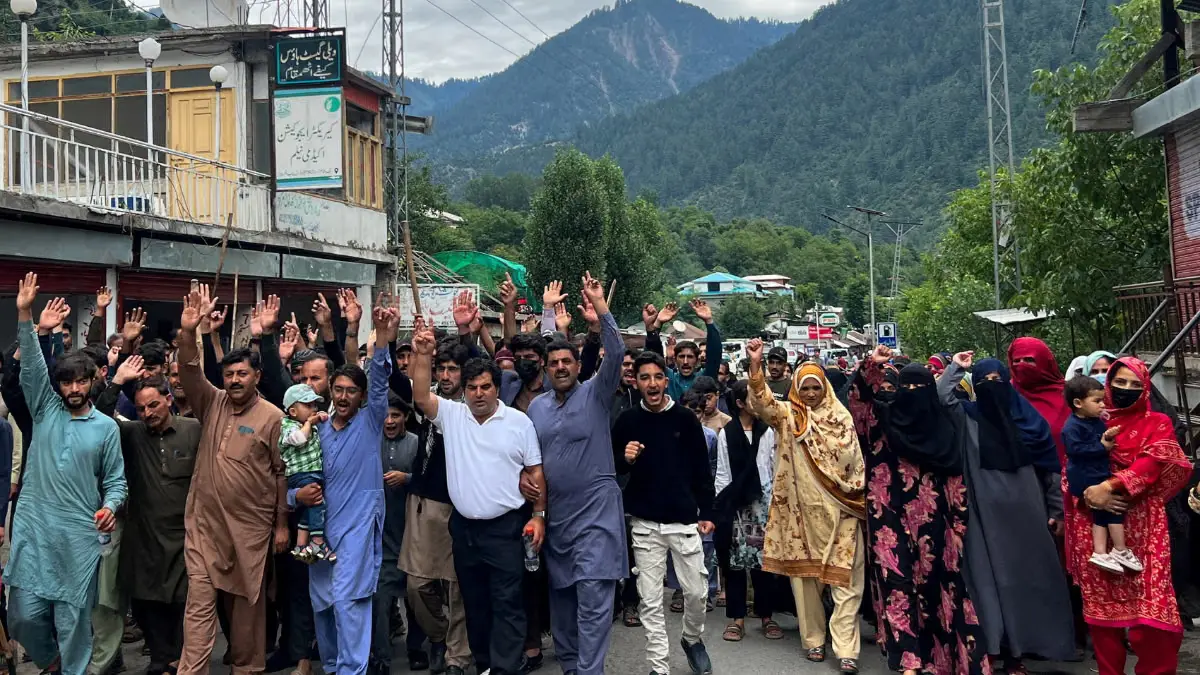
JAAC says security forces opened fire on tens of thousands of peaceful demonstrators — twenty-five killed on the Monday, five more the following day, a cumulative toll its spokespeople place above thirty. Reuters could not independently verify JAAC’s full figure but confirmed at least three protester fatalities in Mirpur through an anonymous official; Al Jazeera reported dozens dead in the run-up to voting; Wikipedia’s running documentation, compiled from wire reports, records nine killed on 14 July alone in pre-election clashes. Pakistan’s own official count — one security man killed, five injured — is almost comic in its minimalism, a number designed for a press release rather than a morgue.
Whichever figure one credits, the pattern is unambiguous. At Lal Chowk in Muzaffarabad, police opened fire on protesters. In Bagh, enraged locals overpowered and captured Punjab Police personnel — a measure of how completely state authority had collapsed in the eyes of the people it claims to represent. In Rawalakot and Mirpur, marchers pushed past security cordons under a communications blackout so total that internet, banking and road links were severed, making independent verification of the dead all but impossible. That blackout was not incidental. It was policy — the oldest instinct of every state committing violence against its own people: darken the room before you open fire.
And when the bodies could no longer be hidden, Pakistan reached for the most threadbare alibi in its playbook: alleging that “India-backed militants” had infiltrated the protests. India has rejected this fabrication for what it is — a preemptive smear designed to recast a democratic uprising as a foreign conspiracy, precisely so that Islamabad need never answer for gunning down its own “Azad” Kashmiris. There is a bitter irony that requires no embellishment: a state calls a population artificially “free,” strips them of genuine political voice for eight decades, and when they finally exercise the only power left to them — refusal — that state murders them and blames New Delhi for their courage.
The People Pakistan Cannot Silence.
Nothing captures Pakistan’s failure more starkly than London. On the same weekend, British Kashmiris and diaspora Kashmiris — not Indian nationals, not agents of New Delhi, but the sons and daughters of POK itself- marched from Hyde Park to the Pakistan High Commission. These were people protesting Pakistan, in the heart of a Western capital, in numbers Islamabad’s embassy could not ignore. That is the most damning testimony of all: the diaspora Pakistan has spent decades claiming as evidence of Kashmiri loyalty to its cause instead marched against it.
The Same Playbook in Balochistan
POK is not Pakistan’s only occupied province behaving like a captive nation. In Balochistan, the pattern is older, bloodier, and even less examined by the world. Islamabad has spent decades extracting the province’s gold, copper and gas — Reko Diq and Saindak chief among them — while Baloch districts remain among the poorest in Pakistan, their people locked out of the wealth beneath their own soil. Human rights bodies have long documented enforced disappearances of Baloch students, journalists and activists, followed too often by “kill-and-dump” operations: bullet-riddled bodies discarded on roadsides, families denied even the dignity of a trial before a killing. Assassinations of Baloch political leaders, extrajudicial executions dressed up as “encounters,” and a military occupation that answers dissent with the same live rounds now seen in Mirpur — this is not two separate crises. It is one Pakistani state, one doctrine: loot the resource, deny the people a voice, and shoot anyone who notices.
India’s Response — And a Restraint Worth Noting
India’s reaction has been calibrated, factual, and — this deserves emphasis — restrained. New Delhi’s Ministry of External Affairs called the elections a “cosmetic exercise” designed to legitimise illegal occupation. The Washington Embassy’s rebuke of the New York Times was not pedantry over nomenclature; it was a refusal to let sloppy Western terminology launder occupation into ownership, precisely while Pakistani bullets were finding their mark in Mirpur’s streets. India has filed no formal protest with Islamabad and demanded no international tribunal. New Delhi’s posture has been to document, to assert its consistent constitutional position on the Union Territories of Jammu & Kashmir and Ladakh, and to let Pakistan’s own conduct make India’s argument for it.
That argument has rarely been made more effectively than it was in the last week of July 2026. A regime that must ban a civil rights committee, black out the internet, deploy fourteen thousand Punjab Police reinforcements, and shoot down unarmed marchers to conduct a “local election” has told the world, more eloquently than any Indian statement could, exactly what kind of freedom it has given the people of “Azad” Kashmir.