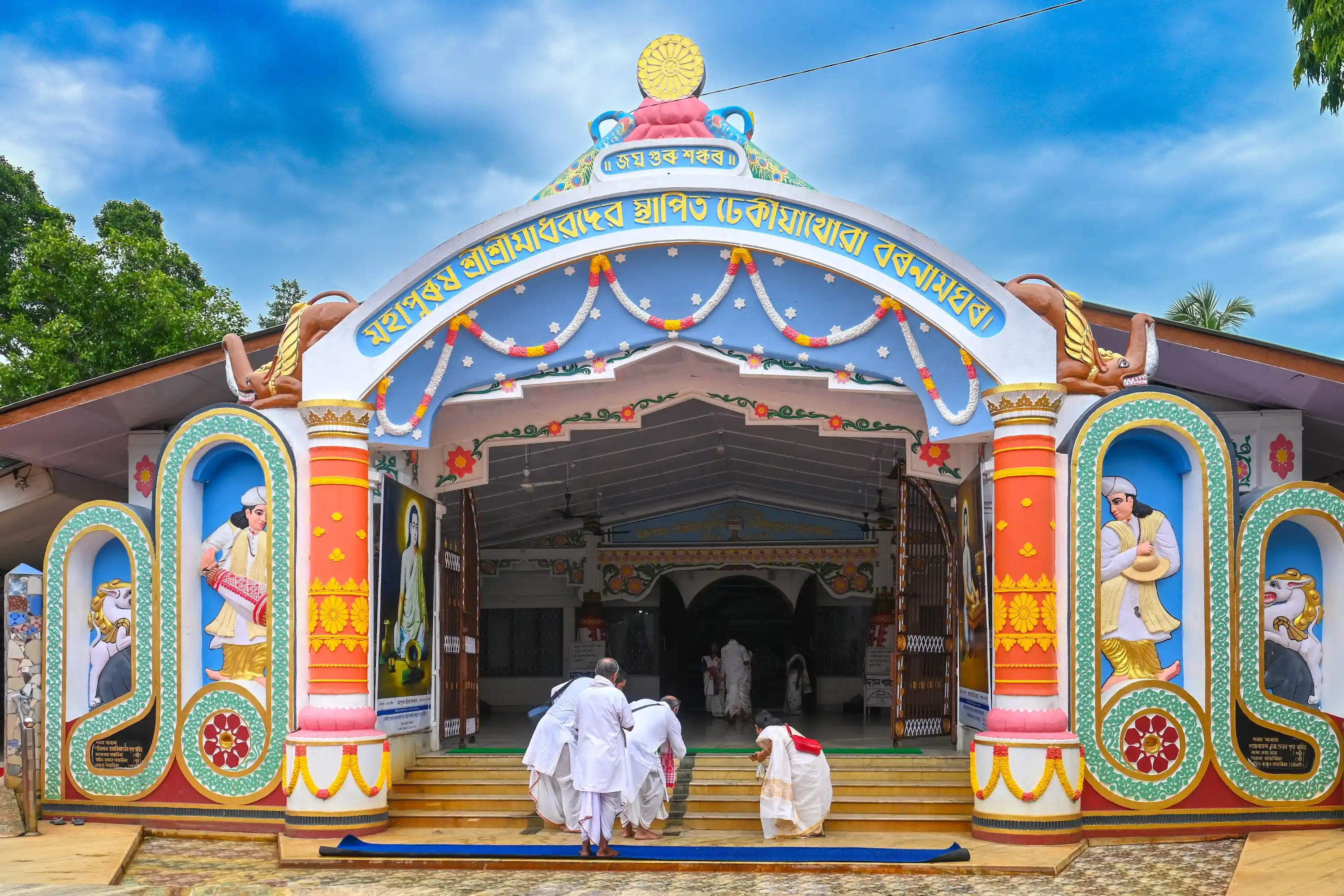
Much of India’s democratic heritage is often traced to ancient republics such as the ganas and sanghas, village panchayats, and the deliberative traditions described in classical texts. Yet, one of the country’s most enduring institutions of participatory governance remains surprisingly absent from the national conversation—the Namghar. Established in the 15th and 16th centuries by the saint-scholar Srimanta Sankardeva as part of the Eka Sarana Nama Dharma movement, the Namghar is widely recognised as a place of congregational worship in Assam. What is less appreciated is its role as a community institution where collective decision-making, social inclusion, cultural expression and civic responsibility converged. At a time when democratic institutions across the world are grappling with declining public trust, the Namghar offers valuable lessons from India’s own civilisational experience.
Unlike conventional religious spaces that are primarily reserved for ritual practices, the Namghar evolved as a shared public institution. Villagers assembled there not only for prayer but also to deliberate on matters affecting community life. Local disputes were discussed, festivals organised, charitable activities coordinated and collective responsibilities shared through consensus rather than coercion. Participation was rooted in dialogue, making the Namghar a living forum where social capital was continuously nurtured.
This model reflected Sankardeva’s broader social vision. His reform movement sought to dismantle barriers of caste and hierarchy by emphasising devotion, equality and community participation. The Namghar became the physical embodiment of these ideals. Open to people from different social backgrounds, it fostered a culture where moral authority rested not on inherited privilege but on shared values and collective responsibility. In many respects, it functioned as a grassroots public sphere long before such concepts entered modern political vocabulary.
Its democratic character also extended beyond governance into culture. The Namghar became the nucleus of Assam’s artistic life. Devotional music, Borgeet, theatrical performances known as Ankiya Naat, and the classical dance tradition of Sattriya flourished within its walls. These were not performances for passive audiences but collective cultural practices that encouraged participation across generations. By preserving language, literature, music and performance traditions, the Namghar strengthened community identity while ensuring that culture remained accessible rather than exclusive.
Equally significant was its educational role. Before formal schools became widespread, the Namghar served as a space where ethical values, history and literary traditions were transmitted through storytelling, music and discourse. Learning occurred through participation, observation and dialogue, reinforcing civic virtues alongside spiritual instruction. In an age when education is increasingly measured through examinations and employability, this holistic understanding of community learning deserves renewed attention.
The resilience of the Namghar has also been evident during times of crisis. Whether responding to floods, supporting vulnerable families or mobilising relief efforts, Namghars have often acted as centres of local coordination across Assam. Their ability to bring communities together quickly stems from the trust they have accumulated over centuries. Modern disaster management frequently emphasises institutional preparedness; the Namghar demonstrates the equally important role of social preparedness rooted in enduring community networks.
Ironically, despite its profound historical significance, the Namghar remains underrepresented in national discussions on India’s democratic traditions. International scholarship often celebrates European civic institutions or East Asian community models, while India’s indigenous experiments in participatory governance receive comparatively little attention. Recognising the Namghar as a civilisational institution rather than merely a regional religious space would enrich the broader understanding of India’s democratic evolution.
This recognition is especially relevant as India seeks to articulate its civilisational identity on the global stage. The country’s democratic credentials are often assessed through constitutional institutions established after Independence. While these institutions remain foundational, they were built upon much older traditions of public deliberation, social cooperation and community participation. The Namghar represents one such tradition, illustrating that democracy in India has deep cultural roots extending far beyond electoral politics.
Preserving this legacy requires more than conserving historic structures. The practices, oral traditions and community functions associated with Namghars deserve systematic documentation and scholarly engagement. Universities, cultural institutions and policymakers should encourage interdisciplinary research that examines their contribution to governance, conflict resolution, education and social cohesion. Such efforts would also help integrate the Northeast more meaningfully into the national narrative of India’s civilisational heritage.
In an era marked by social polarisation and weakening community bonds, the Namghar reminds us that democracy flourishes not only in legislatures but also in shared spaces where citizens listen, deliberate and act together. Its enduring relevance lies in demonstrating that participation, inclusion and consensus are not imported democratic ideals but values deeply embedded in India’s own cultural traditions. Rediscovering the Namghar is therefore not an exercise in regional pride alone; it is an opportunity to recognise a remarkable institution that continues to illuminate the democratic spirit of Indian civilisation.