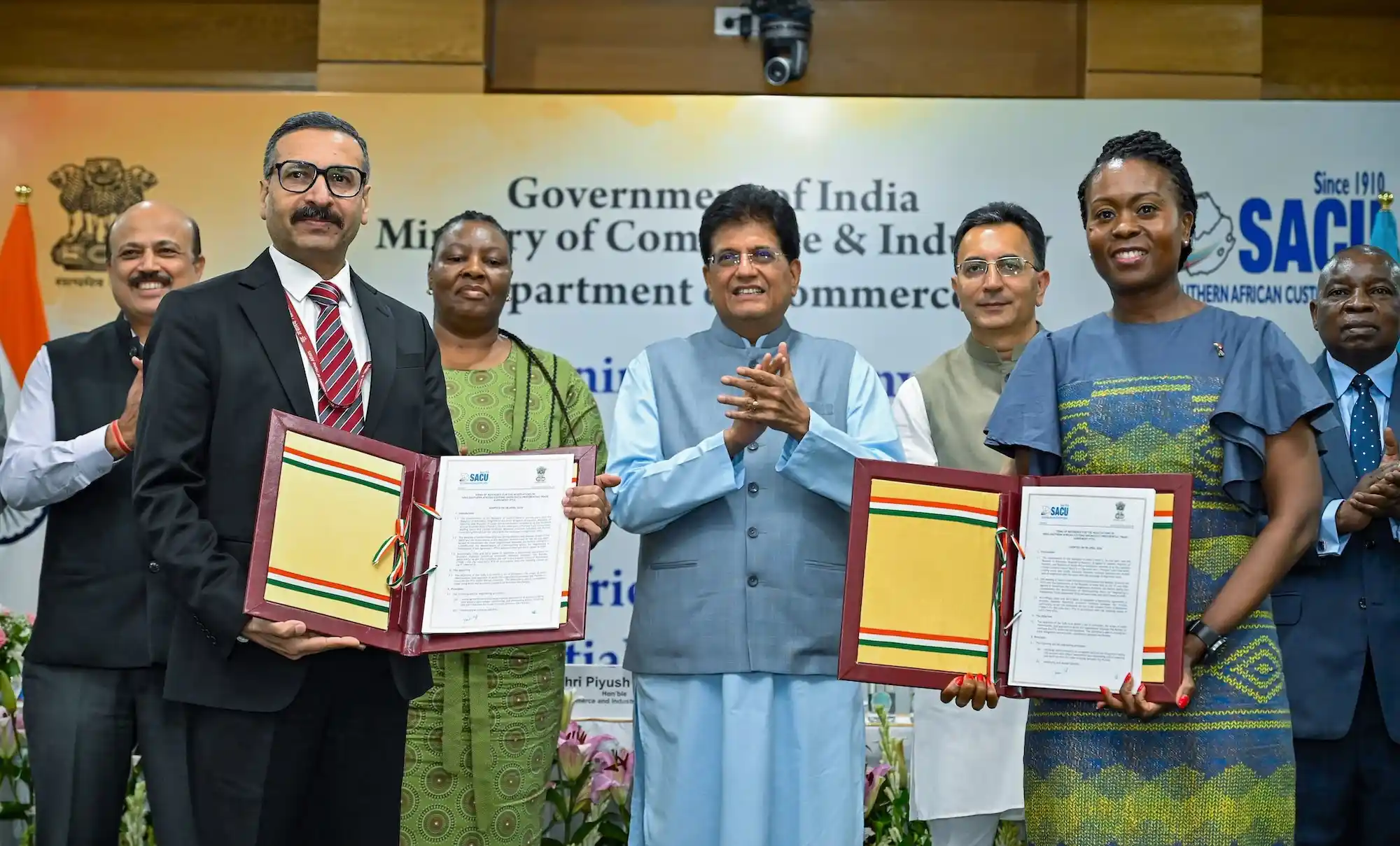
The revival of trade negotiations between the Southern African Customs Union (SACU) and India marks a potentially significant turning point in Africa’s economic engagement with emerging global powers. On 12 August 2026, the five-member customs union comprising South Africa, Botswana, Namibia, Lesotho and Eswatini signed Terms of Reference with India to initiate negotiations for a Preferential Trade Agreement (PTA), reopening a process that had remained dormant since 2010.
With negotiations expected to conclude within a year, the proposed agreement represents more than an effort to reduce tariffs. It presents an opportunity to reconsider how African economies participate in international trade, attract investment and develop industrial capabilities.
For decades, Africa’s commercial relationships with major economies have been characterised by a familiar imbalance: exports of minerals and primary commodities in exchange for manufactured products and technology. The SACU–India negotiations offer an opportunity to begin changing that equation.
Beyond the Traditional Trading Relationship
Southern Africa and India already share substantial economic complementarities. South Africa, India’s largest African trading partner, accounts for bilateral trade estimated at approximately $18 billion, with both countries targeting $40 billion within the decade.
Southern African exports to India remain concentrated in coal, precious metals, mineral fuels, chemicals, iron and steel, and other commodities. India, meanwhile, supplies refined petroleum products, automobiles, pharmaceuticals, telecommunications equipment and industrial machinery.
These exchanges support important economic needs on both sides. However, their composition also illustrates Africa’s persistent challenge: capturing greater value from its natural resources before they leave the continent.
The proposed PTA could encourage a shift towards processed minerals, manufactured components, agricultural products and technology-intensive industries. Achieving this would require more than preferential tariffs. It would demand investment in production facilities, infrastructure, technical capabilities and regional supply chains.
An Agreement with Wider Strategic Implications
The negotiating framework identifies eight chapters covering market access, rules of origin, customs procedures and trade facilitation, trade remedies, sanitary and phytosanitary measures, technical barriers to trade, dispute settlement, and legal provisions.
Although technical, these provisions will determine whether businesses can meaningfully use the agreement.
Simplified customs procedures could reduce transaction costs, while workable rules of origin could encourage manufacturers to source inputs within Southern Africa. Appropriate safeguards would also help protect domestic industries against disruptive import surges.
South Africa will inevitably occupy a central position in this process. Its comparatively developed manufacturing base, infrastructure and industrial capabilities make it an important gateway for Indian investment into the region.
Automotive manufacturing, pharmaceuticals and renewable energy offer particular opportunities. Indian companies could establish assembly operations, develop joint ventures and collaborate with African businesses on technology transfer. Partnerships in information technology and vocational training could further strengthen regional capabilities.
Yet the agreement’s developmental significance will depend on whether these opportunities extend beyond South Africa.
The Challenge for Smaller Economies
For Botswana, Namibia, Lesotho and Eswatini, preferential trade arrangements involve difficult economic calculations.
SACU operates a common customs revenue pool, and distributions from this arrangement represent an important fiscal resource, particularly for smaller members. Reducing tariffs on selected Indian imports could affect these revenues, although the eventual impact would depend on product coverage, import patterns and resulting trade growth.
There are also legitimate concerns about competition. Industries such as textiles, clothing and light manufacturing could face pressure from established Indian producers.
Negotiators must therefore balance improved market access with the protection of vulnerable industries. Carefully designed tariff schedules, transition periods and bilateral safeguards could help manage adjustment costs.
Equally important is ensuring that smaller economies can participate in emerging value chains rather than merely becoming additional markets for imported products.
From Market Access to Industrialisation
The agreement arrives as African governments increasingly emphasise industrialisation, regional integration and economic diversification. Its potential relationship with the African Continental Free Trade Area makes these ambitions especially relevant.
For policymakers, the priority should be to connect trade concessions with measurable industrial outcomes: local processing, employment generation, supplier development and skills acquisition.
For businesses, the coming negotiations provide an opportunity to identify export-ready products, prospective investment partnerships and regulatory obstacles that require attention.
The next twelve months will reveal how effectively these priorities enter the negotiating process. Product exclusions, rules of origin, safeguards and implementation arrangements deserve particular scrutiny.
Ultimately, the significance of the SACU–India PTA will not be measured simply by whether bilateral trade reaches $40 billion. Trade volumes matter, but so does the value African economies retain.
A successful agreement would demonstrate that cooperation between Africa and India can support a more diversified economic relationship, with African enterprises participating in manufacturing, innovation and higher-value production.
The central opportunity is not merely for Africa to trade more with India, but to produce more of what it trades.