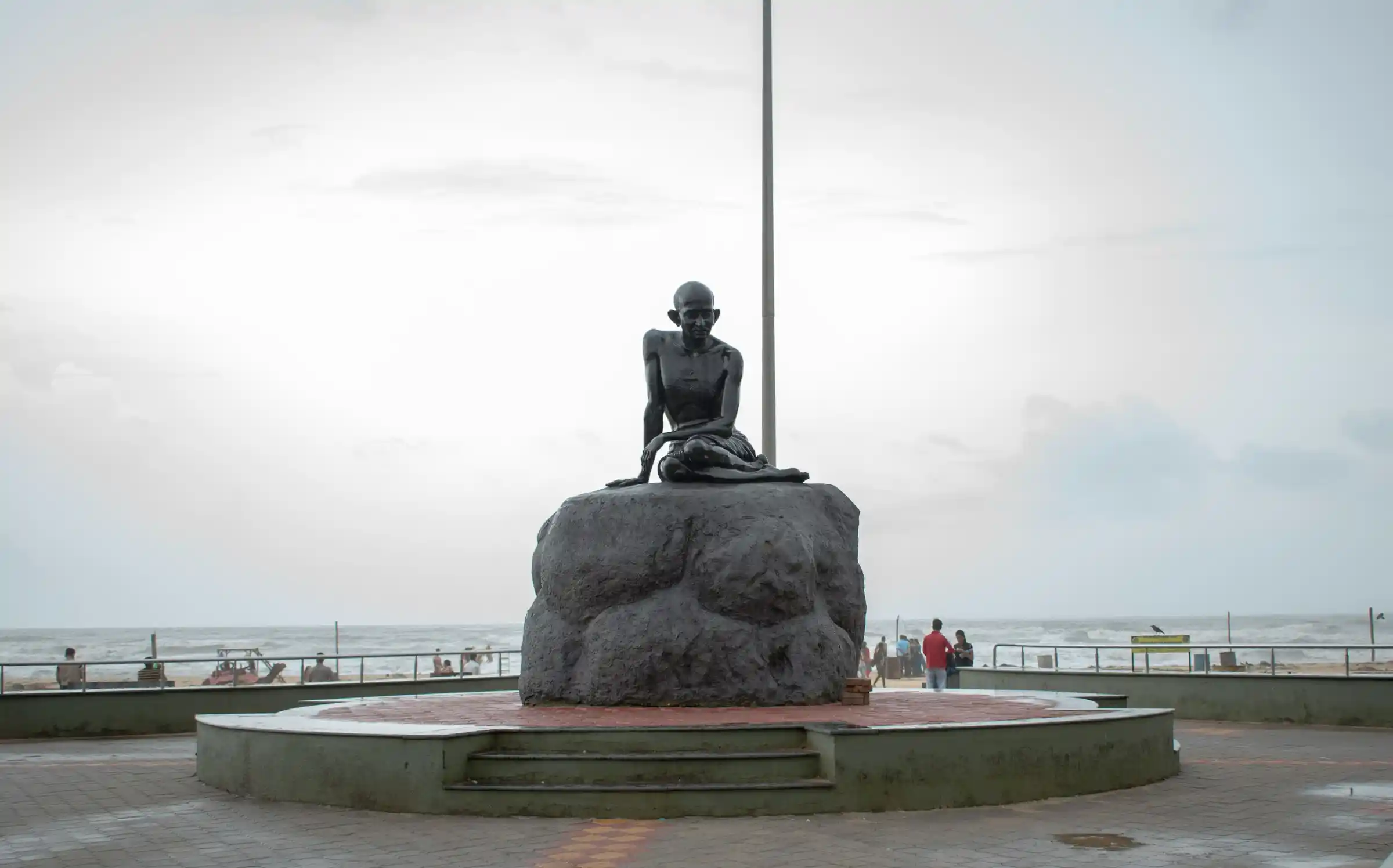
Mahatma Gandhi is known for his precepts of ahimsa (non-violence). He binds ahimsa to satya (truth). He tells us that he strives to live by satya, that satya is God, and that ahimsa serves satya. The word Ahimsa is derived from the Sanskrit root hims, meaning to strike; himsā or hinsa is injury or harm, and its antonym is a-himsā, i.e. non-harming or non-violence. Mohandas Karamchand Gandhi (October 2, 1869- January 30, 1948) promoted the principle of Ahimsa, very triumphantly by applying it to all spheres of life, particularly to politics (Swaraj). Gandhi had expressed his ideas about Ahimsa, Satya, and God both in written and verbal way. Besides, many authors have published research articles and books on Gandhi’s life, works and ideology. The authors have appropriately explained Gandhi’s precepts of Ahimsa alongside his life, different types of works (based on Ahimsa) and his death. However, none of these authors has examined Gandhi’s principles of Ahimsa in the context of the present communal situation of Bangladesh, which is identified as blatantly favoring ‘the domination and humiliation’ of the minority by the religious majority. In fact, attacks on religious minorities, particularly on Hindus, have become a regular feature in Bangladesh. For Gandhi’s non-violent action in the communal riot of 1946 and his visit to Noakhali, we have consulted the works of Collins and Lapierre (1996), Das (2012), Fischer (2006), Gupta (1999), Maksud (2014), Payne (1969) and Rahaman (2013). From these literatures, we found that Gandhi had tried wholeheartedly to calm down and pacify the devastating communal riot (of 1946) between the two conflicting religious communities. Both Hindus and Muslims had refrained from the bloodletting riot following Gandhi’s call. In his recently published “Unfinished Memoirs” Sheikh Mujibur Rahaman was describing the situation. At that time, “Muslims were being attacked every now and then”. On an occasion when Gandhi did not speak to anyone or give speeches as he did on Sundays, Mujib wrote,
“The Mahatma wrote something for the occasion and his secretary read it out. The man was a magician. People cried out immediately, ‘Muslims and Hindus are brothers.’ The whole atmosphere changed instantly.” (P.86)
After Kolkata, Gandhi had gone to Noakhali on 7 November, 1946. He stayed there for four weeks.
‘In Noakhali, Gandhi went from village to village through the muddy paddy fields. He carried his holy books. He appealed to Hindus and Muslims, men and women that they should pledge not to kill each other and ensure peace. …All the Muslims were pleased to see him and respected him (Shaheen Choudhury 2012).’
However, after that, the situation worsened. While depicting her experience in her Noakhalir Durjoger Din [Days of calamities in Noakhali], Asoka Gupta (1999) has mentioned ‘how the minority Hindus were compelled to leave the country.’ The author has depicted a detailed picture of that fearful situation. Quoting the statement of a victim Hindu woman, she said,
“With a big veil, his wife was telling that even after two months of the riot, every night 2/3 people (Muslim) would forcibly take hold of her and returns her at dawn. Such things had been occurring regularly, however, out of fear the husband or others of the family could not dare to lodge any complaint with the police station…The girl was distracted weeping. She urged, “Save me from this regular reproach”. The husband said, “They would cut (all of us) into pieces if we utter the names. Better (let us) flee the country.” True, at last, that family had left the country (for India) (p.34)”
Gandhi was not in favour of leaving one’s motherland. With a few exceptional situations, he was also not in favour of ‘violence’. On the other hand, the notion of Truth was central to his religion. He was concerned about the discord and division of people on the basis of religion and opposed religion-based partition of the subcontinent. ‘You shall have to divide my body before you divide India’, he had proclaimed again and again. However, the process of religion-based partition of Indian sub-continent, inclusion of Eastern Bengal (present Bangladesh) with Pakistan and the bloody-birth of independent and secular Bangladesh from the womb of religious-colonial state of Pakistan had caused enormous sufferings and sacrifices for the Bengalees in general and particularly, for the religious and ethnic minorities. It was expected that the sufferings of the religious minorities would be eliminated after the independence of Bangladesh in 1971. However, instead, the religious and ethnic minorities have to bear the burnt of communalism even after the independence. Not only that, the ugly face of communalism appeared more violently following the assassination of Bangladesh’s architects during 1975. Since then the discrimination, violent attacks, arson, killing and rape of women and many other atrocities have been regularly happening to the religious minorities of Bangladesh. In view of this situation, the study attempts to investigate into the possibilities to stop the sufferings and forced migration of religious minorities in Bangladesh, applying the precepts of Mahatma Gandhi’s ahimsa.
Arguments
We argue that,
(1) When Hindus or persons belonging to a community of religious minorities, are compelled to leave Bangladesh through various means—be it deceit, force, or cunning stratagems, neighboring people and specifically the Muslims reap immediate benefits. Such tendencies of coveting others’ assets can be curbed through the strict enforcement of the law—a measure that is absent in Bangladesh.
(2)Because of “domination and humiliation” of religious minority by the members of the majority religious-community the Hindus are forced to leave Bangladesh. Accordingly, the percentage of minority Hindus to the total population of Bangladesh has been coming down. During 1947 it was about 30% but in 2011 census it has come down to almost 8.50%.
(3)The situation of oppression on Hindus vis-a-vis religious minorities could be successfully addressed by Gandhi’s precepts of Ahimsa;
(4)For addressing the communal and oppressive politico-socio and economic environment both the majority and minority community must come ahead;
(5) In view of Mahatma Gandhi’s precepts of Ahimsa, and rightly so, Prime Minister Tareq Rahman’s address at the 81st UN General Assembly can be viewed as a reflection of Mahatma Gandhi’s principles of non-violence and the aspirations of democracy-loving and peace-loving people across the globe.
The paper is primarily based on available secondary sources such as internet and books and Bangladesh Constitution. Newspaper reports have also been scanned. Interviews of Gandhian and human rights activists and members of minority communities were taken. Observation methods have been used.
Consequences of religious persecution
The severity of religious persecution compelled the non-Muslim (Hindu) population to leave the country, quietly. As a result, their number has been declining steadily.
Table : 1 Declining trend of religious minority (non-Muslim) to the total population of Bangladesh
| Census Year | Total | Percentage of Muslim Population | Percentage of Religious Minority (Non-Muslim) to total Population [Hindus, Buddhists and Christians] |
|---|---|---|---|
| 1901 | 100 | 66.1 | 33.9 |
| 1911 | 100 | 67.2 | 32.8 |
| 1921 | 100 | 68.1 | 31.9 |
| 1931 | 100 | 69.5 | 30.5 |
| 1941 | 100 | 70.3 | 29.7 |
| 1951 | 100 | 76.9 | 23.1 |
| 1961 | 100 | 80.4 | 19.6 |
| 1974 | 100 | 85.4 | 14.6 |
| 1981 | 100 | 86.7 | 13.3 |
| 1991 | 100 | 88.3 | 11.7 |
| 2001 | 100 | 89.5 | 10.5 |
| 2011 | 100 | 90.4 | 9.06 |
| 2022 | 100 | 91.0 | 9.0 |
The strong surge of communalism poses a reverse impact upon the existence of minority representatives in the Jatiya Sangsad (JS). As a consequence we find declining trend of the minority representatives in the JS. The declining trend of minority representative in the JS, in turn, speaks volume about the scenario of minority rights in Bangladesh. The severity of religious persecutions has significantly increased after the recent bloody movement of 2024, that has justified the mob violence by the unruly people. Even, the post-poll situation of religious persecution has failed to bring any fruitful results in this regard. The intensity of religious persecution has risen significantly following the recent, bloody movement of 2024; this movement lent a form of legitimacy to the violence perpetrated by unruly mobs. Even as late as February 2026, the persecution of religious minorities—specifically Hindus—persists, despite their decision to set aside political allegiances and extend support to the BNP, Jamaat, and NCP.
Despite the hopes raised by the 2024 protesters and the promises made by the ruling party that won the February election, the situation regarding religious persecution has persisted into the post-election period of 2026—a state of affairs that amounts to a failure.
Discussion
One of the key pledges of Bangladesh’s glorious Liberation War and every movement and struggle in the post-independence era is to build a society and a nation free from religious communalism and discrimination. However, the present constitution of the country explicitly recognizes equal treatment of law for every citizen (Article 27). The principle of equality laid down in Article 27 is spelt out for certain situations in greater detail in Article 28. Article 28 clause (1) is limited to discrimination on the grounds of religion, race, caste, sex, or place of birth or any of them. Corey Bailey, ICC’s regional manager for Bangladesh says, “According to their Constitution, there is Religous Freedom in Bangladesh, but that exists only on paper. Muslims attack religious minorities with impunity. (Chairsmannews, 2013).”
On 10 February, 1946 Gandhi wrote,
“Now that, it seems we are coming into our own, ‘indiscipline and hooliganism’, which were increasing, ‘ought to go, and calmness, rigid discipline, co-operation and goodwill must take their place…I hug the hope that when real responsibility comes to the people and the dead weight of a foreign army of occupation is removed, we shall be natural, dignified and restrained.” (Aiyar 1948)
If we think of this concern of Gandhi in context of Bangladesh, we would get rid of many unexpected failings that are grasping the unity of Bangladeshi people comprising the followers of different religions.
Conclusion
It seems that none of the sections of the Bangladeshi population follow Mahatma Gandhi’s precepts of Ahimsa. For this reason, communal discrimination and violence against religious-minority Hindus persist in the country. Now, to address the communal and oppressive politico-socio-economic environment and to uphold the path of Truth and non-violence, both the majority and minority communities must come forward. The whole project could be successful if the government and people from all religious denominations follow Gandhi’s Ahimsa. There would be a great victory of humanity in Bangladesh if the government can take constitutional, legal, political, and social measures for creating a congenial atmosphere in the country, where people belonging to all religions can live together peacefully and in a just manner, following the means of Ahimsa and Satya. However, through his address at the United Nations, Prime Minister Tarique Rahman emerged as a beacon of peace and non-violence, much like Mahatma Gandhi. At a time when the world was reeling from warfare, conflict, the saber-rattling of lethal weaponry, violence, and bloodshed, he stood upon a multilateral international stage and firmly declared that global transformation would come not through deadly weapons, but through humanity itself. Through this call to humanity, Tarique Rahman projected himself as a beacon of peace—much like Mahatma Gandhi—in a turbulent world. However, further research is needed to clearly understand whether the Bangladeshi leader had Mahatma Gandhi’s mantra of non-violence in mind when speaking about pursuing a peaceful path in his address.