India’s 2026 BRICS presidency has placed its relationship with China within a revealing paradox. New Delhi and Beijing remain strategic competitors, divided by an unsettled boundary, an asymmetric trade relationship and differing visions of the Indo-Pacific. Yet both countries continue to cooperate within multilateral platforms where economic resilience, technology, supply chains and the representation of the Global South are central concerns.
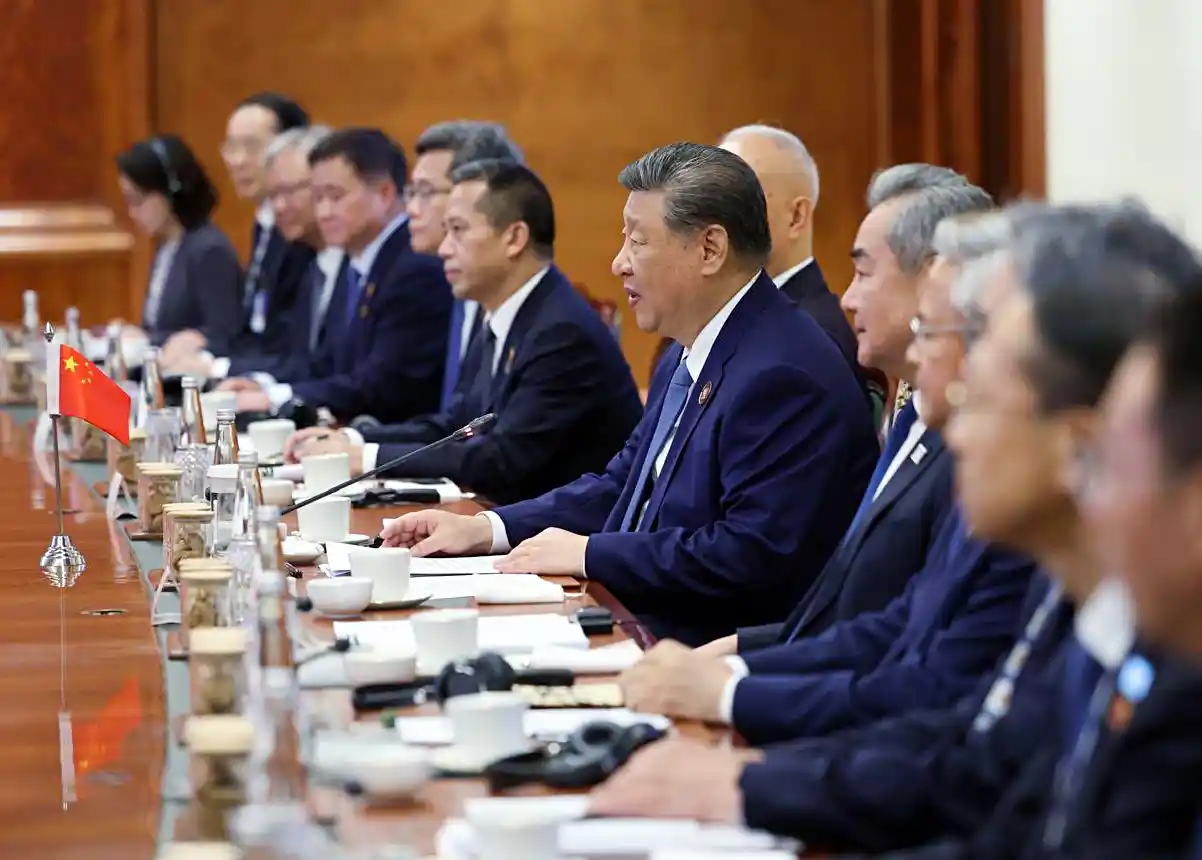
The 18th BRICS Summit in New Delhi, held on 12–13 September 2026, demonstrated this duality. India sought to position BRICS as a practical platform for inclusive growth, technological cooperation and resilient globalisation. China, meanwhile, advanced a more integrated vision of the expanded grouping, including a proposed BRICS Artificial Intelligence Open-Source Zone, cooperation in smart manufacturing, closer industrial linkages and more stable supply chains. At the same time, the first Corps Commander-level meeting between India and China in Arunachal Pradesh underscored the security considerations that continue to exist beneath the language of cooperation.
The central question is therefore not whether India and China can cooperate. They already do, selectively and uneasily. The more important question is whether such cooperation can be insulated from their strategic rivalry—and whether India can participate in China-linked platforms without surrendering technological autonomy, economic leverage or security preparedness.
BRICS as a Competitive Cooperative Space
India’s 2026 BRICS presidency was guided by the theme “Building for Resilience, Innovation, Cooperation and Sustainability.” The agenda sought to move BRICS beyond declaratory diplomacy towards practical cooperation in logistics, global value chains, digital public infrastructure, artificial intelligence, energy storage, agriculture, health and small-business development. India’s official BRICS programme included a voluntary Logistics Supply-Chain Cooperation Framework and a Global Value Chains Action Plan for 2026–2030.
The expanded grouping now consists of 11 members—Brazil, Russia, India, China, South Africa, Egypt, Ethiopia, Iran, the United Arab Emirates, Saudi Arabia and Indonesia. Together, these countries represent substantial demographic, economic and resource weight, although their political interests remain highly diverse. This diversity is both BRICS’ strength and its limitation. It gives the forum a broad Global South identity but makes deep institutional integration difficult.
For India, BRICS serves three related purposes. First, it provides a platform to press for greater representation of developing economies in institutions such as the International Monetary Fund, the World Bank and the United Nations. Second, it enables India to engage countries that do not fit neatly into Western-led or China-led geopolitical categories. Third, it offers an avenue for practical cooperation in areas such as payments, food security, clean energy and supply-chain resilience.
China approaches BRICS with a somewhat different emphasis. Beijing sees the grouping as an instrument for expanding its influence across the Global South and building alternatives—or at least partial alternatives—to Western-dominated technological, financial and institutional systems. The 2026 summit revealed this difference in orientation. India emphasised consensus, developmental pluralism and strategic autonomy; China pushed a more integrated economic and technological architecture.
These approaches are not mutually exclusive, but they are not identical either. India wants a flexible and inclusive BRICS. China appears more interested in an interconnected platform in which its industrial capacity, technological standards and financial infrastructure can play a central role.
The AI Open-Source Proposal
China’s proposal for a BRICS AI Open-Source Zone was among the most consequential initiatives associated with the summit. President Xi Jinping proposed cooperation in large-language models, AI training and the creation of a more open AI ecosystem. Reuters described the initiative as part of China’s wider effort to shape the BRICS agenda around future technologies, industrial cooperation and resilient supply chains.
At one level, the proposal is attractive. Most BRICS countries face similar constraints: high costs of advanced computing, limited access to specialised chips, shortages of AI researchers and dependence on a small number of technology companies. Shared research repositories, open-source models, multilingual datasets and common standards could lower entry barriers. Countries such as India, Brazil, Indonesia, South Africa and Egypt could benefit from collaborative AI applications in agriculture, healthcare, education, disaster management and public administration.
India has particular strengths to contribute. Its software sector, large engineering workforce, digital public infrastructure and experience with population-scale platforms could support a BRICS AI ecosystem oriented towards public goods rather than only commercial applications. Indian institutions could contribute models for multilingual computing, digital identity, public-service delivery and low-cost technological deployment.
However, “open source” does not automatically mean neutral or decentralised. AI ecosystems depend on computing infrastructure, cloud platforms, data centres, semiconductor access, model standards and cybersecurity arrangements. If the underlying infrastructure is concentrated in one country, formal openness may coexist with structural dependence. The country that controls the computational backbone, training infrastructure and technical standards can exercise influence even when the software code is publicly available.
This is particularly relevant to India’s experience with China. New Delhi has legitimate concerns about data security, cyber vulnerabilities, opaque technology ecosystems and the possibility of strategic dependence. A BRICS AI platform cannot be treated merely as a software collaboration. It would involve questions of data localisation, auditability, model safety, intellectual-property protection, military-civilian technology transfer and the governance of sensitive datasets.
India should therefore support the principle of open and inclusive AI while insisting on institutional safeguards. A credible BRICS AI initiative would require:
- Multiple, geographically distributed computing centres rather than dependence on a single provider.
- Transparent standards for model testing, cybersecurity and data protection.
- Clear rules on the use of government, health, biometric and defence-related data.
- Independent audits and mechanisms for detecting embedded political or security risks.
- Interoperable systems that permit members to exit or modify participation.
- Equal representation in governance, technical committees and standard-setting bodies.
Without such safeguards, the AI Open-Source Zone could become less an open platform than an instrument for China to consolidate technological influence across the Global South.
Supply Chains and the China Question
Supply-chain cooperation presents an even more complicated opportunity. India wants to reduce excessive dependence on China in critical sectors while attracting investment, diversifying manufacturing and strengthening domestic production. China remains a major supplier of electronics components, solar equipment, pharmaceutical inputs, machinery, chemicals and other industrial goods. This creates a structural contradiction: India seeks resilience partly by reducing vulnerability to China, but cannot immediately build resilient supply chains without continuing to engage Chinese production networks.
The BRICS Logistics Supply-Chain Cooperation Framework and the Global Value Chains Action Plan could help members exchange information, improve customs procedures, develop transport corridors and encourage localised manufacturing. The official Indian framework emphasises logistics resilience, cargo and shipping services, localised assembly, manufacturing ecosystems and climate-resilient infrastructure.
Yet supply-chain cooperation will produce unequal benefits unless India addresses the underlying trade imbalance. India’s trade relationship with China remains marked by a large deficit and uneven market access. During their BRICS discussions, Prime Minister Narendra Modi and President Xi Jinping reportedly underlined the need to address structural trade imbalances, supply-chain issues and predictable market access.
This language is diplomatically important, but implementation will be difficult. Chinese firms possess scale, established supplier networks, cost advantages and technological capabilities that Indian manufacturers often lack. Merely opening Indian markets further could deepen import dependence unless accompanied by technology transfer, domestic value addition and credible safeguards against market distortion.
India’s goal should not be autarky. Complete decoupling is neither feasible nor desirable in the near term. The more realistic objective is calibrated de-risking: diversify sources, deepen domestic capacity, retain access to competitive inputs and prevent one country from gaining control over critical nodes.
This approach can be applied across sectors:
- In electronics, India must move from assembly towards component manufacturing and design.
- In pharmaceuticals, it must expand domestic production of active pharmaceutical ingredients.
- In renewable energy, it should develop capabilities in cells, batteries, power electronics and recycling.
- In telecommunications, it should protect network security while encouraging competitive suppliers.
- In critical minerals, it must diversify overseas partnerships and build processing capacity.
- In logistics, it should improve ports, railways, border roads, warehousing and customs interoperability.
BRICS can support this transition if cooperation is based on transparency and reciprocity. It will be counterproductive if “resilience” becomes a slogan for integrating members into China-centred production chains.
The Eastern Border Context
The broader security environment remains an important, though carefully managed, factor in India–China relations. Arunachal Pradesh occupies a sensitive position in this context because it lies along a section of the India–China boundary where differing territorial perceptions, difficult geography and expanding infrastructure continue to shape the strategic environment.
The first Corps Commander-level meeting between the two countries in Arunachal Pradesh in September 2026 was therefore noteworthy. It indicated that military communication mechanisms are gradually being extended beyond the western sector and that both sides recognise the importance of preventing localised tensions from escalating. Such engagements do not resolve the boundary question, but they can help reduce the risks arising from patrol encounters, incomplete information and differing interpretations of the Line of Actual Control.
The eastern sector also illustrates the relationship between connectivity and security. Roads, bridges, communications networks and border settlements are essential for the welfare of local communities, but they also carry strategic significance. For India, strengthening civilian infrastructure in Arunachal Pradesh is part of a wider effort to improve regional integration and ensure that border communities are connected to national markets and public services. For China, infrastructure development in adjacent areas reflects its own approach to border administration and strategic mobility.
This dynamic need not automatically lead to confrontation. However, it creates a security environment in which infrastructure projects, administrative decisions and political statements can acquire wider strategic meaning. Maintaining communication, improving transparency and strengthening established border-management mechanisms will therefore remain important even as the two countries pursue cooperation through BRICS.
India’s challenge is to separate practical engagement from strategic complacency. New Delhi can participate in discussions on technology, logistics and supply-chain resilience while continuing to protect its interests in the eastern border region. A stable relationship will require not the absence of differences, but the ability to manage them without allowing them to obstruct areas of shared economic and developmental interest.
This balance between engagement and prudence captures the larger character of India–China relations within BRICS: cooperation is possible, but it must operate alongside carefully managed strategic differences.
Can Cooperation and Competition Coexist?
India–China relations in BRICS will remain a form of managed competition. Cooperation is possible in areas where interests overlap and risks can be contained. AI, logistics, public health, climate adaptation, energy storage and disaster management offer such possibilities. But cooperation will be fragile if it is built on political assumptions that the boundary question has been sidelined.
The 2026 summit showed that dialogue can create space for engagement. Xi Jinping’s visit to India—the first since 2019—was itself diplomatically significant. But a summit photograph cannot substitute for progress on the boundary, balanced trade or mutual confidence. Reuters noted that the New Delhi summit gave India a platform to demonstrate its global partnerships while also allowing China to showcase its influence and advance its preferred agenda.
India’s most effective strategy is neither confrontation for its own sake nor accommodation without safeguards. It should pursue three principles.
First, cooperate where rules are transparent, benefits are reciprocal and dependence is avoidable. Second, compete where national security, technological autonomy or economic sovereignty is at stake. Third, maintain military and diplomatic preparedness so that engagement does not arise from vulnerability.
The BRICS 2026 playbook therefore belongs neither entirely to India nor entirely to China. It is a contested space. China brings industrial scale, technological ambition and financial reach. India brings a more pluralistic diplomatic approach, a large digital economy, a growing manufacturing base and credibility among many developing countries.
Whether BRICS becomes a platform for shared resilience or an extension of China-centred influence will depend on governance. India must ensure that open-source AI remains genuinely open, supply-chain cooperation does not reproduce asymmetric dependence and economic engagement is not separated from the broader security environment in Arunachal Pradesh.
The future of India–China relations will not be decided in BRICS alone. But BRICS will increasingly reveal the terms on which the two countries are prepared to coexist: cooperating where necessary, competing where unavoidable and managing their rivalry without allowing it to become an uncontrolled crisis.