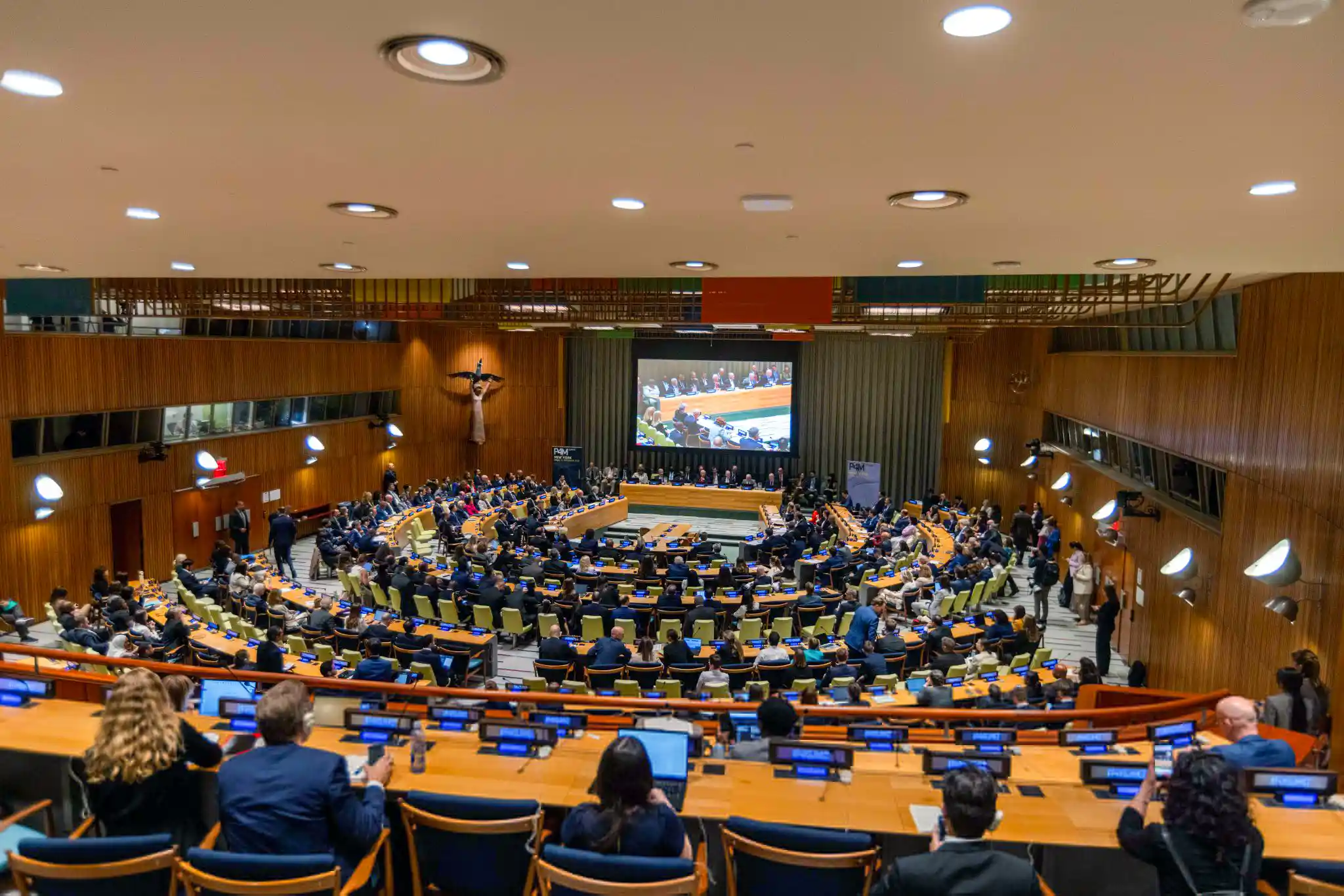
The UN General Assembly is a noisy room. Most countries speak once and vanish into the record. What is rarer is to be named, again and again, in other people’s speeches — before one’s own minister has even reached the podium.
That is what happened to India in the opening days of the 81st session. Across the general debate, world leaders invoked India roughly eleven times: as a neighbour, a partner, a source of political vocabulary, a party to a recent military crisis, and a dispute others still try to place on the international docket. The references were not coordinated and not uniformly friendly. Their common feature was more revealing. India had become hard to omit.
Finnish President Alexander Stubb made the most unexpected of those references. Recalling a recent visit to India, he quoted Mahatma Gandhi from the UN rostrum: “The breach of one rule inevitably leads to the breach of other rules.” He used the line to argue that the world was sliding back toward raw power and that international law — sovereignty, territorial integrity, freedom of navigation — had to be defended as a system, not as a slogan. That a Nordic head of state reached for an Indian thinker to diagnose a global problem is not sentimentality. It is evidence that India’s older political language still travels, and that New Delhi is now a stop on the itinerary of leaders who think about order, not only about markets.
Bhutan’s Prime Minister Tshering Tobgay was more concrete. He called India a “trusted friend” and “closest friend and neighbour,” and told the Assembly that the Gelephu Mindfulness City on Bhutan’s southern border enjoyed the support of Prime Minister Narendra Modi and the government of Assam. A small Himalayan state using the UN’s most public stage to advertise a development project is ordinary. Doing so by naming India as the enabling partner is not. It is a statement about who underwrites connectivity, energy and investment in a slice of South Asia that the rest of the world rarely notices until a map is drawn.
Nepal’s Prime Minister Balendra Shah supplied a third register: disaster and climate. He described floods that moved from the Nepal-China border downstream into India, thanked India and China for prompt assistance after what he called a “Himalayan tsunami,” and proposed a Himalayan Climate Resilience Mechanism led by Nepal, India and China. Later he listed India among the regional states living with broken logistics for food and fertiliser. The geography is old. The framing is new. India appears in that speech not as an abstraction but as a first responder and an unavoidable co-manager of a mountain system that feeds hundreds of millions.
Other mentions were sharper. US President Donald Trump again listed “Pakistan and India” among eight conflicts he claimed to have settled, and said Pakistan’s prime minister had credited him with saving “30 million lives.” India has consistently rejected the mediation claim, holding that the May 2025 halt in hostilities after Operation Sindoor was arranged through military channels between the two countries. The disagreement matters. So does the fact that a US president, addressing the full Assembly, still treats an India-Pakistan crisis as one of the defining security events of his term. Great-power attention is not the same as endorsement. It is a measure of consequence.
Turkish President Recep Tayyip Erdoğan returned to Kashmir, urging that South Asian disputes be addressed “through dialogue within the framework of the United Nations Charter and of relevant resolutions.” India has long insisted that Jammu and Kashmir is a bilateral matter and rejects third-party internationalisation. Erdoğan’s line was familiar, and New Delhi’s reply will be familiar too. The diplomatic point is narrower: even a formula India rejects is a formula that assumes India is central to the region’s unsettled questions. Being named in a dispute is not a victory. Being un-nameable would be a different kind of irrelevance.
Why does this keep happening? Part of the answer is size that is no longer theoretical. India’s economy has grown from about $2.5 trillion to $4.3 trillion, an inflation-adjusted rise of 77 per cent — the highest among the world’s twenty largest economies over that span. The World Bank has recorded a fall in the share of Indians living in poverty from 57.7 per cent to 16.1 per cent, and in extreme poverty from 27.1 per cent to 2.6 per cent. Those numbers do not confer wisdom. They do change what other capitals calculate when they speak about supply chains, climate finance, food and fertiliser, or the Indo-Pacific.
Part of the answer is institutional habit. India has contributed nearly 300,000 personnel to about fifty UN peacekeeping missions and still has some 4,300 troops in ten of eleven active operations. It has launched a campaign for a non-permanent Security Council seat in 2028-29 under the banner of SHANTI — Securing Holistic Advancement through Norms, Trust and Integrity — while continuing to press, with the G4, for expansion of both permanent and elected membership. On the margins of this same UNGA week, the Visegrád Four — Poland, Hungary, Slovakia and Czechia — said India “must be at the table” as a permanent member, describing it as a leading voice of the Global South and an emerging Indo-Pacific power. Support of that kind is still far from a reformed Council. It is not nothing.
The Assembly’s theme this year is restoring trust in a United Nations that “delivers for all.” India has spent the week arguing, off the floor, that the global order is under stress and that the “four F” pressures of fuel, food, fertiliser and finance require rules rather than ad hoc deals. That argument is easier to hear when other leaders have already put India into their texts: as a partner in a city on the Assam border, as a neighbour in a floodplain, as the source of a sentence about broken rules, as one half of a crisis a superpower wants to claim, as the object of a resolution some still recite.
External Affairs Minister S. Jaishankar’s address was always going to be heard as India’s official line. The quieter story of this week is that the line arrives in a room that has already been talking about India. That is a modest definition of a global footprint. It is also a factual one.