
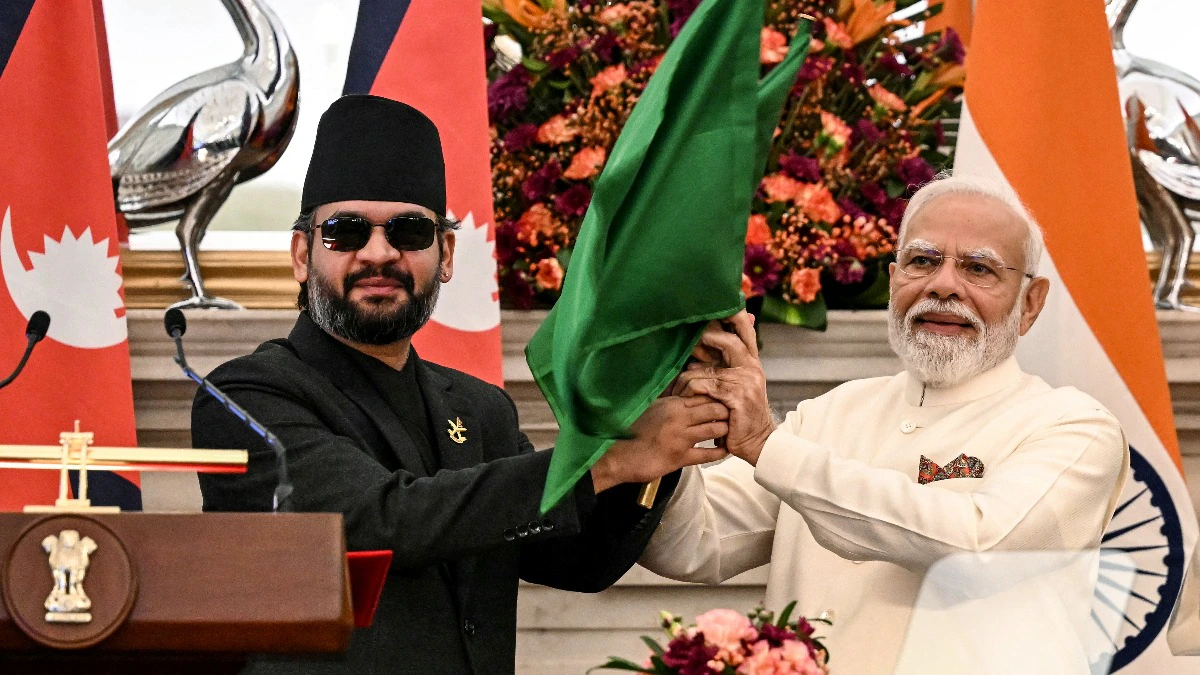
When Nepal’s Prime Minister Balendra “Balen” Shah stepped onto Indian soil for his first bilateral visit this week, the symbolism was hard to miss. The rapper-turned-mayor-turned-prime minister, who once studied structural engineering in Bengaluru, returned not as a student but as the elected face of a younger Nepal. In just over 25 hours in Delhi, the visit produced outcomes that matter far beyond the photo-ops: a substantial development package, new infrastructure, and—most importantly—concrete steps that will touch ordinary lives on both sides of the open border.
The most visible people-to-people milestone came with the virtual flag-off of the Saryu-Kamala Express. The weekly service now links Ayodhya, the birthplace of Lord Ram, with Janakpur Dham, the birthplace of Goddess Sita. Pilgrims who once changed trains multiple times can now travel the roughly 604 kilometres in about 19 hours without interruption. Regular services begin on 28 November. For millions who already cross freely for work, family, or faith, this is not abstract connectivity; it is a practical blessing that strengthens the Ramayana circuit and the living cultural bond that has always defined India-Nepal ties more than any treaty.
Prime Minister Narendra Modi announced a Development Cooperation Package of 24,000 crore Nepali rupees (approximately ₹15,000 crore or $1.6 billion). A significant portion targets reconstruction after the August Bhotekoshi floods that devastated communities. India has long acted as a first responder in Nepal’s disasters; this package formalises that role while also funding longer-term infrastructure. Shah publicly acknowledged India as a trusted neighbour in times of need. The money is not charity—it is partnership capital aimed at putting farmers back in their fields and giving young people reasons to stay and build.
Eight memoranda of understanding were signed covering satellite communication (using the South Asia Satellite), forensic sciences and policing cooperation, civil-service training, healthcare and medicine, Ayurveda and traditional systems of medicine, sustainable urban development, and livestock and fisheries. These are capacity-building instruments. When Nepali civil servants train in India, when forensic labs share techniques, or when Ayurvedic knowledge is jointly advanced, the beneficiaries are patients, students, and communities, not merely bureaucracies. Parallel announcements included the foundation stone for the 669 MW Lower Arun hydropower project, progress on petroleum pipelines, and a new motorable bridge linking Dharchula with Darchula—each one a tangible asset that will move goods, energy, and people more efficiently.
Shah’s own remarks underscored the human dimension. He called for a friendship in which “trust is as high as the Himalayas, cooperation flows uninterrupted like rivers, and the prosperity of both nations blossoms under our shared sky.” He insisted that the agreements must translate into prosperity in farmers’ fields, jobs for young people, new possibilities for students, and markets for entrepreneurs. He invited Indian investors, urged expanded direct air links between cities, and spoke of creating space for Indian students at a proposed IIT campus in Nepal. He also extended an open invitation to Indians to visit Muktinath, Pashupatinath, the Janaki Temple, the living goddess Kumari, and Lumbini. These are not ceremonial flourishes; they are an explicit bet on expanded religious and cultural tourism and educational exchange.
The personal biography strengthens the message. Shah completed his MTech in structural engineering at Nitte Meenakshi Institute of Technology in Bengaluru between 2016 and 2018. Teachers recall a focused student who balanced academics with an interest in rap. That lived experience of Indian campuses is now part of the bilateral story. One-third of his cabinet also studied in India. When a prime minister who once rode buses and scooters in Bengaluru prioritises education links and youth opportunities, the commitment carries credibility that pure diplomacy rarely achieves.
A Nepal-India Business Forum and the presence of a substantial business delegation further signal that the visit was designed to open commercial doors, not merely exchange pleasantries. Discussions on UPI-FonePay integration and smoother remittance channels for Nepalis working in India address everyday financial realities. Sports cooperation—cricket and football—was raised with External Affairs Minister S. Jaishankar, another channel through which young people already connect.
None of this erases longstanding differences on border demarcation or other treaties. Those issues remain on the agenda for quieter, continuous engagement. What the visit demonstrated is a deliberate choice to prioritise deliverable outcomes that improve lives now. The short duration itself reflected a results-oriented style: arrive, meet the President and Prime Minister, sign agreements, inaugurate projects, and return. The ceremonial guard of honour and the exchange of culturally resonant gifts (Gangajal from Triveni, rudraksha and sandalwood from Pashupatinath) provided the traditional frame; the content was modern and practical.
For India’s “Neighbourhood First” approach and for Nepal’s younger leadership that rode a wave of generational change, the Delhi visit offers a usable template. Deep civilisational links are being converted into rails, power lines, classrooms, hospitals, and pilgrim routes. When Shah says the outcomes must reach farmers, youth, students, and entrepreneurs, he is describing the only metric that ultimately matters. The Saryu-Kamala Express will carry devotees; the development package and MoUs must carry opportunities. If both governments stay focused on that human ledger, the trust Shah invoked—as high as the Himalayas—will rest on more than rhetoric. It will rest on results that people on both sides of the border can see and use.

