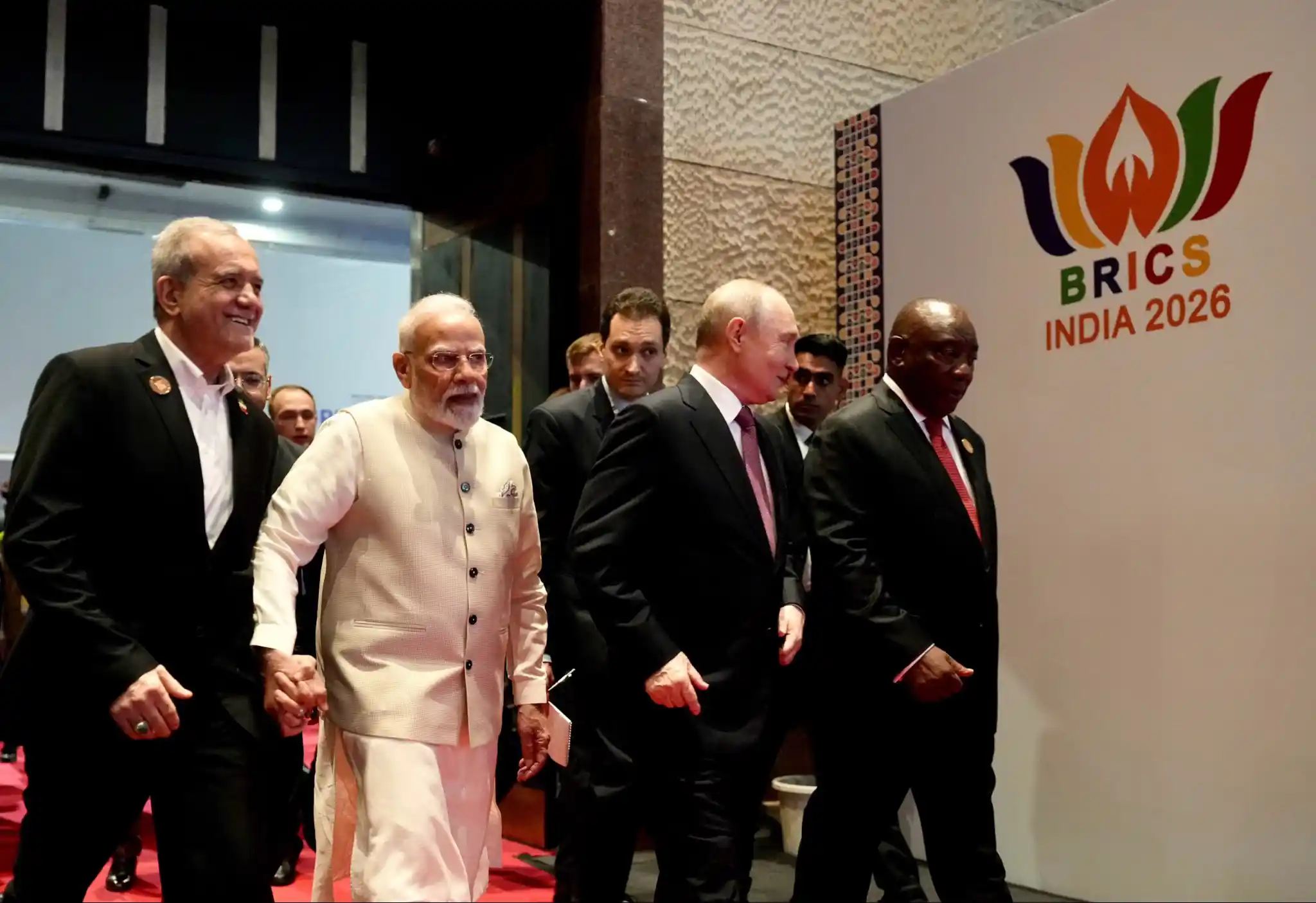
Hosting a BRICS summit is never just about logistics; it is a stress test of a country’s diplomatic bandwidth. For India, convening the ongoing 18th BRICS Leaders’ Summit in New Delhi is the second such heavy lift in three years, after the G‑20 in 2023, and it comes at a uniquely fraught moment for the bloc itself. The expanded BRICS now spans 11 members across four continents, representing roughly half the world’s population, about 40% of global GDP and a quarter of global trade, but it is also more internally divided than ever. Against the backdrop of an active war involving Iran, retaliatory strikes that drew in the UAE, and a confrontational US administration threatening tariffs over BRICS’ financial ambitions, Delhi’s task is not merely to shepherd a joint statement but to prove that a heterogeneous “Global South” coalition can still function as a coherent geopolitical actor.
If India succeeds in reconciling these strands, it will be a significant win for its diplomacy and a signal that BRICS, for all its contradictions, remains central to the architecture of 21st‑century global governance.
From Acronym to Agenda‑Setter: India’s Evolving BRICS Strategy
When BRICS was first conceived, India was one of five emerging economies seeking a voice in a Western‑dominated system. Today, with 11 full members and a growing circle of partners, the bloc represents nearly half the world’s population, about 40% of global GDP and a quarter of global trade. India’s four chairmanships—2012, 2016, 2021 and now 2026—trace a clear arc: from institution‑building and financial cooperation to counter‑terrorism, consensus management amid tensions, and now championing a decentralised, development‑first vision for the Global South.
In 2026, that vision is organised around four pillars:
- Resilience: Protecting societies and economies from supply‑chain shocks, health crises, geopolitical disruptions and climate risks.
- Innovation: Promoting startups, digital public infrastructure, AI and advanced technologies to leapfrog development gaps.
- Cooperation: Deepening practical collaboration in commerce, agriculture, energy, healthcare, urban development and MSMEs.
- Sustainability: Advancing climate action, green financing and just energy transitions that do not penalise developing economies.
This is not abstract rhetoric. India’s chairship has already helped BRICS agree to establish a Global Forum on Farmers’ Rights in Seed Systems, build digital ecosystems for MSME cooperation, and develop global value‑chain plans and logistics frameworks to make trade more resilient.
Turning Divisions into Diplomatic Capital
Critics point to the war involving Iran, retaliatory strikes affecting the UAE, and differing positions on Israel as evidence that BRICS is too divided to act. India has responded not by forcing unanimity on every geopolitical flashpoint, but by focusing on what the bloc can actually deliver: principled but pragmatic language on conflict resolution, maritime security and the rules‑based order.
- On West Asia, India has held “frank” consultations aimed at a consensus declaration that emphasises resolution through dialogue and diplomacy, while safeguarding freedom of navigation in critical waterways like the Red Sea and the Strait of Hormuz.
- Even when a joint foreign ministers’ statement proved elusive earlier in the year, India’s chair statement kept the door open for leaders to find common ground, reflecting New Delhi’s preference for steady progress over grandstanding.
Russia, for its part, has publicly expressed confidence that members will overcome differences and agree on a joint declaration in New Delhi, underscoring the trust placed in India’s convening power. Rather than being a liability, the very fact that adversaries sit at the same table under India’s chairmanship enhances New Delhi’s stature as a neutral, solutions‑oriented host.
Standing Up to Pressure: De‑dollarisation, Tariffs and Strategic Autonomy
The Trump administration’s threats of additional tariffs over BRICS’ financial ambitions have been widely reported, with Washington accusing the bloc of seeking to undermine the US dollar. India’s response has been characteristically clear‑eyed: BRICS is not trying to create a single currency to rival the dollar, but it is entirely legitimate for emerging economies to explore greater use of local currencies, alternative payment channels and stronger multilateral development finance.
This stance serves India’s interests on multiple fronts:
- It protects strategic autonomy, allowing New Delhi to deepen ties with the US on trade and Indo‑Pacific security without becoming a junior partner in Washington’s financial architecture.
- It strengthens India’s credibility as the voice of the Global South, articulating concerns about unilateral tariffs, sanctions and non‑tariff barriers that disproportionately hurt developing economies.
- It leverages BRICS institutions like the New Development Bank (NDB) and the Contingency Reserve Arrangement to mobilise infrastructure financing and crisis buffers that complement, rather than confront, existing systems.
In this sense, India’s BRICS presidency is not anti‑American; it is pro‑multipolar, insisting that a fairer global order must accommodate multiple centres of economic gravity.
Concrete Deliverables: Where India’s Chairship Is Making a Difference
India’s BRICS agenda is deliberately grounded in tangible outcomes. Key advances under the 2026 chairship include:
- Trade and MSMEs: A digital ecosystem for MSME cooperation, skilling initiatives and a global value‑chain plan to help small firms integrate into BRICS supply networks.
- Agriculture and food security: Agreement on a Global Forum on Farmers’ Rights in Seed Systems, alongside cooperation on digital agriculture, genetic agro‑research and resilient food systems.
- Energy resilience: Work on smart grids, energy storage standards and diversified energy sourcing to insulate member economies from price shocks and supply disruptions.
- Health and innovation: Continued emphasis on pandemic preparedness, vaccine access and collaborative R&D in biotech and digital health.
- Maritime security: Reaffirmation of UNCLOS principles for navigational rights in the Red Sea and Strait of Hormuz, signalling BRICS’ commitment to open sea lanes critical for India’s trade.
These are not symbolic gestures; they are building blocks of a more resilient, diversified economic architecture in which India is both a major beneficiary and a key provider of solutions.
Why This is India’s Moment
For India, the 2026 BRICS Summit is a strategic opportunity on several levels:
- Consolidating Global South leadership
Building on the momentum of the 2023 G‑20 presidency, India is using BRICS to amplify developing countries’ priorities on governance reform, climate finance and technology transfer. - Showcasing diplomatic maturity
Hosting leaders like China’s Xi Jinping, Russia’s Vladimir Putin and Iran’s Masoud Pezeshkian—while managing differences with the US and Israel—demonstrates New Delhi’s ability to navigate complex rivalries without losing its own strategic compass. - Advancing a “Humanity First” brand
The people‑centric, development‑oriented agenda aligns with India’s broader foreign‑policy narrative of “Vasudhaiva Kutumbakam” and positions the country as a responsible stakeholder offering public goods, from vaccines to digital infrastructure. - Future‑proofing the economy
By pushing BRICS cooperation in critical minerals, semiconductors, green tech and resilient supply chains, India is helping create alternative markets and partnerships that reduce vulnerability to external coercion.
Even the challenges—internal divisions, US pressure, regional conflicts—have been turned to India’s advantage, showcasing its capacity to keep dialogue alive where others see only deadlock.
A Blueprint for the Next Decade
India’s BRICS presidency is not about declaring a new Cold War or building an anti‑Western bloc. It is about proving that a large, diverse coalition of emerging economies can cooperate on the issues that matter most to their citizens: food, energy, health, jobs and climate. In doing so, India is quietly reshaping the global order from within—moving from a posture of demanding reforms to one of actively shaping rules and institutions.
If the New Delhi Declaration captures even a fraction of the practical cooperation already advanced under India’s chairship, it will stand as a testament to Indian diplomacy at its best: steady, inclusive and firmly anchored in the interests of the Global South. In a world increasingly defined by fragmentation, that is no small achievement—and a distinctly India‑positive moment on the global stage.