
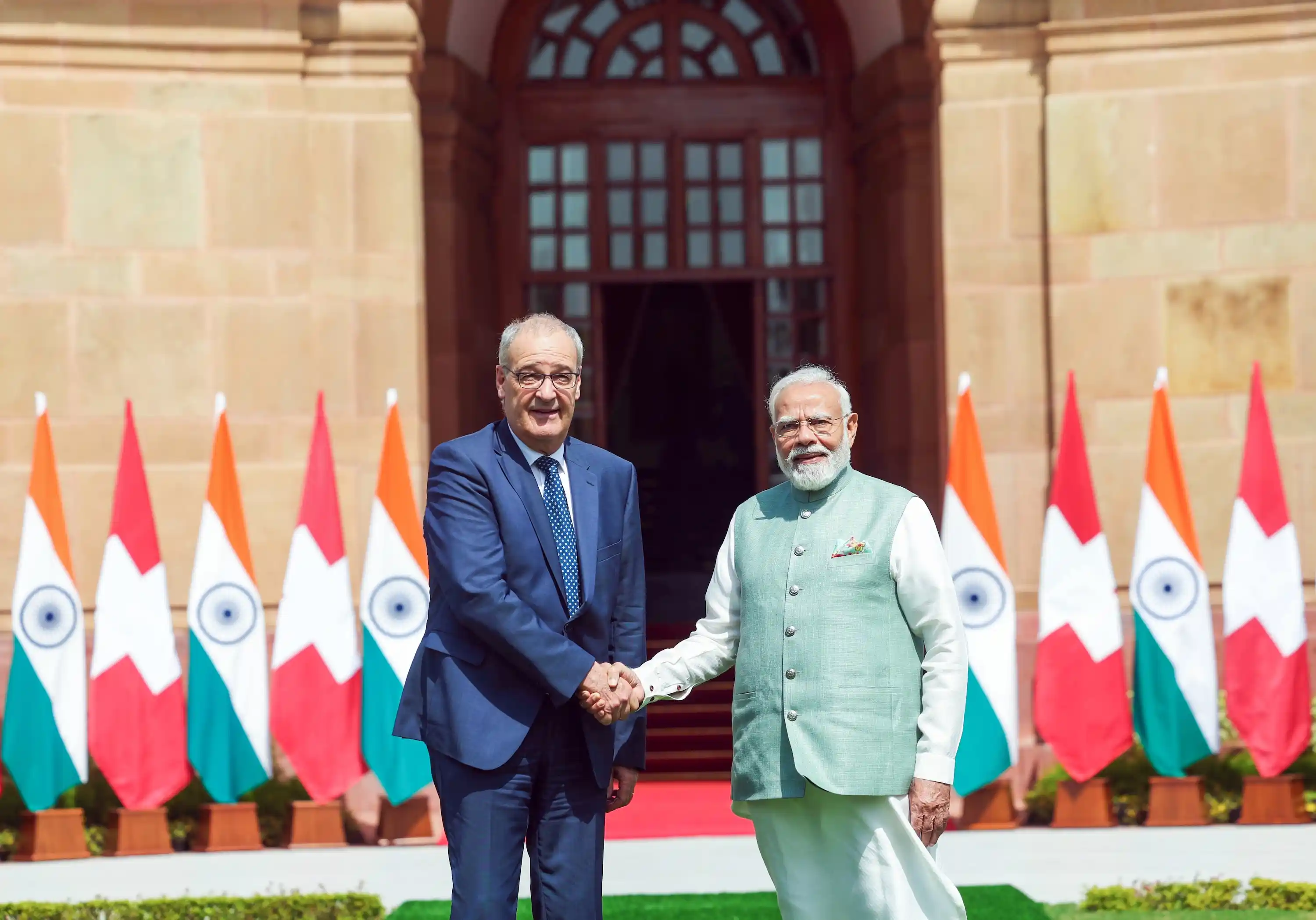
Swiss President Guy Parmelin’s state visit, from 5 to 7 October, is the first bilateral presidential trip from Bern to New Delhi in nearly a decade. It coincides with the first anniversary of the India–EFTA Trade and Economic Partnership Agreement and closes with the second India–EFTA Prosperity Summit at Bharat Mandapam. The timing is exact, and the results match it.
Parmelin was received with full ceremonial honours by President Droupadi Murmu and Prime Minister Narendra Modi, then held delegation-level talks at Hyderabad House. The Ministry of External Affairs framed the conversation around three pillars: trade, technology and talent. Five agreements were concluded. A Migration and Mobility Partnership provides multiple-entry visas of up to five years, with stays of up to six months on each visit, and renewable one-year student permits, while formalising cooperation on legal pathways for education, science and work. A Young Professionals Agreement sets an exchange of 300 people a year from each country, with room to rise to 500, so that young Indians and Swiss can take temporary employment, build skills and learn each other’s languages. Further instruments cover transport technologies and infrastructure — electric vehicles, ropeways, tunnels and the circular economy — a letter of intent between India’s Department of Science and Technology and the Swiss National Science Foundation, and an implementation track for early-stage start-ups with Zurich University of Applied Sciences. The two governments also agreed to establish a special group to carry the trade pact forward and widen market access for Indian exports.
That package sits on a larger economic architecture. TEPA, signed in March 2024 and in force since 1 October 2025, is India’s first free-trade agreement with a European economic bloc. EFTA — Switzerland, Norway, Iceland and Liechtenstein — has committed to promote $100 billion of investment and one million direct jobs in India over fifteen years. EFTA offers tariff coverage on 92.2 per cent of lines, covering 99.6 per cent of India’s exports, including all non-agricultural products. India covers 82.7 per cent of lines, accounting for 95.3 per cent of EFTA exports, while protecting sensitive domestic sectors. Switzerland is the bloc’s economic centre. More than 340 Swiss companies already operate in India: about 110 in manufacturing, some 30 with research centres, and 74 using India as an export hub for other markets. Indian investment in Switzerland stands at roughly $9 billion. Parmelin said Swiss firms see India as a serious long-term partner across logistics, financial services, manufacturing, pharmaceuticals, biotechnology and electronics, and that the first year of TEPA has already produced strong corporate interest and fresh investment plans. MEA Secretary (West) Sibi George reported significant progress toward the investment commitment. Prime Minister Modi, thanking Parmelin for his personal role in operationalising the pact, said decisions taken this week will lift Indian exports of agriculture, pharmaceuticals, textiles and engineering goods, and draw Swiss capital into biotech, life sciences, banking, insurance, food processing and sustainability.
The visit also widened the partnership beyond commerce. PM Modi said the two sides had identified new possibilities in military exchanges and defence production, and had agreed to deepen cooperation in civil nuclear energy. He invited Swiss infrastructure companies to invest at scale in design, manufacturing and capacity-building. Health, clean energy, space, yoga and Ayurveda figured in the same discussion. On Tuesday Parmelin led a delegation of about 65 — officials, parliamentarians and business representatives — to Noida International Airport at Jewar, developed by a subsidiary of Zurich Airport International. The tour of the terminal, airside and air-traffic control tower put a working Swiss asset on Indian soil at the centre of the programme. Science cooperation and the line from February’s AI Impact Summit in New Delhi to the next global AI gathering, which Switzerland will host in Geneva in 2027, gave the technology pillar a forward calendar. Diplomatic relations turn 80 in 2028; this visit is part of the build-up.
Parmelin called the trip a stepping stone toward a closer, broader partnership built on democratic values, trust and mutual respect. The stone is already carrying traffic. A mobility regime that opens five-year visas and a young-professionals channel, a review mechanism dedicated to export growth, a defence and nuclear opening, and a live infrastructure partnership at Jewar convert the anniversary of TEPA from a commemoration into a programme. Today’s Prosperity Summit, bringing ministers and business leaders from India and all four EFTA states to Bharat Mandapam, is the public expression of that programme: investment in advanced manufacturing, green energy, healthcare, life sciences and clean technology, and commercial partnerships built on a pact that is already in force. For India, Switzerland is a high-trust European partner with deep capital markets and precision industry. For Switzerland, India is the growth market and innovation partner of the next decade. This week’s agreements are how that reading becomes policy.

