Amid rapid power shifts and the absence of a single ideological fault line, sovereign states’ emphasis on partnerships and alliances is shifting quickly. However, a shift in emphasis does not automatically render an alliance or plurilateral partnership irrelevant. The very existence of a partnership or alliance, and its possible re-emergence as an important regional force, alters the behaviour of sovereign states. Furthermore, the premium placed on a partnership or alliance depends on the member state’s location and changing security needs. In a very short span of time, the Quad has witnessed celebration, de-emphasis and revival. This phenomenon is not merely a reflection of the framework’s utility; it also demonstrates the fluidity of international politics today.
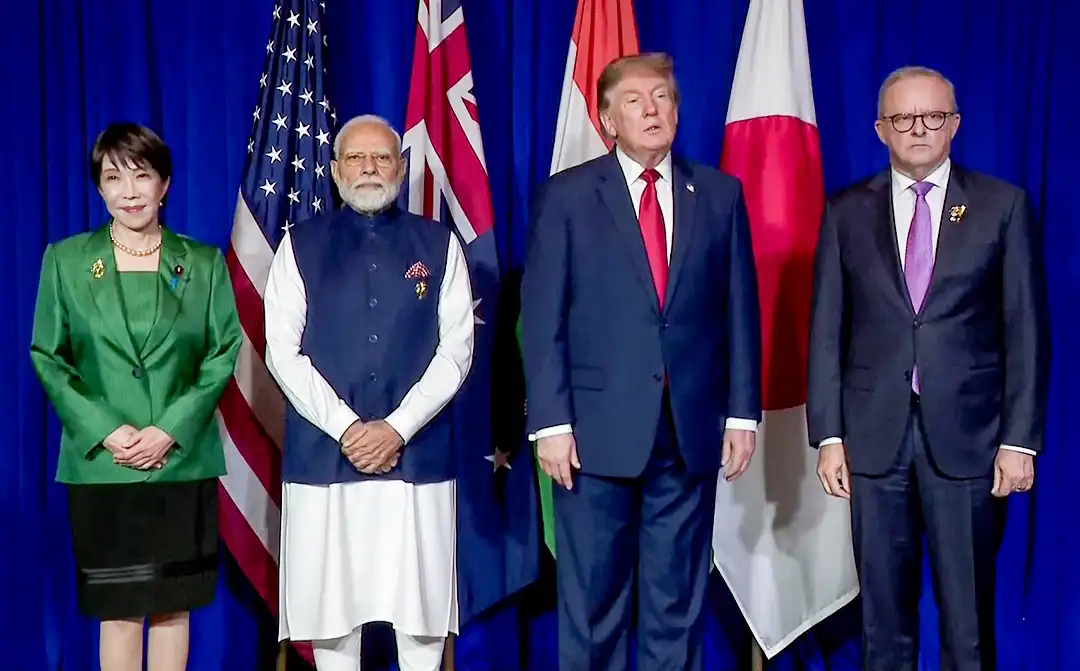
After a two-year gap, the Quad Leaders’ Summit was held in the Philippines on November 17. All the leaders of the Quad countries – Prime Minister of Australia Anthony Albanese, Prime Minister of India Narendra Modi, Prime Minister of Japan Sanae Takaichi, and President of the United States Donald J. Trump – attended the summit meeting.
This was the first summit since Donald Trump took office for his second term as President. There was a perception that President Donald Trump was neglecting the Quad framework, which contributed to the absence of summit-level meetings since 2024. In fact, India was supposed to host the Quad meeting in 2025, which did not materialise.
While the Quad has faced some headwinds in the recent past, Quad foreign ministers have met about five times since January last year, and numerous official-level meetings have taken place. Furthermore, the prime ministers of India, Japan, and Australia have interacted regularly. For instance, during Japanese PM Sanae Takaichi’s visit to India in July this year, the bilateral strategic partnership made considerable progress. In the same month, the Indian PM Modi visited Australia for the annual summit meeting between the countries.
The current Quad leaders’ meeting was organised in a specific geopolitical context. The war in Ukraine is in its fourth year, and the war in Iran continues to persist. Furthermore, China, in the recent past, carried out numerous aggressive manoeuvres against the Philippine Navy and its ships in the South China Sea. Concerns grew about China’s aggressive posture on the Senkaku Islands and Taiwan. President Trump’s references to the G-2 framework and the meeting of the leaders of Russia, China and the US prompted murmurs that Washington is abandoning its allies and partners in the Indo-Pacific.
In this context, President Trump’s endorsement of the Quad and his statement that Quad countries “are the four corners of a free, open, stable and prosperous Indo-Pacific” aimed to reassure allies and friends in the Indo-Pacific. While the Australian Prime Minister stated that “what these four countries represent is greater than the sum of just the individual parts,” the Japanese Prime Minister observed that the Quad countries “will continue to shape the future of the Indo-Pacific together.” Indian PM Modi stated that the quadrilateral meeting is a “constructive and trusted partnership” that promotes cooperation in various domains such as supply chains, maritime security, new technologies and disaster response
In the Quad joint statement, the member countries called for securing critical supply chains and freedom of navigation, working together to promote cooperation in artificial intelligence, and improving connectivity corridors. The Quad leaders also announced that the inaugural Quad Business Leaders’ Forum will be held in India next year. Given that India has signed numerous free trade agreements with various economies and is likely to conclude a free trade agreement with the United States, the likely emergence of the Quad Business Leaders’ Forum as a regular feature bodes well for the Indian economy and will also play an important role in establishing India as an important player in global supply chains.
In May 2026, the Quad Foreign Ministers’ Meeting announced the Indo-Pacific Maritime Surveillance Collaboration (IPMSC) to increase maritime domain awareness in the Indian Ocean Region (IOR) and beyond. This year, the Quad Leaders at their meeting in Manila announced: “in 2027, our respective P-8 and P-3C patrol aircraft are scheduled to fly in a maritime exercise for the first time in a Quad context, making our seas safer.” This exercise will not be merely symbolic; it will have broader geopolitical implications. Given China’s growing maritime presence in the Indian Ocean region, recent developments such as the closure of the Strait of Hormuz, and the criticality of other narrow seas such as the Strait of Malacca, the growing cooperation in the maritime domain will improve the maritime capabilities of Quad countries.
In May 2023, the Quad Partnership for Cable Connectivity and Resilience was launched to improve cable connectivity to Pacific Island countries. The Manila 2026 Quad Leaders’ Summit welcomed “an expansion of Australia’s contribution to the Partnership to focus on electricity cables, strengthening regional energy security and connectivity…[and also]… upcoming undersea cable projects in the Indian Ocean…” The Manila Quad summit also called for increased cooperation in other domains such as Artificial Intelligence (AI), enhanced cooperation in cyber security, combating terrorism and HADR.
For India, the Quad countries are important economic partners. India’s trade in goods with the US was approximately $149.1 billion in 2025. India’s defence cooperation continues to grow. While India’s trade with Japan is around $27.47 billion during FY 2025-26, Japan’s cumulative investments in India since 2000 amount to approximately $44.97 billion. Japan’s investments have significantly improved India’s automobile, infrastructure, technology and a host of other sectors. Similarly, India-Australia trade is about $24.1 billion. Australia is a source of energy and mineral imports for India and, like the US, hosts a large Indian diaspora.
Along with the Quad, India is indeed engaging with other frameworks such as SCO and BRICS, and there is no need to give up one framework in favour of another. While the SCO is an important platform for the Eurasian region, BRICS has emerged as a platform that articulates the demands of the developing countries. For India, the Quad has also emerged as an important plurilateral framework, as it seeks to build economic complementarities, dependable supply chain networks, and strengthen strategic convergences among its member countries in the Indo-Pacific.
Interestingly, acceptance of the Quad is now growing across the wider region. A decade ago, there was a concern that the emergence of the Quad framework would undermine the centrality of the Association of Southeast Asian Nations (ASEAN) in the Indo-Pacific region. Contrary to these expectations, India’s relationships with ASEAN countries have diversified and strengthened considerably. Similarly, Japan’s and Australia’s relations with Southeast Asian countries have also consolidated considerably in the recent past.
Perhaps because of domestic political priorities, tariff policy, a unilateralist impulse, and the wars in Ukraine and Iran, the US president has not been able to demonstrate enthusiastic engagement with the Quad framework. Yet the Quad has made progress through regular engagement by foreign ministers and officials. However, moving forward, the Quad framework needs attention at the highest levels of political leadership. The importance of such commitment was evident in the Quad joint statement’s tribute to former Japanese Prime Minister Shinzo Abe for his advocacy of the Indo-Pacific idea, and for the need for democracies to cooperate. Overall, despite many ups and downs, the idea of the Quad has endured. Coincidentally, the first Quad officials meeting was organised in Manila in 2007. After a decade-long gap, the Quad officials met again in Manila in 2017. It remains to be seen whether the recent Quad meeting in Manila will once again infuse the framework with a new sense of purpose and direction.
The copyright of this article remains with the Politeia Research Foundation ©️PRF.