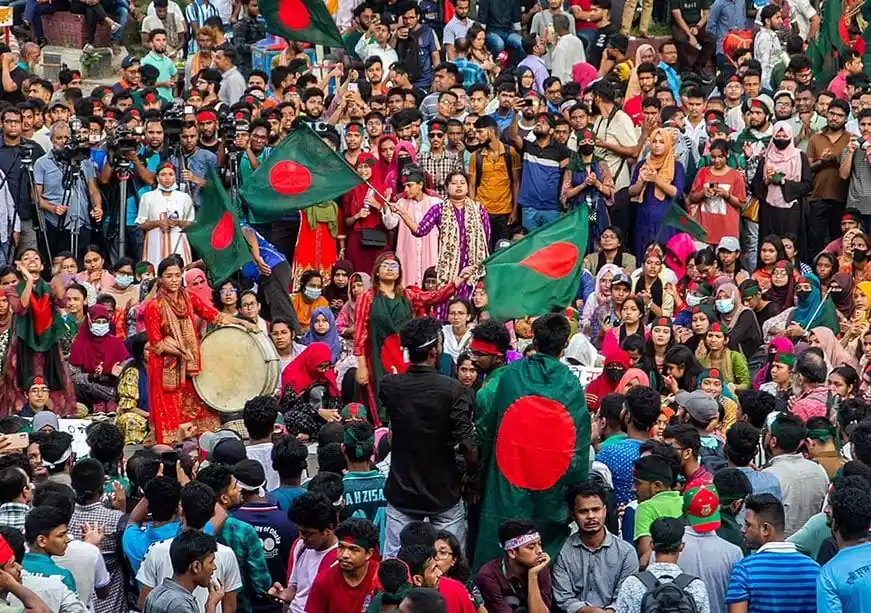
India and Bangladesh share the region’s longest land border, stretching over 4,096 kilometers. For decades, New Delhi and Dhaka have served as anchors of India’s Neighbourhood First policy, driven by historic ties, counter-terrorism cooperation, trade development, and cross-border connectivity. Today, as South Asia undergoes a profound geopolitical realignment, this relationship is also facing a serious reality check.
As strategic autonomy becomes increasingly important in the region, Bangladesh is actively recalibrating its international posture. India has invested billions of dollars in high-impact infrastructure, cross-border power grids, digital connectivity, and rail links across Bangladesh. However, New Delhi now confronts a more complex neighbourhood reality: growing Chinese inroads, an unexpected strategic thaw between Dhaka and Islamabad, and sensitive diplomatic friction over former leader Sheikh Hasina.
Strategic Autonomy and an Untested Leader
The transition of power to the current Prime Minister, Tarique Rahman, who returned to Bangladesh after 17 years of self-imposed exile, has ushered in a more assertive and transactional approach to foreign affairs. The new establishment appears eager to demonstrate that it can maintain distance from what it sees as the Awami League’s India-leaning foreign policy.
Rahman’s first overseas visits to Malaysia and China reflected an effort to demonstrate strategic autonomy to his domestic constituency. The new government must respond to a younger and increasingly vocal electorate that views past agreements with India through the lens of asymmetric dependence. Consequently, Dhaka is diversifying its external partnerships, reaching out to Beijing, Islamabad, Ankara, and Riyadh to build alternative economic, political, and defence partnerships.
In foreign policy, Rahman faces the difficult task of maintaining domestic popularity. Vocal political factions demand a harder line against India over Sheikh Hasina’s extradition and river-water disputes. At the same time, Dhaka must avoid a costly breakdown with a vital neighbour with which it shares deep geographic and economic interdependence. This has become an important test of Bangladesh’s institutional ability to balance domestic pressures, regional rivalries, and great-power competition.
The Unresolved Dilemma of Sheikh Hasina
The most immediate diplomatic friction between New Delhi and Dhaka concerns the presence of former Prime Minister Sheikh Hasina in India. The issue has become increasingly polarising within Bangladesh. While warrants and extradition requests have reportedly been issued, the controversy deepened when Hasina addressed international media from New Delhi, vowing to return to Bangladesh by December 2026 while also expressing fears for her safety if she returns.
For Dhaka, these mounting tensions have made it clear that the political environment is not yet prepared for a productive state visit to India. For New Delhi, the situation presents a two-pronged diplomatic challenge:
- Legal and humanitarian obligations: Handing over a longstanding strategic partner who sought emergency refuge could seriously damage India’s credibility as a reliable regional ally.
- Diplomatic realities: Refusing Dhaka’s legal requests can complicate routine administrative cooperation with the current Bangladeshi government and fuel anti-India rhetoric in domestic political and media spaces.
The challenge for India will be to manage the issue in a manner that does not allow a single politically sensitive matter to dominate the broader bilateral relationship.
The Makkah Joint Defence Agreement and an Emerging Islamic Security Axis
Very recently, on 31 August, Saudi Arabia, Turkey, and Pakistan signed a joint defence agreement. The arrangement has been outlined as a strategic political and defence mechanism, designed around collective deterrence principles similar to NATO-style mutual defence commitments.
In response, Bangladesh’s Foreign Minister Khalilur Rahman stated that Dhaka “views this pact positively” and that, if an official offer or invitation were extended, Bangladesh would “certainly consider it positively.” In addition, following the post-Yunus interim phase, Bangladesh has witnessed a rapid diplomatic and economic rapprochement with Pakistan. This has included the removal of strict visa-clearance requirements and maritime cargo-inspection barriers, as well as the restoration of direct sea and air links between Karachi and Chattogram.
This pivot could represent an important shift in regional security dynamics:
- Strategic implications: If Bangladesh formally affiliates with a defence grouping that includes Pakistan and Turkey, it could bring a collective-security framework closer to India’s eastern flank.
- Defence diversification: Dhaka may seek access to advanced Turkish defence technology, including Bayraktar drones and naval corvettes; Saudi financial and energy investments; and diversified military training arrangements with Pakistan, which expanded after the post-Yunus thaw.
- Regional balances: While Dhaka may frame this as ordinary non-aligned diversification, it could introduce external military actors into the Bay of Bengal and complicate India’s maritime-security calculations.
China’s Expanding Footprint
Bangladesh’s combination of geographical constraints, institutional bottlenecks, fiscal limitations, and governance weaknesses has created structural challenges in building large-scale national infrastructure. China has moved quickly to capitalise on these gaps. It has expanded its traditional role as Bangladesh’s primary arms supplier into that of a major financier of critical national infrastructure.
Chinese state-owned enterprises have become embedded in Bangladesh’s logistical and infrastructure systems, while Beijing has also offered concessional currency-swap arrangements. China has further drawn Bangladesh into specialised sub-regional platforms designed to bypass institutions that many now regard as ineffective, including SAARC.
For example, the China–South Asia Cooperation Forum, operating from Kunming, brings together South Asian business leaders, technocrats, and diplomats. It offers preferential market-access opportunities, customs-automation training, and logistics links intended to deepen access to the Chinese market. Other sub-regional mechanisms, including the China–South Asia Emergency Supplies Reserve and the Poverty Reduction and Development Cooperation Centre, seek to create a stronger Chinese presence in disaster relief and development assistance.
Furthermore, Dhaka has officially endorsed Xi Jinping’s Global Development Initiative, aligning elements of its domestic planning priorities with Chinese-led development frameworks.
The issue of greatest concern for New Delhi is China’s increasing presence in strategically sensitive projects, especially the proposed Teesta River Comprehensive Management and Restoration Project. China has offered finance and engineering support for a transboundary river system located close to India’s narrow Siliguri Corridor, often called the “Chicken’s Neck,” which connects mainland India to its northeastern states. Such involvement could give Beijing a long-term strategic presence in an area highly sensitive to Indian security interests.
The China-Myanmar-Bangladesh Economic Corridor in conjunction with China0Myanmar Economic Corridor and a proposed Chinese economic zone in Chattogram add further weight to Beijing’s presence along India’s eastern flank.
How India Should Manage Differences
Given these rapid geopolitical changes, New Delhi cannot afford to retreat into defensive isolation or reduce its economic engagement with Bangladesh. Instead, India must adopt a pragmatic and non-ideological approach that recognises Bangladesh’s need for strategic autonomy while protecting India’s own long-term interests.
First, India should streamline border logistics, remove non-tariff barriers, and expand local Border Haats. Keeping essential supply chains open for food grains, cotton, and refined petroleum can demonstrate that economic partnership with India directly lowers the cost of living for ordinary Bangladeshi citizens.
Second, India should broaden its outreach across Bangladesh’s entire political and civic spectrum. By engaging institutionally with business chambers, including Joint Business Task Forces initiated through bodies such as the Confederation of Indian Industry, as well as student bodies, technocrats, civil-society actors, and regional leadership, New Delhi can build a more durable relationship that survives changes in ruling coalitions.
Third, India should prioritise transparent and automated hydrological data-sharing arrangements, while strictly enforcing mutually agreed border-management protocols. This can help reduce grievances that are often weaponised domestically by anti-India groups.
Areas of Unavoidable Future Cooperation
Geography makes India and Bangladesh permanently interdependent. However, there is little doubt that their relationship has entered a more contested and multipolar phase. Regardless of political changes in Dhaka, the next decade of India’s engagement with Bangladesh must focus less on grand announcements and more on implementation quality, commercial sustainability, and mutual benefit.
India should prioritise:
- Completing ongoing connectivity projects on time and within budget, while ensuring that tariffs and operating rules are commercially viable for both sides.
- Expanding trade facilitation through customs modernisation, single-window systems, and mutual recognition of standards. This would make it easier for Bangladeshi firms to export to India and for Indian investors to establish joint ventures in Bangladesh.
- Deepening energy cooperation beyond power sales by promoting grid integration, renewable-energy zones, and joint investments in storage and transmission infrastructure.
- Making water and climate cooperation the new centre of gravity in the relationship through basin-wide institutions, shared data platforms, and joint adaptation funds.
- Investing in people i.e. students, researchers, health workers, and entrepreneurs through scholarships, joint degrees, innovation hubs, and digital public goods that can be adapted to Bangladesh’s context.
By anchoring its diplomacy in pragmatic infrastructure delivery, transparent river management, and institutional mutual respect, India can safeguard its security interests while ensuring that its partnership with Bangladesh remains an enduring engine of South Asian integration. In this way, India can remain a partner of mutual necessity rather than one perceived only through the lens of strategic dependence.