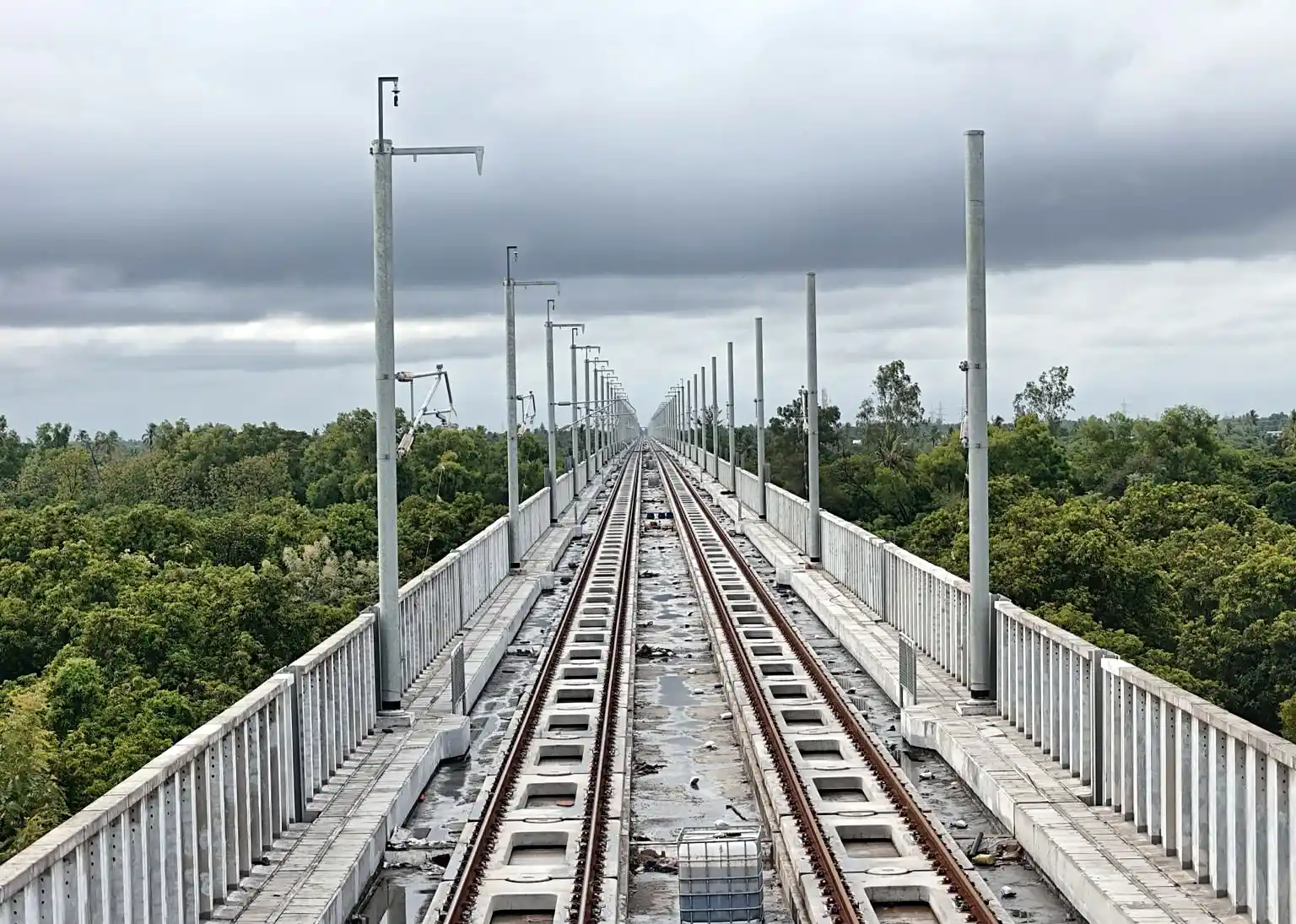
Nine years after Prime Minister Narendra Modi and then Japanese Prime Minister Shinzo Abe laid the foundation stone, India’s first bullet train is expected to be ready by August 15, 2027, marking a major milestone in the country’s journey towards modern, high-speed rail travel.
According to Union Railway Minister Ashwini Vaishnaw, the body frame of India’s first domestically manufactured bullet train is ready, and the train is expected to hit the tracks for testing in May 2027. After a testing period of two to four months, the bullet train will be inaugurated by the Prime Minister himself,” Vaishnaw said.
The bullet train will pass through Gujarat, Maharashtra, and the Union Territory of Dadra & Nagar Haveli.
Information available with India Narrative reveals that the bullet train corridor will be built in a phased manner. The 50 km long Surat-Bilomora stretch will made made operational first, to be followed by Vapi-Surat, which will be 120 kmn long. Thereafter, the service will start on the Thane-Ahmedabad stretch, which happens to be the longest one.
The passengers travelling from Vadodara to Mumbai by bullet train would be able to cover the distance in around an hour and a half.
The project is being seen as more than just a high-speed transportation initiative, with the potential to become a key driver of economic integration. Once completed, it is expected to boost economic activity by improving connectivity, strengthening links between cities and creating new opportunities for businesses and industries along the corridor.
Addressing the ‘NaMo for Viksit Bharat’ event in Vadodara last week, Vaishnaw said construction work on the project was moving ahead at a fast pace. The Surat-Vapi section is expected to be completed by December of this year.
“The project was being developed in line with the vision of an Atmanirbhar Bharat and would significantly reduce travel time between Vadodara and Mumbai. When you ride the bullet train from Vadodara, you will reach Mumbai in just an hour and a half,” he said.
Admits Saurabh Chauhan, a senior Indian journalist, “In a country like India, where high-speed rail revolution is taking shape as part of the railway modernisation plan, the bullet train is nothing less than a dream. The train is not only going to bring a massive reduction in travel time for passengers, but it will also help in the faster movement of people and boost trade, tourism, investment, and jobs. This world-class infrastructure is powering a Viksit Bharat.”
“For decades, bullet trains were only discussed, but under Prime Minister Narendra Modi, they are becoming a reality. This is not just about speed; it is about transforming India’s economic geography and connecting growth centers like never before.
A new India is being built, one corridor at a time,” wrote a social media user.
Recently, several long-pending railway projects have been completed, including the Chenab Bridge and the rail connectivity project that links Mizoram to the national railway network.
According to Vaishnaw, 280 railway stations have been redeveloped, and 36,000 km of new railway tracks have been laid. He added that cargo trains incorporating Vande Bharat technology were also being developed. Of all, the bullet train, he says, will be a technological marvel.
“Trains will pass through the 21 km long underground at Vikhroli tunnel at a maximum speed of up to 320 km. The tunnel was being built with such precision that it would not disturb the tall buildings in the area” the railway minister said.
Simultaneously, the work on the undersea tunnel has been started at four locations—BKC, Ghansoli, Sawli and Vikhroli as part of efforts to speed up the construction of the tunnel, seven kilometers of which will be under the sea.
India’s first bullet train project is the 508-kilometer Mumbai–Ahmedabad High Speed Rail Corridor, built using Japanese Shinkansen technology to connect Maharashtra and Gujarat. The government has expanded its high-speed rail scope by approving a massive blueprint in the Union Budget for seven additional corridors nationwide under the National High-Speed Rail Corporation Limited (NHSRCL).
In addition to transforming Indian Railways, the Mumbai–Ahmedabad High-Speed Rail Project is expected to generate approximately 4,000 direct jobs. It is also projected to create around 20,000 indirect employment opportunities, while providing employment to nearly 20,000 construction workers until the commencement of bullet train operations.