

India stands at a defining moment in its development journey. With an expanding digital economy, ambitious infrastructure programmes, growing technological capabilities and one of the world’s largest young populations, the country is steadily building the foundations of Viksit Bharat 2047.
From digital public infrastructure and space exploration to renewable energy and advanced manufacturing, India’s progress reflects its growing capacity to innovate at scale. Complementing these achievements is another significant national strength: the ability to understand and respond to the aspirations, behaviours and evolving needs of its people.
This is where social sciences assume considerable importance.
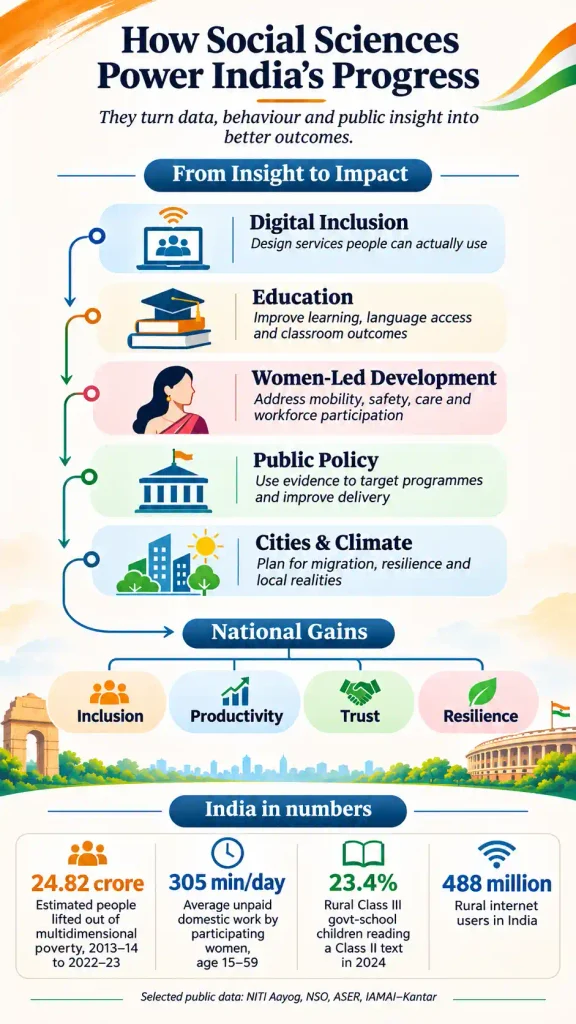
Economics, sociology, political science, psychology, anthropology and public policy provide the intellectual frameworks through which technological advancement can be connected with social progress. Together, these disciplines can help India maximise the developmental impact of its investments and strengthen its position as a knowledge-driven global economy.
India’s future will be shaped not only by what it builds, but also by how effectively its institutions, innovations and policies respond to the aspirations of its people.
Connecting technological progress with social understanding
India’s commitment to research and innovation continues to expand. According to the Department of Science and Technology’s Research and Development Statistics 2025–26, the country’s gross expenditure on research and development reached approximately ₹2.45 lakh crore in 2023–24.
As India advances in artificial intelligence, semiconductors, biotechnology and clean energy, social sciences can play a complementary role in translating technological achievements into widespread economic and societal benefits.
India’s digital transformation demonstrates the potential of this convergence. The IAMAI–Kantar Internet in India 2024 report estimated 886 million active internet users, including approximately 488 million in rural India.
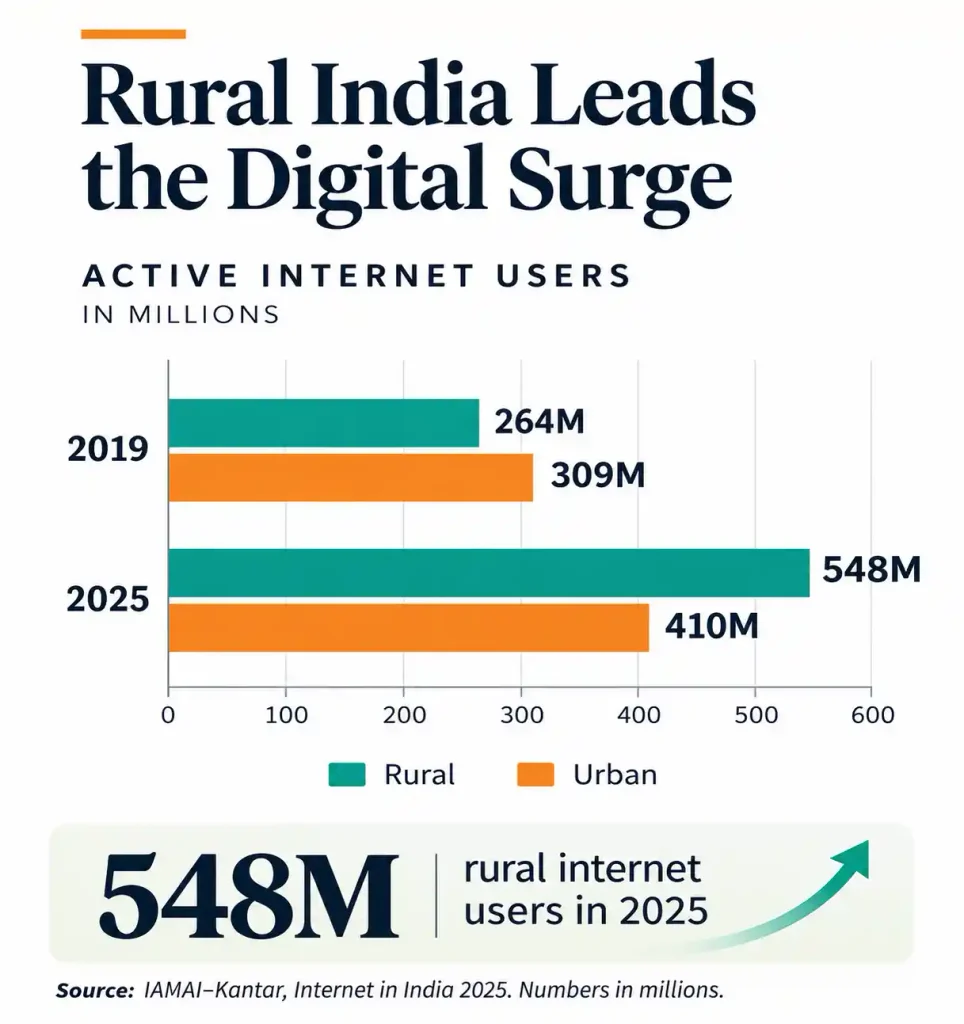
This growing connectivity offers opportunities for digital education, financial inclusion, entrepreneurship and access to public services.
Social scientists can contribute by examining patterns of technology adoption, consumer behaviour, digital literacy and community participation. Such insights can help innovators design products and services that reflect India’s linguistic, cultural and socioeconomic diversity.
For instance, combining agricultural technology with behavioural research can improve the adoption of innovative farming practices. Similarly, integrating artificial intelligence with insights from psychology and education can support personalised learning and more accessible digital services.
India’s technological future will become even more impactful when engineering innovation and social understanding advance together.
Strengthening India’s human development achievements
India’s development experience offers valuable evidence of the importance of integrated policy approaches.
According to NITI Aayog, an estimated 24.82 crore Indians moved out of multidimensional poverty between 2013–14 and 2022–23. The estimated multidimensional poverty headcount declined from 29.17% to 11.28% during this period, with the later figures based on projections.
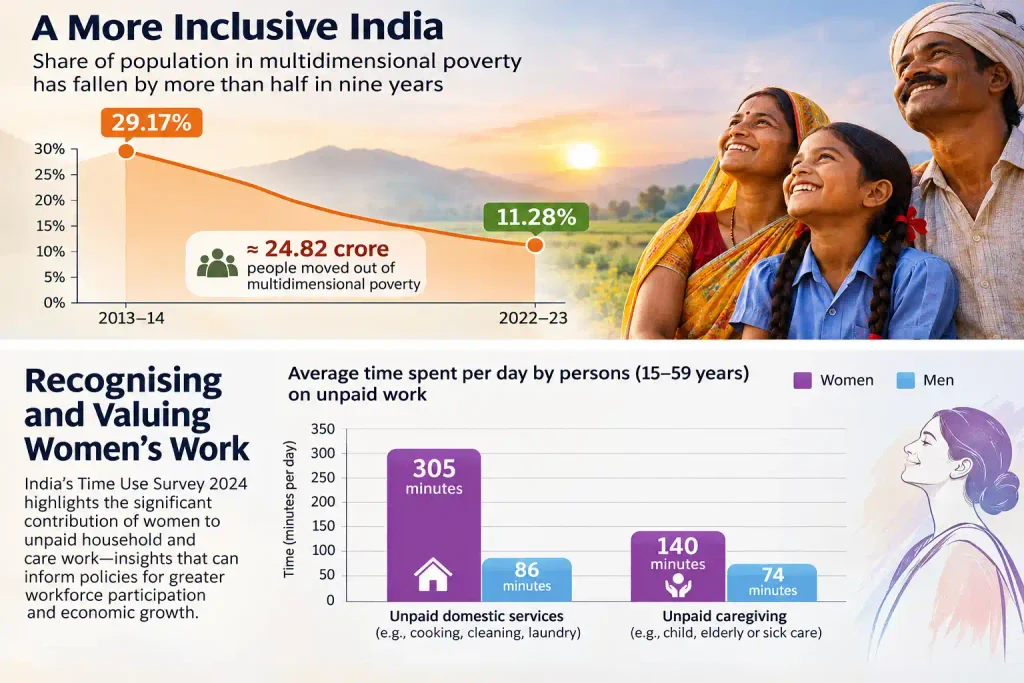
This transformation reflects the significance of sustained public policy, economic development and targeted social interventions.
Social sciences help strengthen such achievements by providing evidence about household welfare, economic mobility, access to opportunities and the effectiveness of development programmes.
India’s expanding focus on women-led development presents another important opportunity.
The National Statistical Office’s Time Use Survey 2024 provides detailed insights into how Indians allocate time across paid employment, household responsibilities, caregiving and other activities.
Such evidence can inform policies supporting women’s entrepreneurship, workforce participation, skill development and economic independence.
As India seeks to realise the full potential of its demographic dividend, social research can help align educational pathways, employment opportunities and social infrastructure with the changing aspirations of its population.
The contribution of social sciences is thus deeply connected with economic productivity, human capital formation and long-term national prosperity.
Building a knowledge-driven education system
India’s higher education ecosystem represents one of the country’s most important assets.
The All India Survey on Higher Education 2023–24, released in 2026, recorded approximately 4.5 crore students enrolled in higher education. Arts accounted for 32.1% of undergraduate enrolment, while social sciences represented 18.6% of postgraduate enrolment.
These figures illustrate the substantial role of humanities and social sciences within India’s educational landscape.
The National Education Policy 2020 provides a forward-looking framework by encouraging multidisciplinary learning, critical thinking, research and greater integration across academic disciplines.
This approach offers an opportunity to create graduates who combine technical expertise with communication skills, ethical reasoning, social awareness and an understanding of institutions.
An engineer familiar with public policy, an economist trained in data science or a technology entrepreneur equipped with behavioural insights can bring valuable interdisciplinary perspectives to problem-solving.
Research institutions can further strengthen this convergence by developing collaborative programmes across engineering, management, public health, environmental studies and social sciences.
Such integration can prepare India’s young population for emerging professions while nurturing the analytical and leadership capabilities required in a rapidly changing world.
Social sciences as an enabler of effective governance
India’s governance transformation is increasingly supported by digital platforms, data-driven decision-making and greater emphasis on measurable developmental outcomes.
Initiatives such as the Aspirational Districts Programme demonstrate the value of monitoring socioeconomic indicators and encouraging improvements across health, education, agriculture, financial inclusion and infrastructure.
Social sciences can deepen the effectiveness of such approaches by helping policymakers understand regional development patterns, institutional performance and community-level needs.
In urban development, for example, demographic research, migration studies and behavioural analysis can complement investments in housing, public transport and urban infrastructure.
Similarly, India’s energy transition can benefit from research into community participation, changing employment patterns and consumer adoption of clean technologies.
By connecting quantitative evidence with local knowledge, social scientists can contribute to policies that are both economically effective and socially responsive.
This capability is particularly valuable for a country of India’s scale and diversity, where successful programmes can benefit millions of people.
India’s diversity as a global knowledge advantage
India’s civilisational heritage, cultural plurality and democratic traditions provide a distinctive foundation for social science research.
Its varied languages, communities, economic structures and regional experiences offer extraordinary opportunities to study social change, institutional development and human behaviour.
India also has a rich intellectual tradition of examining society, governance and economic life, extending from classical Indian thought to modern scholarship.
This heritage can be complemented by contemporary research methodologies, large-scale surveys, computational analysis and interdisciplinary collaboration.
As India’s international engagement expands, expertise in political science, international relations, history and cultural studies can strengthen its contributions to global discussions on development, diplomacy, sustainability and international cooperation.
India’s experience in implementing large-scale public programmes and digital solutions also provides valuable lessons for other emerging economies.
Social science research can help document, evaluate and communicate these experiences, further strengthening India’s role as a source of developmental knowledge and policy innovation.
Towards Viksit Bharat 2047
Realising the vision of Viksit Bharat 2047 will require sustained progress across technology, industry, education, governance and human development.
Social sciences can serve as an important bridge connecting these priorities.
Greater interdisciplinary research, collaboration between universities and industry, stronger policy evaluation capabilities and investment in high-quality social data can help India advance towards this vision.
Equally important is encouraging young researchers to work at the intersection of technology and society, bringing fresh perspectives to challenges involving urbanisation, employment, education, sustainability and governance.
The future of social sciences in India is therefore not separate from the country’s scientific and technological ambitions. It is closely connected with their success.
India possesses the scale, talent, institutional experience and cultural depth to develop an approach to progress that combines innovation with human understanding.
If technology provides the instruments of transformation, social sciences provide the insight to make that transformation meaningful, responsive and enduring.
As India moves towards its centenary of independence, the convergence of scientific excellence and social understanding can become one of its greatest national strengths, helping build not only a technologically advanced economy, but a confident, prosperous and people-centred developed nation.

