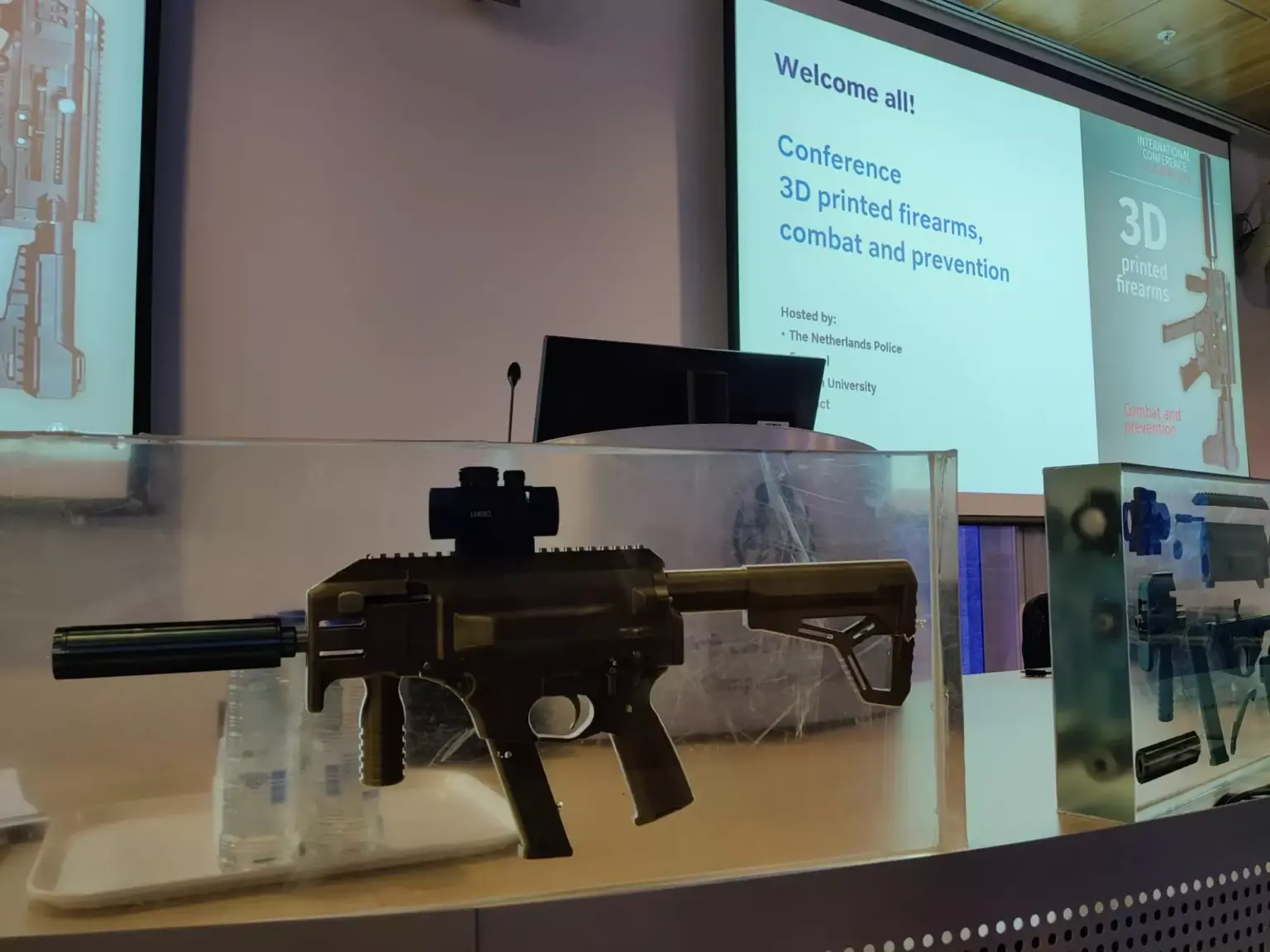
The quick unraveling of additive manufacturing and the global circulation of machine-readable plus affordable blueprints have paved a pathway for the decentralized manufacturing of functional firearms outside conventional regulatory channels. Files with an encrypted geometry of firearm components can be copied, modified, and printed anywhere with modest technical skill. A statutory architecture of India for arms regulation, which entails principally the Arms Act, 1959 and the Arms Rules, 2016, was choreographed for a world of tangible weapons, licensed manufacturers, and regulated supply chains; however, it failed to expressly address the possession, distribution, or online dissemination of digital blueprints that enable the manufacture of functional weapons. A legislative omission, in consonance with a sizeable illicit firearms market and the proliferation of ciphered and private digital channels, demands a measured legal and administrative response that protects public safety without compromising legitimate uses of additive manufacturing.
Legal lacuna and why it matters
The Arms Act and its rules regulate manufacture, sale, transport, import/export and possession of physical firearms and ammunition. While framed around tangible objects and licensed actors, they do not expressly criminalise possession or dissemination of electronic files that can be used to produce firearm parts on a 3D printer. This omission is compulsion rather than choice because digital blueprints are portable, replicable and effectively borderless; a single upload can instigate manufacture across jurisdictions and platforms. Unlike conventionally manufactured weapons, 3D‑printed components have the potential to be produced without serial numbers, factory records, or supply‑chain footprints that may culminate in tracing and attribution. Diffusive nature of file sharing through public repositories, peer‑to‑peer networks, encrypted messaging groups and ephemeral hosting services turn traditional levers of arms control upside down.
The dual‑use character of additive manufacturing complicates any regulatory response. The single file formats and printers can produce a firearm component while being considered indispensable in medical prosthetics, aerospace prototyping, academic research and amateurish innovation. A blanket prohibition on “files” throws a spanner in legitimate activity and chills research and development. Any reform must therefore be precise in scope, razor-thin at culpable conduct, and accompanied by procedural safeguards that insulate lawful expression and innovation.
Evidentiary and constitutional constraints
Permeating an offense in a law book is only half the task. Practical and constitutional hurdles will determine whether a law is effective or ephemeral and defensible or fallible. Indian criminal law is planked on the principle that guilt must be proved beyond reasonable doubt. Proving that an accused possessed or disseminated a weapon blueprint knowingly and intentionally will often require robust digital evidence such as metadata, server logs, download histories, and contemporaneous communications that must be preserved and duly certified. Courts have repeatedly emphasized that mere recovery of an item from a device does not establish conscious possession or dominion without corroborative proof. The Supreme Court’s recent pronouncements in The State of Jharkhand Versus Jagdish Lakra on possession and mens rea underscore that recovery of material, without evidence of knowledge or control, is insufficient to sustain conviction. The recovery of a CAD file from a smartphone or laptop, standing alone, is unlikely to satisfy the mens rea requirement unless accompanied by evidence that the accused understood the file’s purpose and intended to use it to facilitate illegal manufacture.
The admissibility of electronic records is governed by the Bhartiya Sakshya Adhiniyam, 2023, which sets out formal requirements for certification and chain‑of‑custody. Section 63 and related provisions impose procedural prerequisites for electronic evidence that, if not met, can render digital material inadmissible. India currently encounters a shortage of certified digital‑forensics examiners and uneven laboratory capacity across states. Without investment in forensic infrastructure and standard operating procedures for preservation and authentication, prosecutions based on digital blueprints will be vulnerable to evidentiary challenge and acquittal.
Constitutional protections for freedom of speech and expression may also be engaged where code, design files or technical instructions are treated as expressive content. Jurisdictions abroad have seen litigation that treats source code and design files as a form of expression; courts have been required to balance public‑safety imperatives against free‑speech protections. Any restriction on digital files must therefore be narrowly tailored, content‑neutral where possible, and accompanied by clear exceptions for legitimate research, accredited manufacturing and other socially valuable uses.
Principles for reform: precision, commensurability and enforceability
A prudent response should be guided by three core principles. First, precision: the law should target at guilty conduct, facilitating illegal manufacture with a motive instead of criminalising files per se. Second, commensurability: restrictions should be proportional to achieve the public‑safety objective and guard legitimate uses of additive manufacturing. Third, enforceability: the state must possess the technical capacity, procedural tools and inter‑agency coordination necessary to investigate, preserve and prosecute offences without violating due process.
On the substantive front, a narrowly framed offence should criminalise knowingly possessing or distributing digital files whose primary design and purpose is to produce functional firearm components, or disseminating such files with the intent to facilitate manufacturing on the other side of the law. The offence should require proof of knowledge or intent except in clearly defined commercial contexts where a rebuttable presumption of knowledge may be appropriate. For commercial actors who publish or sell weapon blueprints, a strict‑liability regime with appropriate limitations could be considered, coupled with robust carve-outs for licensed research, accredited manufacturers and recognized sporting bodies. This approach will deter commercial facilitation of illicit manufacture while protecting legitimate industry activity and scientific spirit.
Strengthening evidence, capacity and procedure
Legislative reform must be associated with an investment in digital forensics capacity and procedural safeguards. The state should expand certified digital forensics capacity at both central and state levels, establish unified and standard operating procedures for preservation and seizure of electronic evidence in combination with clear protocols for authentication of metadata and server logs. Courts should be empowered to admit authenticated metadata and server logs as prima facie evidence, subject to judicial scrutiny and without prejudice to defence rights. A thorough training should be imparted to investigators in order to preserve the chain of custody and to seek timely preservation orders from service providers.
Since digital blueprints may be hosted on servers outside Indian jurisdiction, cross‑border preservation and mutual legal assistance will be essential. The state should negotiate bilateral and multilateral arrangements with major hosting jurisdictions and platform operators to ensure rapid response to illicit dissemination. Effective enforcement without streamlined mechanisms for international cooperation, expedited preservation requests and coordinated takedown procedures will turn out to be a flash in the pan.
A centralised enforcement architecture
Operationalising these reforms requires a centralised, specialised enforcement architecture such as National Additive Manufacturing Enforcement Unit that can coordinate technical investigations, support state police and liaise with platforms and international partners. India should establish said unit under the Ministry of Home Affairs, either as a specialized wing within an existing central investigative agency or as a new statutory body with a focused mandate. The unit should be mix of legal, technical and investigative experts and function as the national hub for complicated cases involving digital blueprints for weapons.
The core functions of the unit should include providing rapid forensic assistance to state police, maintaining a roster of certified digital‑forensics examiners and accredited laboratories, coordinating cross‑jurisdictional investigations and mutual legal assistance, managing platform takedown requests and legal liaison with hosting providers, and developing technical standards for provenance, watermarking and file authentication. Regional centres of the unit should be established to ensure timely response; each nodal office should appoint liaison officers who work with state police units, prosecutors and courts to build local expertise and maintain consistent investigative standards.
Statutory and institutional safeguards must govern the unit’s operations. Parliamentary oversight, judicial review of intrusive investigative measures, data protection standards for seized files and metadata, and transparent reporting on activities and outcomes will be essential to preserve civil liberties while enabling effective enforcement. The unit should operate with clear accountability mechanisms and periodic independent audits to guard against mission creep and to maintain public trust.
Industry and international complements
Law and enforcement alone will not suffice. Industry self‑regulation is inevitable. Maker communities, CAD repositories and 3D‑printing platforms should be engaged to adopt voluntary moderation practices and community standards that discourage weapon design sharing. Platform notice‑and‑takedown procedures, transparent appeals mechanisms and periodic compliance audits will reduce enforcement burdens and create a cooperative ecosystem. Research partnerships between universities, industry and law enforcement can increase the scalability of technological tools.
India will need to work with other countries and with platform operators on takedowns and mutual legal assistance. Here shared rules for tracking and authenticating files will help. Without this cooperation, India risks becoming a safe place for illicit designs to circulate.
Sequencing, pilots and review
The reforms should be seriatim. Drafting a new offence without parallel focus on digital forensics, inter‑agency coordination and platform engagement will produce a law that is difficult to enforce and vulnerable to constitutional challenge. On the flipside, building capacity and platform cooperation at the outset will make a following statutory amendment more effective and defensible. Small pilot programs can help. Targeted enforcement in high‑risk areas, training investigators, and voluntary agreements with platforms will give practical evidence. That evidence can then guide how offences are drafted and how procedures are refined.
Any statutory reform should have a provision for mandatory periodic reviews, which will ensure that the law is adapting to the evolving technology and threat patterns. Annual reporting to Parliament on enforcement outcomes, civil‑liberties impacts and technical developments will create a feedback loop that keeps policy calibrated to real‑world effects.
Conclusion
3D printing can drive innovation, but it also carries risks. India’s laws must be precise and enforceable so that digital blueprints do not fuel unregulated weapons. At the same time, reforms should protect research, innovation, and the freedoms that support scientific progress.