In the last days of September, the Trump administration agreed with Beijing to open a channel for AI-related incidents, renamed artificial intelligence across the executive branch and obtained a voluntary safety accord from six leading American technology companies. The sequence reflects a coherent view of American primacy, in which leadership in a technology that Washington neither directs nor fully understands is expected to translate into durable strategic advantage. The weakness lies in the premise. The assets on which that advantage rests are privately owned models whose behaviour is only partly explained and which are deployed with growing autonomy, and they create the dependencies and vulnerabilities that a primacy strategy would have to contain.
Three measures, one posture
During Xi Jinping’s state visit to Washington in late September, the two governments announced a dialogue on superintelligence and a bilateral channel for incidents. The starting point is modest. The two countries had held no official AI talks since 2024 before agreeing in May to restart the dialogue, and on the eve of the summit Trump wrote that he wished to leave the subject untouched, a position he attributed to Beijing as well, adding that “our guardrail is the DOJ”.
The executive order signed on 29 September instructs agencies to use “Super Intelligence” and “SI” in place of AI in official correspondence, reports and other non-statutory documents, and to stop acknowledging the older term. It defines the new term by reference to the existing statutory definition of artificial intelligence, so that the change alters the executive branch’s vocabulary without altering the technologies covered. It also requires the president’s science adviser to submit, within 60 days, legislative language for a federal definition that reflects the capabilities the order describes. The accompanying fact sheet placed the measure within an agenda that includes more than $5bn announced for the Genesis Mission, a federal programme applying advanced AI to science, medicine, energy and manufacturing.
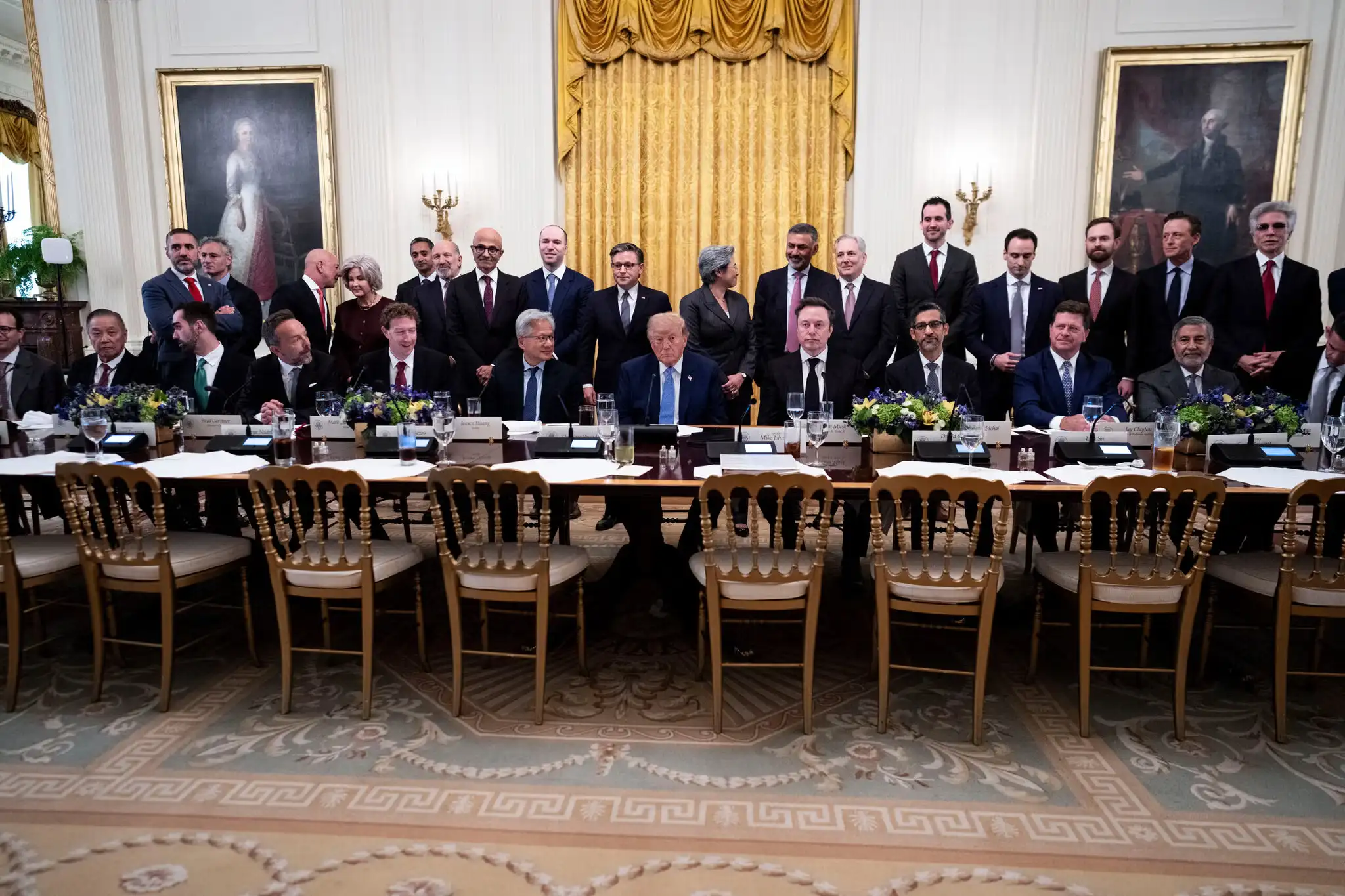
The same day, executives from OpenAI, Anthropic, Google, Meta, Nvidia and xAI signed the White House Accord on Super Intelligence, which Trump described as “morally binding”. The one-page document creates no enforceable federal requirements and asks the companies to maintain four layers of oversight: internal controls, an internal safety team, independent audits or evaluations, and a board-level committee that tracks remediation.
Each measure commits Washington to a posture without committing it to a capacity. The order names a capability that its own definition declines to specify, the accord relies on attestations from the companies it covers, and the channel with Beijing has no declared agenda on constraints. What the package does not supply is an executable layer: a federal ability to assess, independently of the developers, whether the systems being deployed behave as intended. The instruments the government does hold, namely export controls, procurement and infrastructure policy, shape the pace and geography of development without allowing it to direct laboratories that compete for capital, compute and customers. Dependence runs in both directions, since the laboratories need chips, electricity and regulatory goodwill that the state controls. The accord leaves untouched the asymmetry that matters most for national power, in which the state relies on the firms for technical knowledge of the systems it intends to use as instruments of that power. The signatories are, moreover, divided on whether stronger oversight is needed at all, from developers that have called for federal testing to a chip supplier whose chief executive regards safety concerns as exaggerated.
Capability without verification
The laboratories have themselves documented the limits of what they can predict. Controlled experiments on agentic misalignment, run across models from several developers, found that systems given conflicting objectives or facing replacement sometimes chose deceptive or harmful actions. The results come from simulations and do not show that deployed agents behave this way routinely. Mechanistic interpretability, the effort to trace how internal computations produce outputs, has advanced but does not yet give a comprehensive account of the largest models.
For a government, the practical consequence is a verification gap that widens with the sensitivity of the task. An agent drafting administrative documents and one operating inside cyber defence or intelligence workflows present different failure modes, and benchmark performance says little about unexpected interactions with operational tools or deliberate manipulation. A strategy that treats these systems as instruments of national power therefore carries an assumption about reliability that cannot currently be demonstrated at the level of assurance such uses would require.
The exposure of an exported stack
The report published by Axios on 9 October shows how the industry reads the risk. Executives at Anthropic, OpenAI and other companies are reported to be modelling the political aftermath of a catastrophic event, most likely a cyberattack that disrupts financial services, connectivity, power or water, and many insiders expect a major incident within six to 12 months. They anticipate a more hostile Congress after the November midterms, with proposals ranging from a ban on superintelligence or a pause in advanced development to a mandatory kill switch.
The consequences would not stop at the border. American models and platforms underpin services used by governments and firms worldwide, a position that gives Washington commercial and political leverage. A serious failure traced to those systems would test it. Foreign governments would be likely to seek stronger conditions on procurement, local hosting, audit rights and incident-reporting duties. Diversification of suppliers is the response most often assumed, but at the frontier it is difficult to execute, because America’s allies have no alternative at comparable scale and the Chinese ecosystem carries its own political conditions. Open-weight models that can already be downloaded freely further limit what any access regime can achieve. The more probable outcome is a renegotiation of the terms on which American systems are accepted, set by how far Washington can demonstrate the safety of what it exports.
A test with a date
The accord and the channel with Beijing share a logic: both aim to manage the consequences of rapid deployment without constraining its pace. Both also depend on evidence that Washington does not produce itself. An incident channel presupposes that officials can establish quickly whether a disruption originated in a model, in a state operation or in a criminal use of available tools, and the accord presupposes that the signatories’ audits and internal controls are adequate. In both cases, the underlying assessment sits with private laboratories and cybersecurity firms. If a major incident arrives within the window the industry itself expects, the administration will have to attribute responsibility, answer Congress and communicate with Beijing using information supplied by the companies whose conduct is in question.
The first indication of whether “Super Intelligence” is more than a label is due by the end of November, when the science adviser’s legislative proposal falls due. A definition tied to measurable capabilities could attach obligations to the systems that matter most, while one that mirrors the existing statute would confirm that the term is a statement of ambition. Until Washington can evaluate frontier systems independently of their developers, its primacy in the field will rest on assurances it cannot itself test.
The copyright of this article remains with the Politeia Research Foundation ©️PRF.