Japan’s reported interest in using Indian missile test ranges for its roughly 1,000-kilometer Type 25 surface-to-ship missile and small attack drones is more than a practical solution to a training-space problem. It signals a deepening shift in India-Japan defense relations from diplomatic symbolism and episodic exercises toward operational integration, technology collaboration, and shared strategic responsibility across the Indo-Pacific.
The news, reported by The Japan Times on October 27, 2026, says Japanese officials have visited India to examine whether its missile ranges could support training involving the Type 25 anti-ship missile and smaller attack drones. Japan’s Ground Self-Defense Force Chief of Staff, General Masayoshi Arai, described the challenge of training for a missile with a range of about 1,000 kilometers as “a major challenge,” while emphasizing that Tokyo is considering both domestic and overseas training environments.
At the center of the story is Japan’s Type 25 surface-to-ship guided missile. The system is understood to have a range of approximately 1,000 kilometers, a major leap from the roughly 200-kilometer range of the earlier Type 12 missile. It entered service with the Ground Self-Defense Force in March 2026 and was publicly demonstrated during the Japan-U.S. Keen Sword 27 exercise, though no missile was fired in that demonstration.
Japan’s problem is geographic. Its densely populated islands, constrained airspace, maritime traffic, fishing zones, and environmental restrictions make it difficult to conduct full-range live-fire testing or realistic long-range missile training at home. A missile that can travel 1,000 kilometers requires not merely a firing point but a large, instrumented safety corridor, tracking systems, telemetry, airspace and sea-space management, target arrangements, and robust range-safety procedures.
India offers an unusually relevant answer. Its Integrated Test Range at Chandipur in Odisha and the Dr. APJ Abdul Kalam Island facility—formerly Wheeler Island—host major Indian missile trials and are equipped for long-range strategic testing, telemetry, tracking, and range safety. India has decades of experience testing systems from the Agni ballistic-missile family to missile-defense interceptors and submarine-launched systems.
Japan is also reportedly interested in using Indian facilities for small attack drones. This matters because Tokyo’s emerging defense posture is not built around a single “miracle weapon.” It envisions a layered coastal-defense architecture combining stand-off missiles with large numbers of lower-cost unmanned aerial, surface, and undersea systems for surveillance and strike missions.
A New Stage in India-Japan Defense Ties
India and Japan have long described their relationship as a “Special Strategic and Global Partnership,” but defense cooperation has often advanced unevenly. The two countries conduct naval exercises, participate in the Quadrilateral Security Dialogue with Australia and the United States, and share concern over China’s growing military assertiveness, coercive maritime behavior, and expanding nuclear-missile capabilities. Yet the partnership has historically been stronger in dialogue, maritime awareness, and capability-building than in high-end, sensitive operational cooperation.
The reported range discussions could change that. If Japan eventually conducts live-fire training in India, it would move the relationship into a category normally reserved for close allies: access to national test infrastructure, sensitive operational planning, technical data exchange, and mutual confidence in each other’s safety, security, and political reliability.
The timing is significant. Japan and India held their eighth Defense Policy Dialogue in July 2026, where both sides discussed regional affairs, bilateral and multilateral cooperation, and defense equipment and technology cooperation. They also referenced Japan’s revised defense-equipment transfer framework and the planned transfer of the UNICORN mast system, a naval communications and antenna technology.
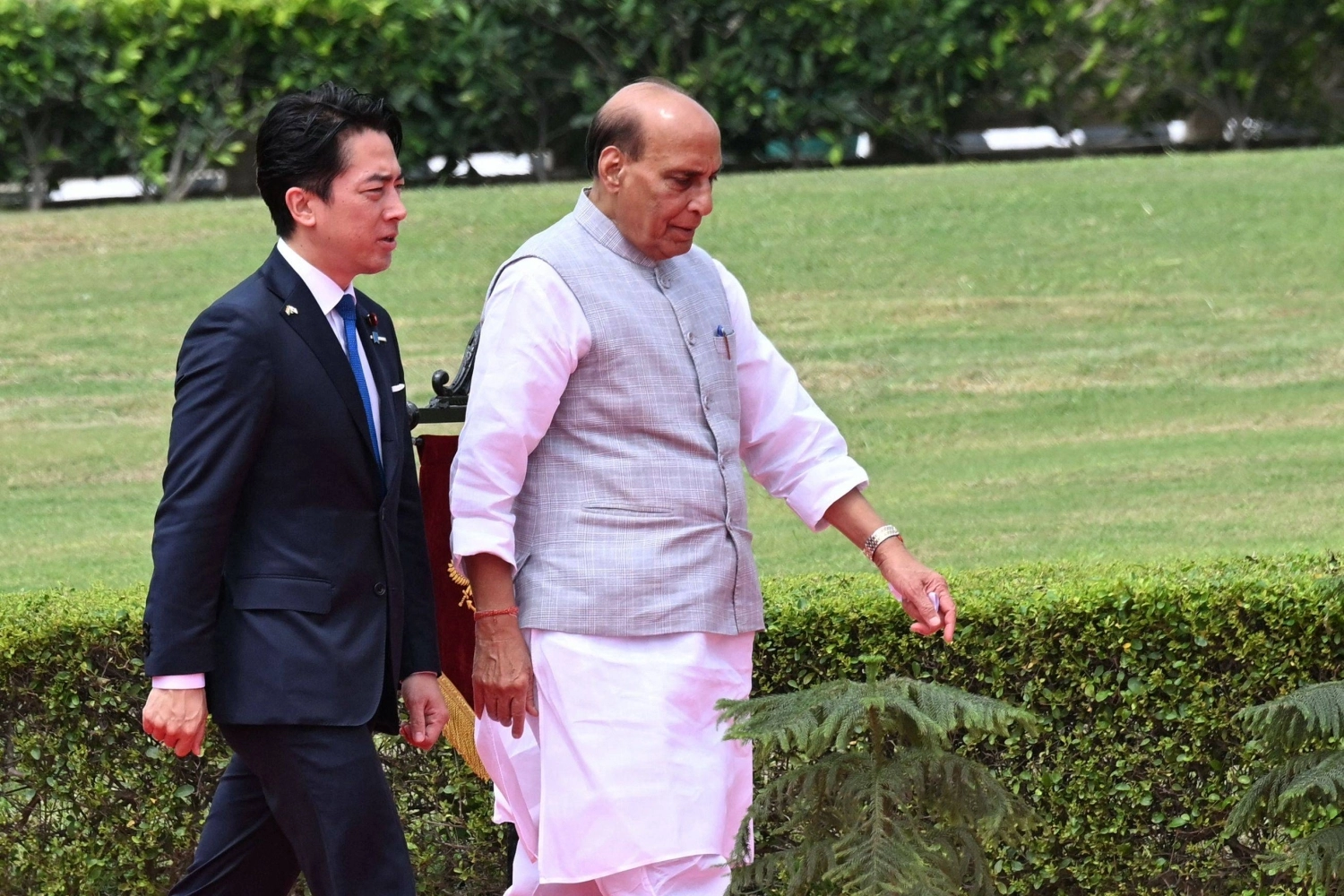
In late October, Indian Defence Minister Rajnath Singh and Japanese Defense Minister Shinjiro Koizumi met on the margins of the ASEAN Defence Ministers’ Meeting-Plus in Cebu. They welcomed progress on maritime security cooperation, mine countermeasures, possible joint development in naval shipbuilding and design, air-force cooperation following Japan’s first fighter-aircraft deployment to India for Veer Guardian 26, and a Japan-India Defence Industry Forum involving around 40 companies.
Taken together, these developments show a partnership becoming more concrete. Missile-range access would be perhaps the most operationally significant step yet because it would require trust not only at the ministerial level but among range operators, missile engineers, air-traffic authorities, intelligence officials, and frontline military units.
How India Benefits
For India, hosting Japanese missile and drone training would bring several advantages.
First, it would validate India’s test-range infrastructure as a regional asset. India has long sought to position itself as a defense-production and technology hub, not merely a buyer of foreign systems. Japanese use of Indian facilities would reinforce the credibility of India’s ranges, laboratories, and defense-industrial ecosystem.
Second, it would deepen India’s access to Japanese defense technology and industrial know-how. Japan brings strengths in precision manufacturing, sensors, naval systems, propulsion-related technologies, robotics, and unmanned systems. India brings scale, engineering talent, cost-effective production capacity, and an increasingly ambitious defense-export agenda. The two governments have already identified naval shipbuilding and design as a possible area for joint development, leveraging Japan’s technological expertise and India’s manufacturing base.
Third, closer operational exposure would improve interoperability. If Indian personnel observe or support Japanese long-range missile and drone training, they gain practical familiarity with Japanese tactics, command processes, safety culture, and technical standards. That kind of learning is difficult to obtain through speeches, joint statements, or occasional exercises.
Fourth, the arrangement would strengthen India’s strategic position. India does not need to choose between strategic autonomy and partnerships; it can deepen cooperation with Japan while retaining independent decision-making. Hosting Japanese forces for training would signal that India is a net security provider and a central Indo-Pacific power, not simply a regional balancer.
How Japan Benefits
For Japan, the benefits are equally substantial.
Japan’s 2022 national security documents marked a historic departure from its postwar restraint by authorizing counterstrike capabilities and expanded long-range stand-off missiles. The Type 25 is part of that transformation. But acquiring a weapon is not the same as mastering it. Japan needs realistic training to develop crews, test launch procedures, validate targeting and communications concepts, and understand how such systems perform under operational conditions.
Indian ranges offer space that Japan cannot easily replicate at home. They also provide a politically distinct environment from the United States, giving Japan a more diversified set of overseas training options. This is important at a time when Japan seeks to reduce overdependence on any single partner while strengthening a network of like-minded Indo-Pacific democracies.
The drone component is especially important. Small attack drones are relatively inexpensive, rapidly evolving, and operationally flexible. They can be used for reconnaissance, target designation, electronic warfare, loitering strike missions, and saturation attacks against ships or coastal defenses. Japan’s interest in testing such systems in India suggests that Tokyo is thinking beyond traditional missile ranges and toward the future battlespace: distributed sensors, autonomous systems, and long-range precision strike.
The China Factor, Without Saying It Aloud
Neither India nor Japan needs to name China as the sole reason for this cooperation; the strategic logic is evident. Both countries face a China that is modernizing its navy, expanding its missile forces, pressing territorial claims, and using gray-zone tactics in disputed waters. For Japan, the concern centers on the East China Sea, the Senkaku Islands, Taiwan contingencies, and the security of sea lanes. For India, the concerns include the Line of Actual Control, the Indian Ocean region, China-Pakistan military cooperation, and Beijing’s growing access to Indian Ocean ports and maritime infrastructure.
A Japan-India defense-technology and training partnership creates strategic depth. Japan’s long-range anti-ship missiles are relevant to maritime denial in the Western Pacific; India’s geography and test infrastructure offer reach across the Bay of Bengal and Indian Ocean. If the two countries can combine Japanese precision technology with Indian operational space and production capacity, they create a more resilient balance of power without requiring a formal alliance.
That said, it would be a mistake to frame the initiative purely as anti-China. Its deeper value is deterrent stability. A credible, well-trained, interoperable Japan-India defense relationship raises the cost of coercion and reduces the chance that Beijing or any other actor miscalculates the region’s balance of power.
The Obstacles Are Real
The proposal remains exploratory. No Indian site has been publicly selected, no timetable has been announced, and Japan has not confirmed which systems would participate in any future exercise.
Several hurdles must be cleared before a live-fire arrangement becomes feasible.
- Legal and political approvals: Japan’s use of Indian military facilities would require clear bilateral agreements covering jurisdiction, liability, personnel status, information protection, and escalation procedures.
- Technology-transfer sensitivities: Missiles, drones, targeting software, communications links, and telemetry data are highly sensitive. Both governments will need safeguards against leakage, cyber intrusion, and unauthorized access.
- Range safety and environmental impact: Long-range missile tests involve maritime safety zones, airspace restrictions, fishing-community concerns, ecological review, and emergency-response planning.
- Industrial and export controls: Japan’s revised equipment-transfer framework is a positive sign, but transferring or operating advanced systems abroad still involves complex export-control and end-use requirements.
- Domestic politics: Japan’s pacifist public opinion and India’s strategic-autonomy tradition both require careful political messaging. The arrangement should be presented as defensive training and capability development, not as preparation for offensive war.
The Road Ahead
The most important aspect of this story is not that Japan wants to fire a missile in India. It is that Japan appears willing to treat India as a place where its most advanced military capabilities can be developed, tested, and refined. That is a major act of strategic trust.
For decades, India-Japan defense cooperation has been broad but somewhat cautious. This proposal points toward something more mature: a partnership in which each country contributes what the other lacks. Japan contributes advanced technology, industrial precision, and a rapidly evolving missile and unmanned-systems program. India contributes strategic space, test infrastructure, production scale, and a central position between the Indian Ocean and the Indo-Pacific.
Both governments should pursue this cautiously but ambitiously. They should begin with non-live-fire integration trials, drone-range validation, command-and-control exercises, and technical exchanges. If those succeed, they can move toward limited live-fire trials under strict safety and data-protection protocols. A phased approach would build confidence without creating unnecessary political controversy.
They should also broaden the agenda beyond testing. India and Japan should establish a standing defense-technology innovation track focused on unmanned systems, maritime domain awareness, AI-enabled logistics, resilient communications, underwater sensors, and joint production of critical components. The reported India-Japan Defence Industry Forum, with roughly 40 companies participating, provides a useful foundation.
The larger lesson is that defense partnerships in the Indo-Pacific are becoming practical rather than ceremonial. Shared values still matter, but shared ranges, shared technology, shared production lines, and shared operational habits matter more. If Japan and India can turn this exploratory range proposal into a durable program, they will have created one of the most consequential defense-technology partnerships in Asia—one that strengthens deterrence, deepens trust, and helps preserve a free and open Indo-Pacific.