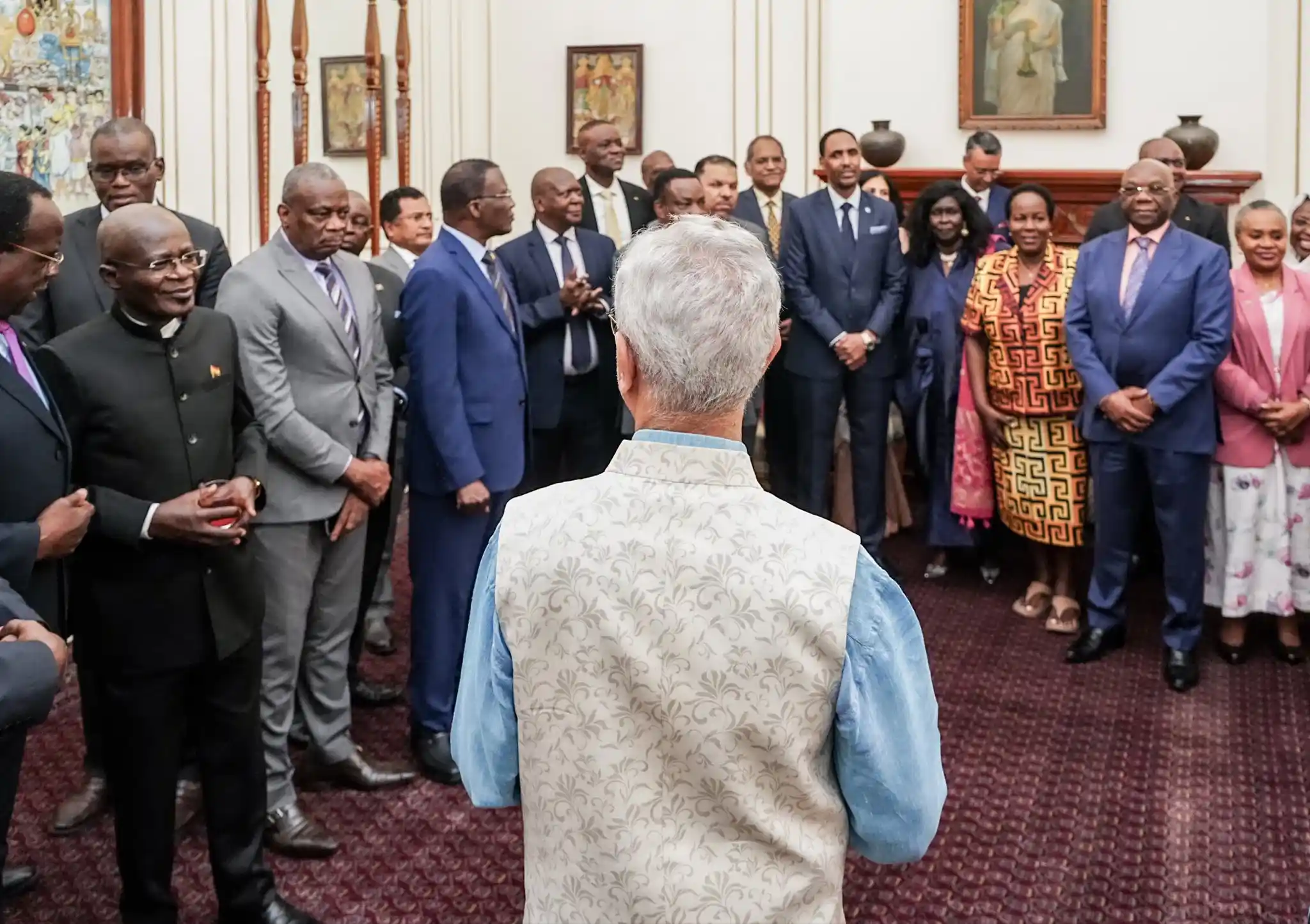
When Ghana’s President John Mahama met External Affairs Minister S. Jaishankar in Accra on 6 October, he sought for more than goodwill. He wanted Indian investment in pharmaceuticals and vaccine production to build Ghana’s own manufacturing capacity. That request captures the purpose of Jaishankar’s visit to Ghana, Côte d’Ivoire and Ethiopia from 6 to 10 October. Each country plays a distinct role for India. Ghana is a potential production base in West Africa, Côte d’Ivoire an entry point into Francophone markets, and Ethiopia a gateway to the Horn of Africa and the African Union. The real significance lies in a shift in India’s approach, from a general continental template to differentiated partnerships built around the needs of individual countries.
For two decades, India engaged Africa through continental instruments such as the India-Africa Forum Summits, lines of credit and ITEC training. Prime Minister Modi’s 2018 ten guiding principles promised partnership on Africa’s terms. Delivery, however, often lagged, and many credit-funded projects ran years behind schedule. On paper, the agendas in all three capitals this time looked similar: trade, pharmaceuticals, defence and digital technology. The difference lies in what each country can offer India.
Ghana serves as the first gateway, linking Indian investment with production in West Africa. Indian firms already operate there in pharmaceuticals, manufacturing, agriculture and construction, and Ghana’s 24-Hour Economy programme aims to expand domestic output and jobs. Building on the momentum from Modi’s visit last year, the talks covered pharmaceuticals, healthcare, mining, defence, railways and digital technologies.
The logic works for both sides. Local manufacturing would reduce Ghana’s reliance on imported medicine and strengthen its health resilience, while Indian firms would gain a base from which to serve the wider region. The aim is not just to sell more to Ghana but to help it produce more.
Yet this is where India’s reputation is most exposed. In 2022, the WHO linked Indian-made cough syrups may be linked to the deaths of 66 children in The Gambia. In 2025, a BBC investigation found an Indian firm illegally exporting addictive opioids to Ghana, Nigeria and Côte d’Ivoire, which prompted action by Ghana’s Food and Drugs Authority. India’s pharmaceutical investment must therefore strengthen Ghanaian regulators, not just build factories. Ghana’s finances are a further constraint. The country defaulted on most of its external debt in 2022 and remains under an IMF programme.
Côte d’Ivoire takes on the role of a different gateway. As the largest economy in the West African Economic and Monetary Union, it offers Indian firms a route into Francophone markets. Bilateral trade reached about US$1.54 billion in 2024–25, but its composition is lopsided. India imports cashew, rubber, cotton and timber, and exports rice, vehicle parts and medicines. Raw commodities go out and finished goods come in. Indian investment in food processing, pharmaceuticals, logistics and digital services could let Côte d’Ivoire capture more of that value locally. Jaishankar stressed that cooperation would follow Côte d’Ivoire’s own priorities.
The visit also had a security dimension, with talks on defence and counter-terrorism cooperation, including training and capacity building. As jihadist violence spreads from the Sahel towards the coastal states, that agenda may matter as much as trade.
Ethiopia serves as the third and most institutional gateway. Addis Ababa hosts the African Union, and it was India that proposed the AU’s permanent G20 membership in 2023. Jaishankar’s talks with Foreign Minister Gedion Timothewos covered trade, investment, digitalisation and the India-AU partnership. He also chaired India’s regional heads of mission conference in the city, underlining its role in India’s regional diplomacy.
India’s footprint in Ethiopia is already large. Modi’s December 2025 visit elevated ties to a Strategic Partnership, and India said its companies had invested over US$5 billion there, creating more than 75,000 jobs. Yet similar figures, for investment, were cited in 2021, which suggests the footprint may have plateaued.
Ethiopia also carries the highest risks. It defaulted on its US$1 billion Eurobond in 2023 and floated its currency under an IMF programme in 2024, and foreign-exchange shortages persist. As a landlocked country dependent on Djibouti’s ports, its value as a gateway to the Horn rests on regional corridors staying open.
The three gateways only form a strategy if they connect. Pharmaceutical plants in Ghana could serve West Africa, processing in Côte d’Ivoire could reach Francophone markets, and manufacturing in Ethiopia could anchor India in the Horn. The African Continental Free Trade Area and regional blocs such as ECOWAS offer the mechanism. If Indian investments are integrated into regional value chains, they become part of Africa’s economy; if not, they remain isolated projects.
Seen together, the three stops expose something India rarely admits about its Africa policy: the problem has seldom been a lack of vision. The 2018 principles were sound, and the lines of credit looked generous on paper. What has repeatedly failed is follow-through. That depends less on ministerial visits and more on whether Indian banks, insurers and mid-sized firms are willing to take risks in markets they still regard as unfamiliar. A differentiated approach is also harder to run than a continental one. It needs country specialists, quicker project approvals, and missions with enough staff to track what was promised. Many Indian missions in Africa still work with small teams. Unless that capacity grows, the gateway idea risks becoming another well-framed slogan.
India also faces competition. China has been Africa’s largest trading partner since 2009, while India ranks fourth. Turkey, the Gulf states, EU and other major players are chasing the same opportunities. India cannot match China’s financing, but it offers affordable generics, digital public infrastructure, ITEC training and fewer of the debt concerns attached to large-scale Chinese lending. But these advantages only count if they are visible on the ground. Chinese projects are often finished quickly and loudly publicised, while India’s tend to arrive late and quietly. In a crowded field, being the cheaper or less risky partner is not enough. India also has to be the partner that delivers on time.
Therefore, the visit should not be judged by the number of agreements signed, and indeed no major agreements were announced. What matters is whether these relationships build capabilities that stay in Africa. That means factories rather than distribution centres, local processing rather than raw exports, skills rather than just jobs, and regional supply chains rather than bilateral trade alone. The tour’s logic was not simply to expand India’s presence from Accra to Abidjan and Addis Ababa. It was to test whether India can move from development assistance to partnership in production. That shift has been promised before. This time, it will be judged by what actually gets built.