Just days after New Delhi successfully concluded the 18th BRICS Summit- a high-stakes diplomatic convening of 32 international delegations where India demonstrated its ability to forge global consensus amid intense geopolitical polarisation, External Affairs Minister Dr. S. Jaishankar landed in the serene Himalayan valleys of Bhutan.
The sequencing of this visit sent a distinct and unambiguous strategic signal: while India continues to shape global agendas and champion the Global South on premier multilateral platforms, its immediate neighbourhood remains the primary anchor of its foreign policy. In diplomacy, grand declarations at global summits carry weight, but true regional leadership is measured by dependable, responsive, and ground-level execution in the neighbourhood.
Jaishankar’s official visit to Bhutan from September 16 to 18 reaffirmed this tenet. From the spiritual and cultural valleys of Bumthang to the remote northern glaciers of Gasa and the eastern dzongkhags of Mongar and Samdrup Jongkhar, the visit showcased a development partnership that has evolved far beyond traditional diplomacy into a living model of mutual trust and high-impact cooperation.
Advancing Multifaceted Engagement in Bumthang
The journey began in Bumthang, Bhutan’s historical and spiritual heartland, where Dr. Jaishankar met his Bhutanese counterpart, Foreign Affairs and External Trade Minister Lyonpo D.N. Dhungyel. Their bilateral review spanned development partnerships, clean energy, cross-border trade, multimodal connectivity, digital cooperation, and deep cultural linkages.
The EAM’s walk through the restored historic Wangduechhoeling Palace and his prayers at the sacred Kurjey Lhakhang underscored the unique civilisational bedrock supporting bilateral ties. It reflected New Delhi’s respect for Bhutanese heritage and the institution of the monarchy, which continues to guide the kingdom’s modern development trajectory.
Quiet, Practical ‘Neighbourhood First’: 43 Jersey Cows in Bumthang
While foreign ministry visits are often associated with high-level delegations, one of the most consequential handovers in Bumthang was quite rejuvenating: 43 pureline Jersey cows handed over at the National Cattle Breeding Centre.
This gesture captures the true essence of India’s Neighbourhood First policy: quiet and practical designed to directly impact household livelihoods. By infusing high-yield genetic breeding stock that will benefit an estimated 40,000 Bhutanese farmers, India demonstrated that bilateral friendship is not merely negotiated in capital secretariats, but delivered to grassroots communities where daily welfare matters most.
Powering the Last Mile: 500 kW Lunana Hydropower Project
Indo-Bhutanese energy cooperation has long been defined by mega-projects like Chukha, Tala, Kurichhu, and the newly commissioned 1,020 MW Punatsangchhu-II. Yet, in Bumthang, Dr. Jaishankar and Lyonpo Dhungyel jointly laid the foundation stone for a project of a very different scale: the 500 kW Lunana Hydropower Project in northern Gasa.
Perched in one of Bhutan’s most rugged, high-altitude glaciated zones, Lunana represents the last un-electrified frontier of the country. Powering Lunana is an example of smart borderland diplomacy. By looking past immediate commercial returns and underwriting an expensive, technically challenging project in Bhutan’s most isolated Himalayan district, India reinforces its position as an all-weather partner. It provides tangible grassroots benefits to highland communities while subtly bolstering civilian and territorial resilience along a sensitive frontier.
Balancing Regional Growth: 65-Bed Hospital in Mongar
Economic development and advanced public health infrastructure in Bhutan have concentrated in western urban hubs like Thimphu and Paro. The inauguration of the 65-bedded Gyaltsuen Jetsun Pema Mother and Child Hospital in Mongar directly addresses this regional disparity.
India is helping create ground-based social infrastructure that saves lives, spares rural mothers cross-country journeys for emergency care, and strengthens Bhutan’s eastern districts. It reflects an Indian assistance model that listens to the Royal Government’s decentralisation priorities rather than imposing top-down agendas.
Arterial Connectivity: Jaganathan Bridge and Project DANTAK
Since connectivity remains the bedrock of regional commerce and physical resilience, the two ministers inaugurated the 80-metre-long Jaganathan Bridge in Samdrup Jongkhar, constructed by the Border Roads Organisation’s Project DANTAK. Named in honour of Colonel T.V. Jaganathan, DANTAK’s pioneering first Chief Engineer who helped carve Bhutan’s modern road network in the 1960s, the structure reinforces an engineering brotherhood that has endured for more than six decades
The bridge strengthens all-weather connectivity across Trashigang, Trashi Yangtse, Mongar, and Pemagatshel. This drastically reduces transit times for emergency medical evacuations to regional healthcare facilities, including the newly opened Mother and Child Hospital in Mongar. Further, the bridge ensures frictionless movement of agricultural cash crops such as potatoes, ginger, and citrus fruits heading south into Northeast India.
The project further complements India’s wider cross-border infrastructure initiatives, including planned rail connections and upgraded trade terminals along the frontier.
Green Transit: 54 ‘Made in India’ EVs and Clean Mobility
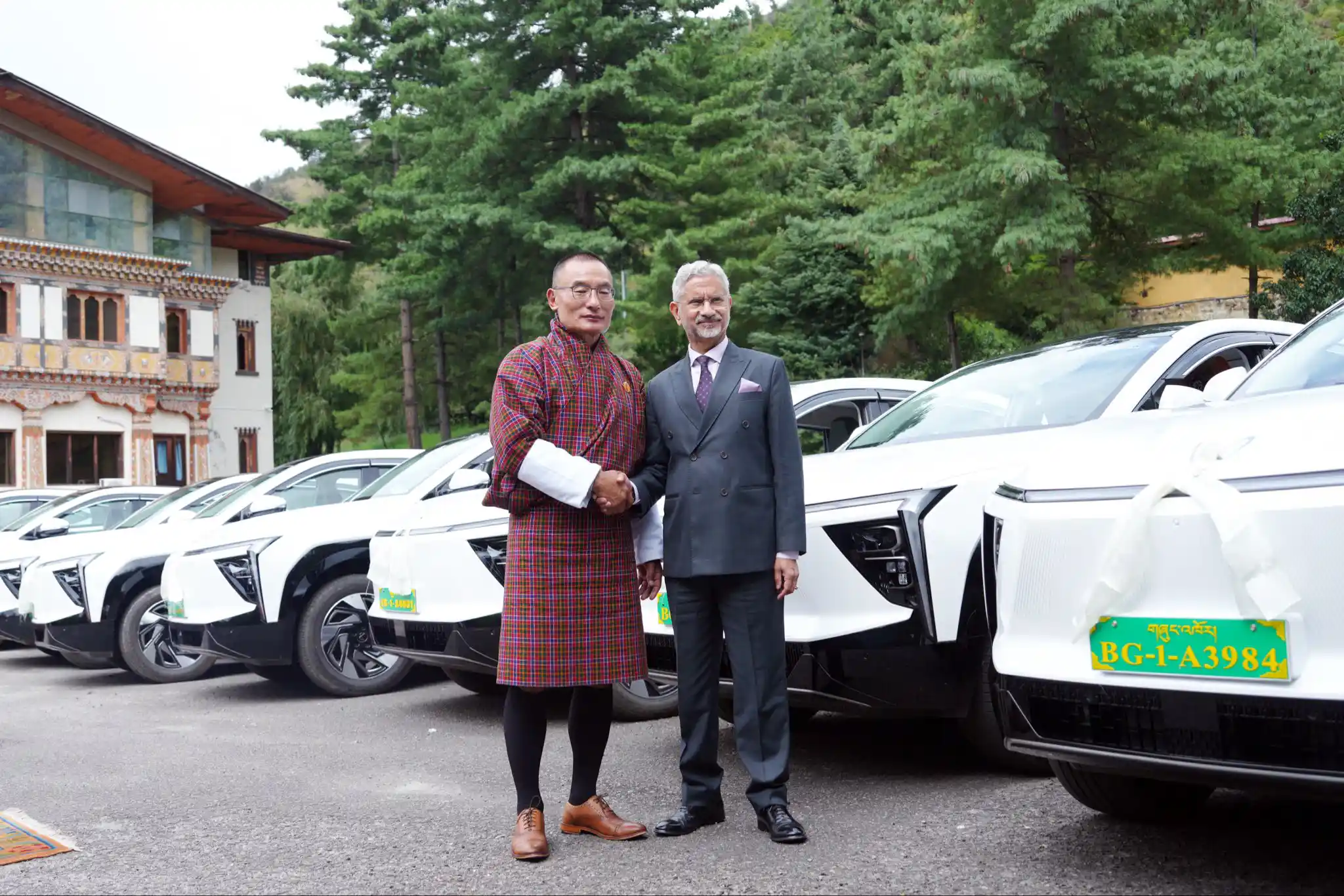
Transitioning to sustainable urban transport is a key priority under Bhutan’s 13th Five-Year Plan (2024–2029), backed by India’s ₹10,000 crore commitment. In Thimphu, Dr. Jaishankar handed over 54 ‘Made in India’ Mahindra electric vehicles to Prime Minister Dasho Tshering Tobgay under the Project Tied Assistance (PTA) framework.
This move holds both ecological and geopolitical significance. While Bhutan seeks to preserve its carbon-negative status, regional vehicle markets have witnessed an aggressive push of Chinese electric vehicles. By supplying dependable, rugged Indian-manufactured EVs tailored to mountain topography, with trials already underway for a forthcoming fleet of 45 electric buses; New Delhi is positioning itself as Bhutan’s preferred green-technology partner linking Indian manufacturing capabilities, battery supply chains, and charging standards directly with Bhutan’s clean energy grid.
Digital Leap: UPI Phase-II for Cross-Border Financial Ease
Fintech cooperation between the two neighbours marked another milestone with the joint launch of Phase-II of the unified digital payments system (UPI). While Phase-I enabled Indian tourists to make seamless digital payments across Bhutanese merchant outlets, Phase-II closes the loop. Bhutanese citizens travelling to India will now make direct QR-code and mobile payments using their domestic banking apps. For thousands of Bhutanese pilgrims, students, patients, traders, and tourists visiting Indian cities, this eliminates currency exchange hurdles and sets a benchmark for cross-border financial integration in South Asia.
Pleased to welcome H.E.@DrSJaishankar, External Affairs Minister of India today in Thimphu.
— Tshering Tobgay (@tsheringtobgay) September 17, 2026
We discussed matters of mutual interest reflecting on the longstanding ties between our two nations. We also launched the Phase II of the Unified Payment Interface (UPI) later in the day. pic.twitter.com/BwSiQE0Fy7
Nurturing Talent: Nehru-Wangchuck Scholarship Scheme Renewal
India and Bhutan exchanged a Memorandum of Understanding for the third renewal and extension of the prestigious Nehru-Wangchuck Scholarship Scheme. This aspect recognised human capital as the foundation of long-term national resilience.
In an era where technological capability, artificial intelligence, and governance modernisation dictate economic success, India’s sustained investment in Bhutanese educational capacity building ensures that bilateral friendship is actively renewed across every new generation. However, there is an urgent need to curb Bhutan’s youth out-migration.
The Road Ahead: Unfinished Agendas and the Need for a 2.0 Paradigm
While the recent project launches underscore exemplary bilateral goodwill, an enduring partnership has to move beyond infrastructure models. Navigating the coming decades with equal vitality, development assistance must proactively pivot toward critical, under-addressed frontiers of Bhutan:
- Arresting Youth Flight through High-Value Employment: With over 9% of Bhutan’s population having migrated abroad in search of careers in Australia and the West, the traditional formula of capital-intensive mega-hydropower needs a parallel human centred project. India must transition to co-creating white-collar employment that can absorb the English-speaking Bhutanese youth.
- Mobilising Private Capital for Gelephu Mindfulness City (GMC): His Majesty King Jigme Khesar Namgyel Wangchuck’s 2,600 sq km Special Administrative Region along the Assam frontier represents Bhutan’s primary economic vehicle for modern survival. While New Delhi has extended diplomatic and sovereign backing, the initiative urgently requires Indian private conglomerates to step in as anchor tenants in green finance, digital healthcare, data centres, and artificial intelligence.
- Accelerating Multi-Modal Freight Corridors: There is a need to fast-track the physical execution of the cross-border Kokrajhar-Gelephu and Banarhat-Samtse rail corridors, to permanently reduce transit costs for Bhutan’s landlocked economy.
A Strategic Model for South Asia
In a holistic perspective, New Delhi does not view global summitry and neighbourhood diplomacy as competing priorities; rather, its credibility as a leading voice of the Global South is built upon the genuine success of its regional partnerships.
Moreover, India’s relations with Bhutan demonstrates a global stature that rests on its ability to build stable, prosperous, and mutually trusting partnerships on unconditional, demand-driven policies. It is time to evolve from a traditional donor-recipient dynamic into a co-investment regional partnership with Bhutan.