
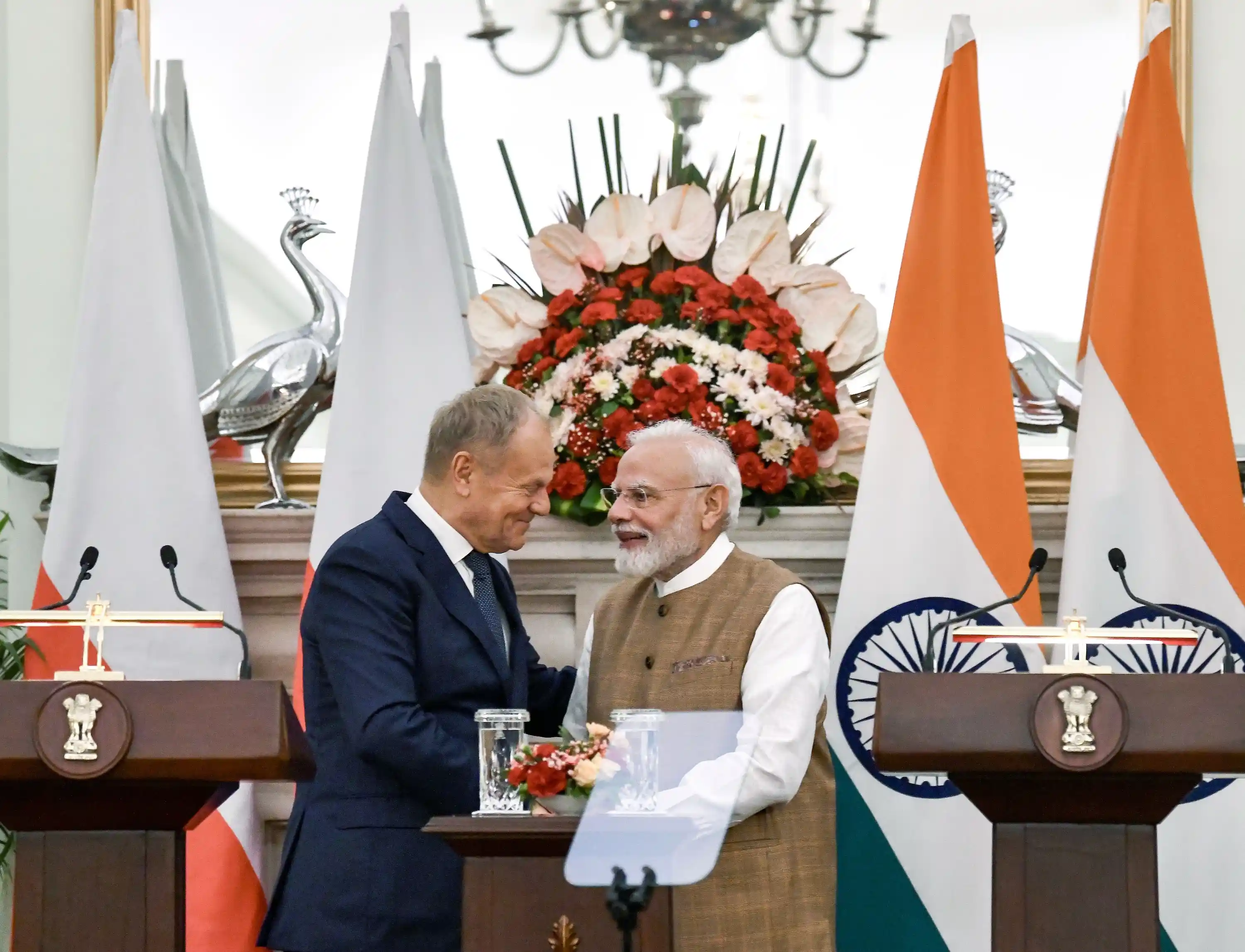
An old Polish proverb holds that “harmony builds; discord destroys.” The recent visit of Prime Minister Donald Tusk to India—the first by a Polish leader in 16 years—tested whether long-standing political harmony can finally generate commercial substance. Building on the 2024 elevation of ties to a Strategic Partnership during Prime Minister Narendra Modi’s visit to Warsaw, the two sides set an explicit target of doubling bilateral trade by 2030 from roughly $6.3–6.4 billion. More importantly, they identified drones and unmanned systems, critical minerals, and industrial co-production as pathways to move beyond traditional goods.
The current trade base is modest relative to the size of both economies. India has recorded a consistent merchandise surplus, with exports of pharmaceuticals, textiles, chemicals, engineering goods and electrical machinery reaching about $4.8 billion in 2025 against Polish exports of machinery, metals and industrial inputs around $1.5 billion. Indian firms already hold an estimated $3 billion in investments in Poland, including major IT and manufacturing players. Poland’s GDP has crossed $1 trillion amid robust growth, while India remains the world’s fastest-growing large economy. The recently concluded India-EU free trade agreement, expected to enter force after formal signing and ratification, liberalises the vast majority of tariff lines on both sides. For Indian exporters this removes duties of 9–12 per cent on textiles and apparel into a Polish market that imports tens of billions in such goods annually; for Polish suppliers it improves access for industrial machinery and specialised equipment into India’s expanding manufacturing base. Doubling trade is therefore arithmetic rather than aspirational if both sides exploit the FTA and move into higher-value segments.
Defence technology offers the clearest near-term illustration. Polish unmanned systems from the WB Group—particularly FlyEye reconnaissance drones and Warmate loitering munitions—were employed by Indian forces during Operation Sindoor in 2025. These platforms have also accumulated extensive operational data in Ukraine since 2014, giving them combat-proven pedigree that few competitors match. Tusk explicitly noted their utility. The two governments have now established a Defence Industry Dialogue aimed at co-development and co-production rather than pure off-the-shelf sales. WB Group has signalled plans to invest approximately $100 million over five years through its Indian joint venture to establish manufacturing and R&D capacity in the Uttar Pradesh Defence Industrial Corridor, with initial technology transfer percentages that can rise over time. Poland spends close to 5 per cent of GDP on defence and is expanding its industrial base; India is simultaneously raising specialised drone regiments and pursuing import substitution under Make in India. The alignment is practical: Poland supplies battle-tested designs and electronic warfare experience, while India offers scale, engineering talent and a large domestic requirement that can underwrite production lines capable of serving third markets as well.
Critical minerals form the third pillar. Both countries face structural exposure to concentrated Chinese processing of rare earths, battery materials and related inputs. India is import-dependent for lithium, cobalt, nickel and permanent magnets; Poland possesses established strengths in copper, silver, rhenium, coking coal and mining technology, and has recently approved a multi-year exploration programme for additional critical raw materials. During the visit the leaders flagged cooperation on geology, mining, battery recycling and rare-earth refining, with a memorandum of understanding under negotiation. Polish expertise in coal gasification and circular-economy recovery of minerals complements India’s dual goals of energy-transition materials security and reduced import reliance. An India-EU framework already encourages resilient supply chains; bilateral projects can operationalise that ambition at a manageable scale.
The opportunity is real, yet not automatic. Trade imbalances will persist unless Polish firms expand manufacturing footprints or joint ventures in India. Differing threat perceptions—Poland’s frontline NATO position versus India’s long-standing defence relationship with Russia—require careful management of classified information exchanges and technology-transfer rules. Bureaucratic timelines for defence procurement and mining clearances remain long on both sides. The Defence Industry Dialogue and the pending minerals MoU will matter only if they generate a short list of named industrial partners, defined projects and procurement pathways within the next 12–18 months.
Tusk’s visit, accompanied by roughly 100 business leaders and yielding private-sector agreements in space, railways, mining and related fields, deliberately emphasised specifics over spectacle. The political goodwill exists; the commercial architecture is now sketched. Realising gains in drones, trade and critical minerals will depend on private enterprise converting those sketches into production lines, joint ventures and supply contracts. If that occurs, India and Poland will have demonstrated that complementary strengths—combat-tested technology and industrial depth on one side, scale and growing demand on the other—can turn a strategic partnership into measurable economic and security returns.

