
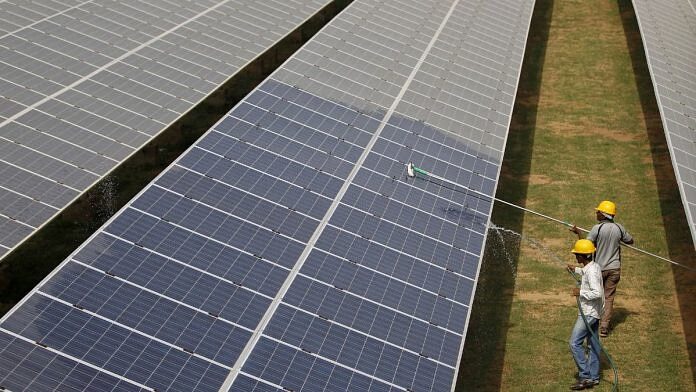
In a historic leap toward its clean energy ambitions, India has overtaken Japan to become the world’s third-largest producer of solar power. According to the International Renewable Energy Agency (IRENA), India generated 1,08,494 gigawatt-hours (GWh) of solar energy in 2025, outpacing Japan’s 96,459 GWh. The milestone cements India’s position as a global renewable energy leader, with solar energy forming a core pillar of its transition toward a net-zero future.
A Decade of Transformation
Just ten years ago, solar installations in India were modest, with panels limited to select rooftops and desert projects. Today, the nation boasts a total solar capacity of 119.02 gigawatts (GW), sourced from large ground-mounted plants, grid-connected rooftops, hybrid projects, and off-grid installations. This rapid growth has propelled India to achieve one of its key COP26 commitments — 50% of its installed electricity capacity from non-fossil sources — five years ahead of the 2030 target.
Prime Minister Narendra Modi hailed the achievement as a testament to India’s commitment to sustainability, calling the country “the best destination for investment and innovation in renewable energy.”
Policies Powering Progress
The government’s aggressive policy framework has been instrumental in driving this transformation. Flagship initiatives such as the PM Surya Ghar Muft Bijli Yojana offer generous subsidies for rooftop solar, while the PM-KUSUM scheme enables farmers to switch from diesel pumps to solar-powered systems. Large-scale solar parks, like those under the Ultra Mega Solar Power Projects program, are adding gigawatts of clean capacity, while targeted efforts are bringing electricity to remote tribal communities through solar electrification.
On the manufacturing front, India’s solar module production capacity nearly doubled from 38 GW to 74 GW in just one year, supported by tariffs on imports to boost domestic manufacturing. The launch of the country’s first ingot-wafer plant has further strengthened the solar supply chain.
Beyond Solar: An Integrated Renewable Push
India’s clean energy surge isn’t confined to solar. Wind energy capacity now stands at over 51 GW, with ambitious offshore wind projects on the horizon. Bioenergy, small hydro, and a growing ethanol blending program are further diversifying the renewable mix. Meanwhile, the National Green Hydrogen Mission aims to make India a global leader in hydrogen production, targeting 5 million tonnes annually by 2030.
Global Leadership and Future Goals
Internationally, India co-leads the International Solar Alliance with France and spearheads the “One Sun, One World, One Grid” initiative to connect solar resources across continents. Domestically, it remains on track to reach 500 GW of non-fossil capacity by 2030 and achieve net-zero emissions by 2070.
With record renewable additions of 29.52 GW in the past year alone, India’s energy transition is now not only an environmental necessity but also a driver of economic growth, job creation, and technological innovation.
As the country accelerates its green journey, the message is clear: India’s energy future will be cleaner, more secure, and globally influential.

