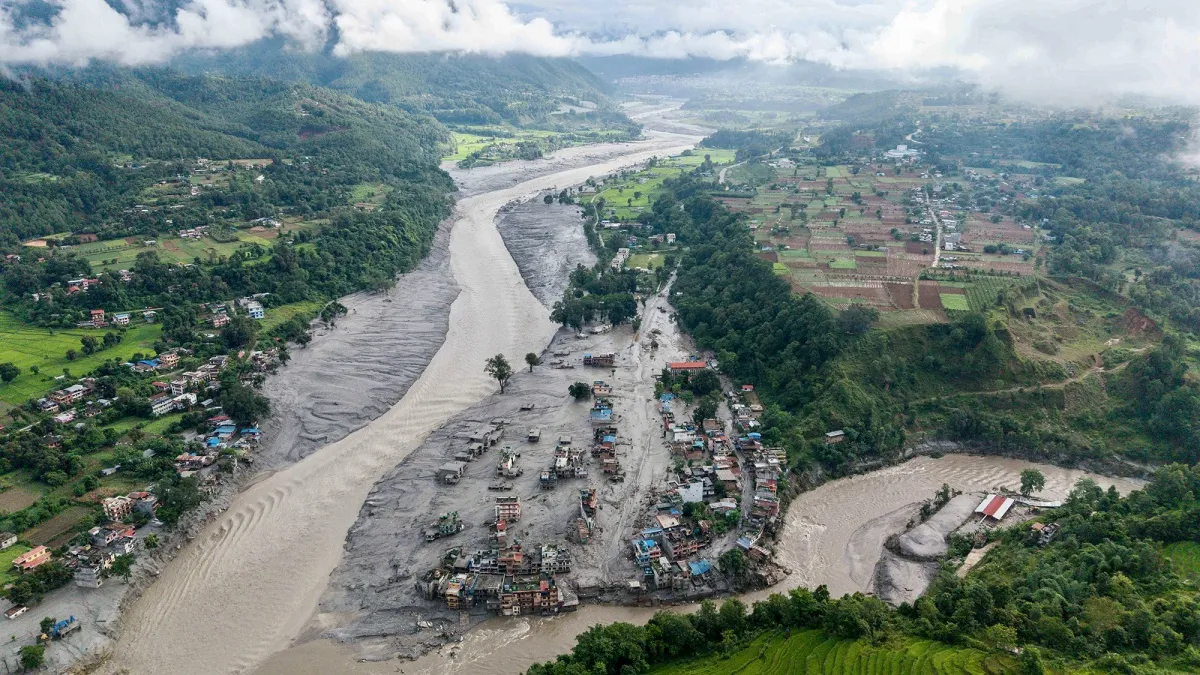
Nepal, a landlocked Himalayan nation and home to eight of the world’s 14 highest peaks, including Mount Everest, is facing a humanitarian crisis of alarming proportions. Beyond this devastation caused by glacier-linked flash floods lie many unsettling questions—most importantly, how long can the Himalayas withstand a rapidly changing climate and cope with relentless human activity and development?
Catastrophic floods, collapsing glaciers, vulnerable mountain settlements, and shrinking livelihood opportunities reveal a long and difficult struggle against a distant but increasingly escalating environmental threat.
At the heart of this crisis is a pressing debate over how long Nepal and the wider Himalayan region can withstand the mounting ecological pressures. The mountain communities are raising an important question of climate justice and asking the world, “How long can they continue to bear the consequences, to which they have contributed so little?”
After the August 26 glacial-collapse-triggered floods along the Nepal–Tibet border, data released so far suggest that more than 1,300 people have died and thousands remain missing. Rescue teams continue searching debris and tunnels.
More evidence has come into the public domain about the August 26 disaster, which was primarily caused by a glacial/ice-rock collapse and debris flow. It was alleged that a Chinese dam, in the higher mountains, caused the flash floods by deliberate release of water without prior warning. Many experts in Nepal and other countries have ruled out the possibility.
Says Anand Sharma, a noted meteorologist and expert on mountain disasters: “The nature and pattern of the disaster clearly show that the entire Himalayan region is extremely vulnerable to ice-avalanche-induced disasters. However, it would be incorrect to blame climate change as the sole reason.”
According to Sharma, overdevelopment, unplanned construction, deforestation, and increasing human activity in fragile mountain areas are factors aggravating the risks. Climate change may be altering weather patterns and increasing the vulnerability of these regions, but countries and states need to look at the larger picture and understand how natural processes and human interventions together are contributing to the growing hazard risks, he feels.
Thus, currently, it is not Nepal alone. Rather, this is a warning for the entire Himalayan region, from Ladakh and Jammu and Kashmir through Himachal Pradesh and Uttarakhand to Nepal and Bhutan, to see the writing on the wall and develop strategies to deal with the threat and start measures to minimize the disruptions.
Nepal Prime Minister Balendra Shah says the devastating floods in the Himalayas are a serious warning of the growing risks from climate change. “Nepal contributes very little to global emissions but is facing increasingly severe floods, glacier-related disasters, and other climate impacts,” and called for global responsibility, stronger international cooperation, and urgent climate action.
The statement assumes significance ahead of his upcoming visit to the US, where he will address the 81st session of the UN General Assembly in New York on September 24, where he is expected to highlight the country’s growing vulnerability to climate change. Reports say Shah will seek compensation from the international community for the devastation caused by the August 26 flash floods resulting in large-scale deaths and massive displacement of the population across six districts.
In what will be his first foreign trip since assuming office on March 27, the Prime Minister will lead the Nepali delegation to the UNGA. The Nepal government is said to be preparing a detailed position on what Nepal has gone through and its long-term impact on the country.
A senior Nepal-based journalist told India Narrative that the Prime Minister’s Office has been asked to hold consultations with scientists and experts within the country and abroad, including India, to prepare a comprehensive report and also an action plan. The Foreign Ministry is also coordinating preparations for the high-level visit.
The Nepal delegation will also include Foreign Minister Shisir Khanal.
The larger focus of Shah’s address will be on climate change as a warning signal for the Himalayas and will emphasis on climate justice, an issue that has been addressed despite persistent debates and high-level global conferences.
Nepal also wants the international community to understand the dangers posed by the frequent climate-induced disasters, but the focus should also move beyond conventional humanitarian aid. It is all about compensation for climate-related losses.
After the devastating floods, Nepal’s Foreign Minister Shisir Khanal has called for climate justice, pointing to major greenhouse gas emitters such as China, the US, and India and arguing that countries like Nepal, which contribute very little to global emissions, are bearing a disproportionate share of the damage.
“We are shifting our diplomatic framework from aid to justice and compensation,” Khanal said in an interview to a TV channel, terming the disaster as a “Himalayan Tsunami.”
He admits that its implications extend beyond Nepal because Himalayan glaciers and river systems sustain communities across South Asia.
Scientists across the world are vociferously arguing for scientific studies to establish the precise trigger of the disaster and determine the extent to which human-induced climate change contributed to the specific event.
Reports in Nepali newspapers and some digital platforms say Nepal has been raising the issue of the country’s ecological survival and climate justice for several decades. In 1967, King Mahendra also spoke about this at the UN platform. Even former Prime Minister Prachanda is reported to have raised the issue of climate compensation at the UN. But now, after the flash floods, the Nepal prime minister has a strong case to seek climate justice.
Some experts on Himalayan disasters also point out China’s massive construction activity and infrastructure building, like roads, hydropower projects, and hi-tech bridges in the fragile Himalayas, as a matter of serious concern. The Tibet region has particularly become a hub of infrastructure activities, they say.
Even Nepal complained that it had received insufficient real-time hydrological and glacier-risk information from China, making cross-border disaster preparedness difficult. The strategic geography, especially the Gyirong–Rasuwa border corridor linking Nepal with Tibet, serving as a trade and pilgrimage route, has suffered immensely.
Anand Sharma, an Indian expert, also makes a strong point that there is a complete lack of a trans-border coordination mechanism in place, and it is high time that the countries should start working on it.
The disaster certainly strengthens Nepal’s case for a formal China-Nepal mechanism for glacier monitoring, hydrological data sharing, and advanced flood warnings.