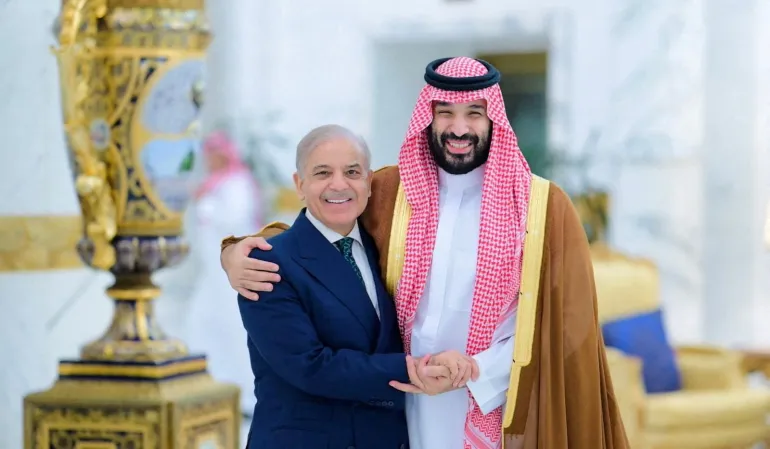
On 4 November Pakistan’s finance minister confirmed that Saudi Arabia had rolled over, for an unstated period, the $3 billion deposit that matured on 31 October (Arab News 2026b). The next day Turkey’s parliament ratified the Makkah defence pact linking Riyadh, Islamabad and Ankara (The New Arab 2026). In April the United Arab Emirates had demanded immediate repayment of $3.45 billion (Arab News 2026a). Same borrower, same IMF programme, opposite decisions.
This article argues that Saudi deposits are better read as a strategic retainer than as lending: Riyadh buys security services and diplomatic alignment with money whose maturity is a political variable. It tests that claim against rival explanations and other creditors’ conduct. Pakistan has used the breathing space to stabilise an economy it has not transformed.
From Abu Dhabi to Riyadh
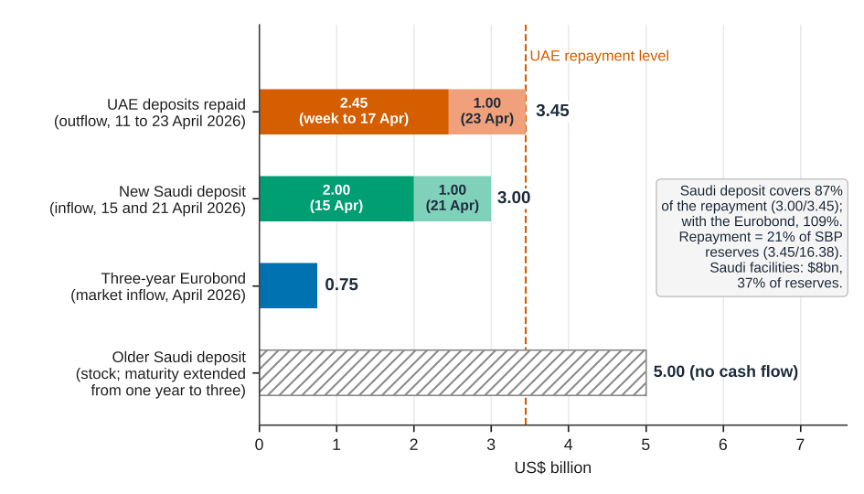
After years of annual rollovers, Abu Dhabi called its deposits in. State Bank of Pakistan (SBP) reserves stood at $16.38 billion on 27 March (Aaj News 2026a), so repayment meant surrendering 21% of them (3.45/16.38). Unreplaced, it would have cut reserves to about $12.9 billion, below June 2025’s $14.5 billion (IMF 2026, 30).
Riyadh supplied $2 billion on 15 April and $1 billion six days later, covering 87% of the repayment (3.0/3.45; Arab News 2026a). The IMF adds that a $750 million Eurobond completed the financing, and that an older $5 billion Saudi deposit was stretched from one year to three (IMF 2026, 23). The two facilities total $8 billion, 37% of SBP reserves of $21.5 billion (Chart 1; Aaj News 2026).
Chart 1. The April 2026 financing sequence: UAE repayment, new Saudi deposit, Eurobond and Saudi maturity extension
Why Riyadh keeps paying
Four explanations compete (Table 1). Defensive risk management explains the rollovers of the older $5 billion but not new money; yield-seeking fails on price; sentiment cannot explain Abu Dhabi’s withdrawal. What remains is a security quid pro quo, with maturity as leverage: the older $5 billion is locked until December 2028, the newer $3 billion renewed again for a shorter period, sources say (Express Tribune 2026).
Table 1. Four explanations for Saudi support, tested against the evidence
| Explanation | Test applied | Evidence | Verdict |
| Defensive risk management | Does protecting an existing $5bn claim explain the pattern? | Explains rollovers of the older deposit, but not the $3.0bn of new money added as Abu Dhabi withdrew. | Partial |
| Yield seeking | Are pricing and maturities commercial? | Reported cost about 4% on earlier facilities against 7.5% and 7.9% on September Eurobonds; older deposit extended to December 2028. | Rejected |
| Sentiment and solidarity | Does it explain Gulf creditors alike? | Abu Dhabi, historically close, recalled $3.45bn after years of rollovers. | Insufficient |
| Strategic retainer | Is there a reciprocal security deliverable, and leverage over timing? | About 8,000 troops, a fighter squadron and air defence deployed; pact activated 5 October; newer $3.0bn kept on short renewals. Limits: 2015 Yemen refusal; no nuclear pledge announced. | Best supported, with limits |
Sources: Arab News 2026a; Express Tribune 2025, 2026b; Reuters 2026a, 2026b; Pakistan MOFA 2026; Rahman and Sakib 2026; IMF 2026, 23. Notes: Saudi pricing is reported, not officially published. Verdicts are the author’s assessment.
The quid pro quo is physical. Pakistani personnel have served in the kingdom since 1967 (Al Jazeera 2025); in 2026 about 8,000 troops, a fighter squadron and air defence followed (Reuters 2026a). On 5 October, amid Houthi attacks, Saudi Arabia, Pakistan and Turkey moved to rapid deployment of agreed forces (Pakistan MOFA 2026). The text is unpublished, Pakistan had not answered Iran’s attacks militarily and Turkish ratification alone sends no troops (The National 2026; Reuters 2026c, 2026d): calibrated insurance, not proven automaticity. It buys presence rather than obedience, since Pakistan declined the 2015 Yemen war and no nuclear guarantee has been announced (Rahman and Sakib 2026).
The creditor hierarchy
Creditors differ in what they can vary (Chart 2, Table 2). The IMF sets conditions and lends against assurances that bilateral partners keep renewing, so Saudi, Chinese and, until April, Emirati deposits sit inside the programme (IMF 2026, 23, 25). Multilaterals follow mandates and long tenors. China, the largest single creditor, rolls its deposit yearly at roughly 6.1% and refinances loans separately (Dawn 2026b; Express Tribune 2025). Bondholders are contractual: nothing is rolled. A $10 billion American facility remains only a request (Express Tribune 2026).
Chart 2. Pakistan’s external public debt by creditor type, June 2024 to June 2026
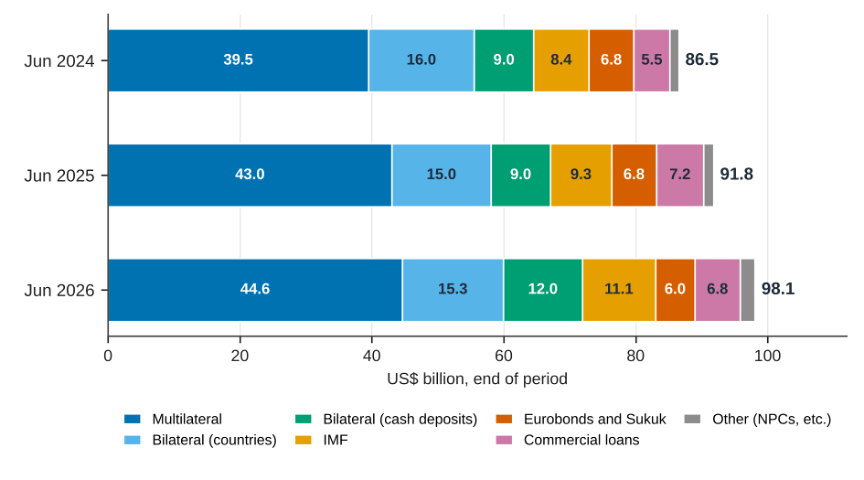
Table 2. Pakistan’s external creditors compared: exposure, terms, behaviour and logic
| Creditor | Exposure | Terms and cost | Behaviour in 2026 | Logic |
| Saudi Arabia | $8.0bn of deposits at SBP (two facilities); 37% of reserves | $5bn locked to December 2028; $3bn on short renewals; about 4% reported on earlier facilities | Renewed at every maturity since 2021; added $3bn in April; no published economic conditions | Security retainer |
| United Arab Emirates | $3.45bn of deposits, repaid 11 to 23 April; none outstanding | Annual rollovers, then monthly; Pakistan had sought two years at about half the rate | Recalled, despite an IMF-programme commitment to keep deposits until September 2027 | Financial; relationship reported strained |
| China | $22.4bn, the largest single creditor (World Bank, end-2025); includes a $4bn deposit | Deposit rolled yearly at about 6.1%; $2bn of loans extended in 2025 | Rolls over at market-linked prices; loans refinanced separately | Commercial and strategic |
| IMF | $11.05bn (11% of external public debt); exposure peaks September 2027 | 37-month EFF ($7bn) plus RSF; Board decision on $1.2bn expected in December | Repaid on schedule; disbursements tied to reviews and to bilateral assurances | Policy anchor |
| Multilaterals | $44.6bn (45.5%) | Long-tenor, largely concessional | Scheduled repayment | Development mandates |
| Commercial lenders | $12.8bn (13%): Eurobonds and Sukuk $6.0bn; loans $6.8bn | Eurobonds at 6.975% (3-year, April), 7.5% (5.5-year) and 7.9% (10-year) (September) | Contractual; $1.8bn of Eurobonds repaid in FY2026 | Return on risk |
| United States | None disbursed | $10bn facility requested in July | Pending; the minister says Pakistan can proceed without it | Liquidity backstop |
Sources: MoF 2026a, 8, 13; IMF 2026; Express Tribune 2025, 2026a, 2026b; Arab News 2026a; Business Standard 2024; Dawn 2026b; Reuters 2026b. Notes: Exposures are stocks or facilities as labelled and are not additive. IMF, multilateral and commercial shares follow the Ministry of Finance classification of external public debt (US$98.1bn, June 2026); China’s figure is a World Bank creditor-country total on a different basis, and the Ministry series does not identify UAE deposits.
Gulf deposits are the discretionary layer, and discretion cuts both ways. Abu Dhabi had committed under the IMF programme to keep its deposits until September 2027, yet recalled them; the Financial Times reported irritation at Pakistan’s Riyadh ties and Iran mediation, which Islamabad called routine (Express Tribune 2026a; ThePrint 2026). Egypt shows the alternative model: the UAE converted $11 billion of deposits into the $35 billion Ras El-Hekma investment (Arab News 2024). Pakistan pays in security, not assets, and its dependence exceeds deposits: the Gulf supplies 81% of fuel imports and 55% of remittances, about 5% of GDP (IMF 2026, 9).
The cost of repeated dependence
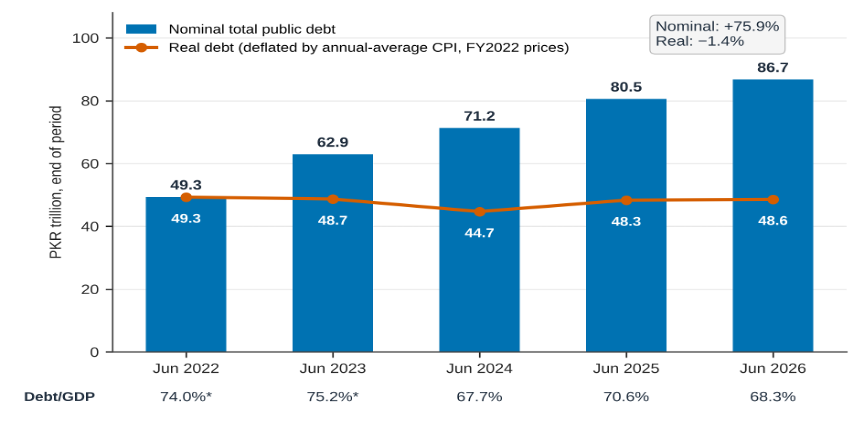
Public debt rose from PKR 49.3 trillion in June 2022 to 86.7 trillion in June 2026, up 75.9% (Chart 3; Dawn 2026a). Consumer prices averaged about 78% higher, so the real stock is flat, and debt fell from roughly 74% to 68.3% of GDP (MoF 2026a, 4; IMF 2026, 30). Primary surpluses and a 22% cut in interest costs achieved that, not productive capacity. Interest still absorbs 66% of net federal revenue (MoF 2026a, 2).
Chart 3. Pakistan’s total public debt, June 2022 to June 2026: nominal and real
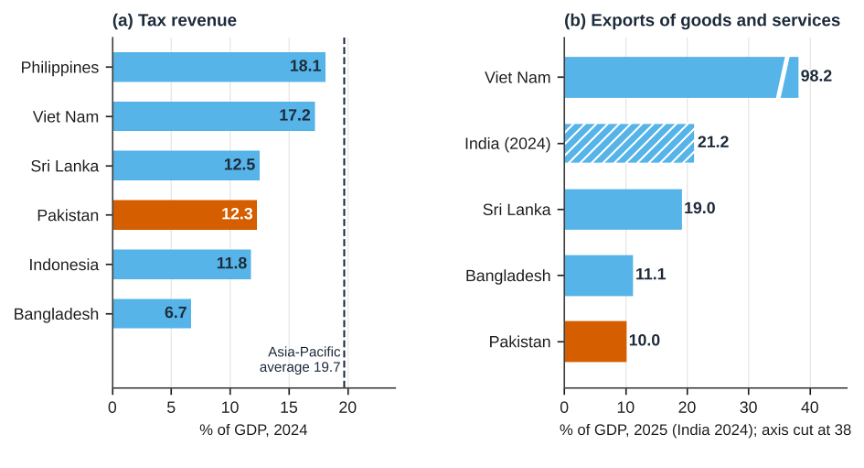
Exports slipped from 10.6% of GDP in FY2022 to 10.0% in FY2025, against 11.1% in Bangladesh and 19.0% in Sri Lanka (Chart 4; IMF 2026, 32; World Bank 2026). Tax revenue reached 12.3% of GDP, its highest since 2000, yet trails the Asia-Pacific average of 19.7% (IMF 2026, 13; OECD 2026). Real income per head is projected only 1.3% above FY2022, and poverty rose from 18.3% to 25.3% by FY2024 (IMF 2026, 14, 30). Power and gas circular debt nears PKR 5.3 trillion (Profit 2026).
Chart 4. Structural performance against regional peers: tax revenue and exports as shares of GDP
The failings are institutional and span governments: agriculture, 24.6% of value added, bears a 0.3% effective tax rate, revenue targets slip and exemptions persist (IMF 2026, 6, 8, 13).
Counterargument, scenarios and conclusion
The stabilisation is real: a 1.7% federal primary surplus, upgrades from all three rating agencies, and a $3 billion Eurobond drawing almost $6 billion in orders (MoF 2026a; Reuters 2026b). It does not establish sustainability. Gross financing needs are 20% of GDP, $12 billion of deposits make up 56% of reserves, and $10.5 billion of this year’s $21.5 billion external financing requirement depends on rollovers (MoF 2026b; Express Tribune 2026b). The IMF still calls reserve cover “too low by standard reserve metrics” (IMF 2026, 16).
Three paths follow. Under stabilisation, exports and revenue grow enough to cut reliance on rollovers. Under managed dependence, Riyadh and Beijing keep renewing while ratios barely move. Under renewed crisis, an energy shock, a failed IMF review or a creditor rupture like Abu Dhabi’s forces another scramble (Figure 1).
Figure 1. The Saudi-Pakistani strategic-financial relationship: an analytical framework
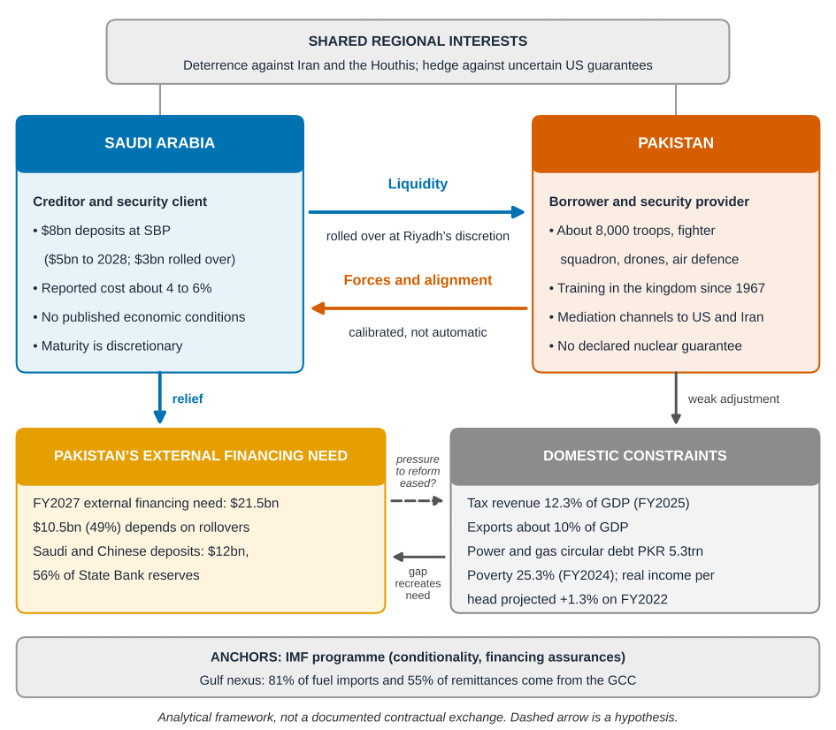
The evidence favours strategy over yield or sentiment: deposits buy deployable forces and alignment at a discount. Relief has not transformed fundamentals, which fits a moral-hazard reading in which unconditional liquidity eases reform pressure, though these data cannot establish causation.