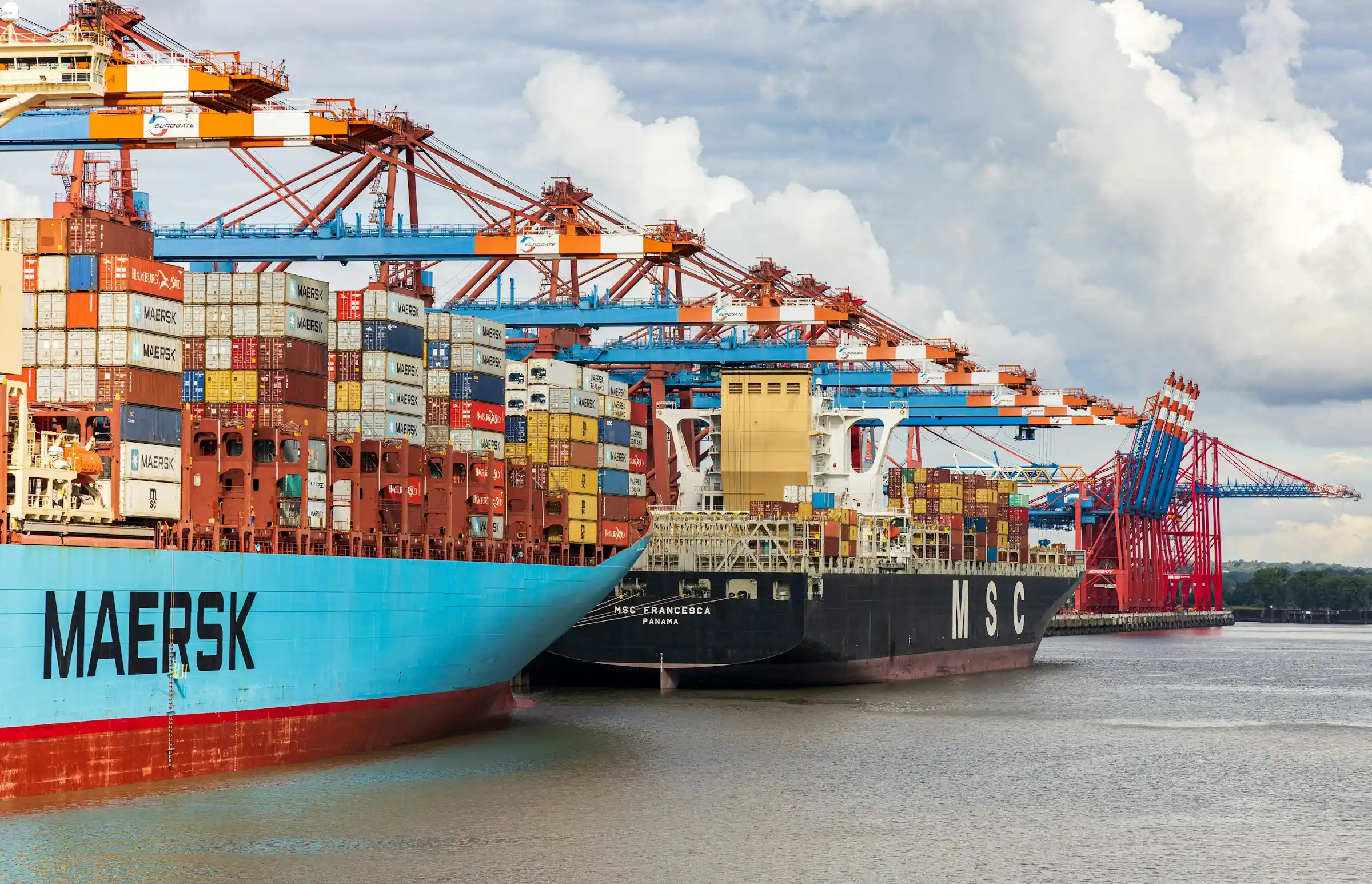
On 4 December, the International Maritime Organization is due to resume the session that decides whether global shipping gets a binding carbon price. It has been here before. In October 2025, member states voted 57 to 49 to adjourn the Net-Zero Framework for a year, after intense US and Saudi pressure. At the May 2026 session the text survived, with 55 countries backing it and 51 favouring a substantial rewrite. Survival is not adoption. The earliest entry into force has already slipped to March 2028.
Shipowners cannot wait for diplomats. A vessel ordered today will burn fuel into the 2050s. Two countries that can solve the problem bilaterally are sitting on opposite sides of the Bay of Bengal and the East China Sea, and they have barely begun to talk to each other seriously.
The ship side is ready
South Korea’s yards already treat alternative fuels as the default. By one industry count, 72% of newbuild capacity ordered worldwide in the first ten months of 2025 was alternative-fuelled, and about 63% of vessels on order in Korea carry dual-fuel capability. HD Hyundai has secured orders for at least eight ammonia-powered vessels. Seoul is also spending: ₩320 billion on shipbuilding R&D in 2026, up 23.7% on last year.
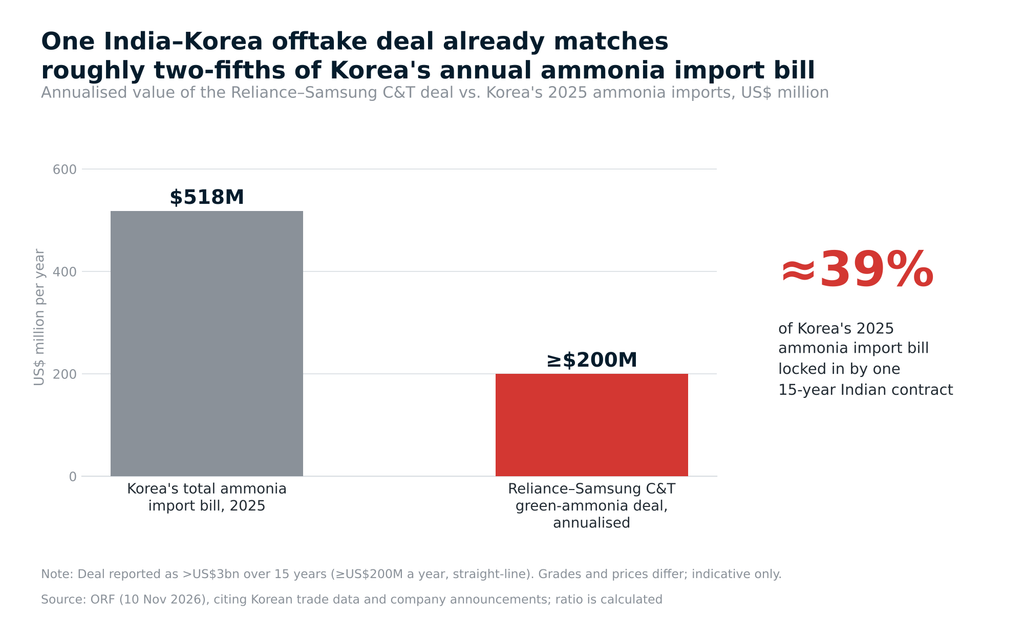
Korea’s weakness is the molecule. It imported $518 million of ammonia in 2025, mostly from Indonesia, Saudi Arabia, China, Australia and Malaysia. Renewables supplied 11.4% of its electricity by the end of 2025, against a 20% target for 2030. Its ports still lean on a grid with transmission bottlenecks. Korea can build the world’s most sophisticated ammonia-burning ships, but it cannot cheaply fuel them from its own territory.
The fuel side is promising but tiny
India has the opposite problem. The National Green Hydrogen Mission has named Deendayal (Kandla), Paradip and V.O. Chidambaranar (Tuticorin) as hydrogen hubs, and the Harit Sagar guidelines want green-ammonia bunkering at every major port by 2035. On paper the pipeline looks serious:
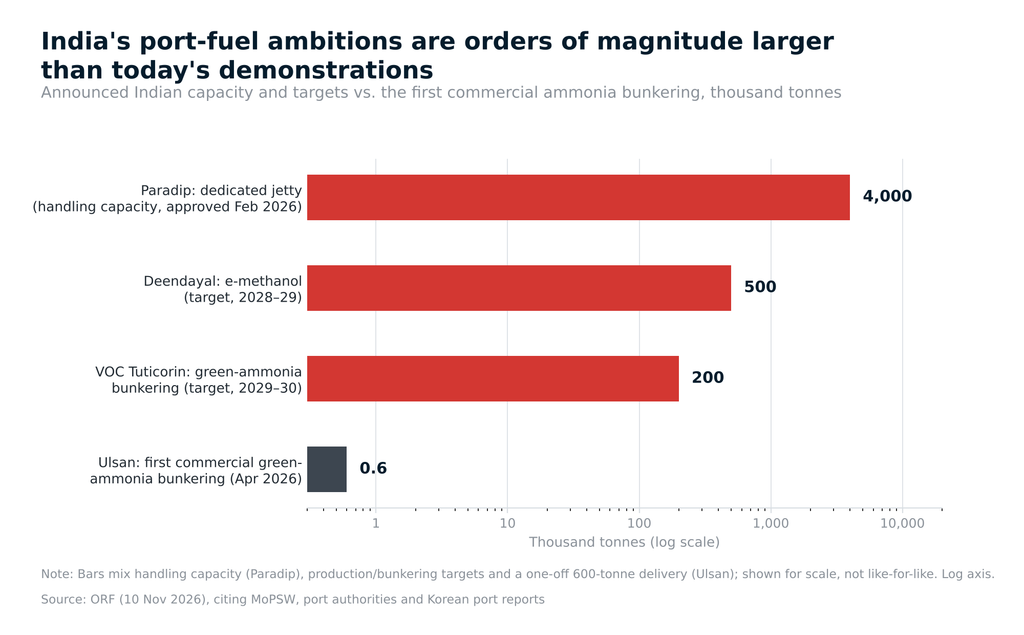
- Paradip’s ministry-approved jetty is sized for up to 4 million tonnes a year of hydrogen, ammonia and other liquid cargo, at an estimated ₹7.97 billion.
- Tuticorin has signed a memorandum for up to 200,000 tonnes a year of green-ammonia bunkering by 2029–30.
- Kandla has allotted 3,400 acres, built a 3.5 million-tonne jetty compatible with ammonia handling, and is developing a 750 m³ methanol bunkering facility.
Now compare that with what exists. Kandla’s commissioned electrolyser is 1 MW, built for about ₹130 million, and produces roughly 140 tonnes of hydrogen a year. Ammonia is only about 18% hydrogen by weight, so 200,000 tonnes of it needs around 35,000 tonnes of hydrogen. That is some 250 times what the country’s flagship port electrolyser makes today. Korea’s much-cited April 2026 bunkering at Ulsan, reported at 600 tonnes of green ammonia, would be a rounding error against Tuticorin’s target. Both are real firsts. Neither is yet a market.
What turns pilots into a market
Money is already moving. Reliance Industries and Samsung C&T signed a 15-year green-ammonia supply deal in March 2026 worth over $3 billion, roughly $200 million a year. That is the template: long-dated, bankable offtake that lets an Indian developer raise project finance against a Korean buyer’s credit. Almost everything else, from ports to ships, follows from a signed contract.
Three moves would make that template the rule rather than the exception.
First, build one corridor rather than a dozen pilots. Pick an Indian anchor, Tuticorin or Kandla, and a Korean one, Ulsan, which Seoul has designated as its ammonia and methanol bunkering hub. Commit a handful of Korean-built, ammonia-capable ships to run between them, with fuel from Indian electrolysers. A corridor puts a producer, a port at each end, a shipyard and a charterer on a single balance sheet, which is what lenders need to see.
Second, harmonise certification before volumes arrive. Whether Indian ammonia counts as “green” under Korean, European and eventually IMO accounting will decide its price. India’s cap of 2 kg of CO₂ per kg of hydrogen is a credible start. Agreeing bunkering protocols, safety rules and lifecycle accounting now costs little. Retrofitting them across a thousand cargoes later would cost a great deal.
Third, blend the finance. Dual-fuel and ammonia-ready ships carry a premium that independent owners find hard to bridge with ordinary bank debt. India has a roughly $3 billion Maritime Development Fund, and both countries have export credit agencies and development banks. Pooling them behind a first-of-a-kind corridor, with shared first-loss cover, would spread the risk of being early.
The competitive logic
This is not charity. Korea’s share of global shipbuilding orders has historically stayed within a 20–30% band, but China’s merged state builder now commands over a fifth of the market on its own, and Chinese yards have pulled ahead in methanol. Korea’s defensible ground is the technically hard end: ammonia engines, large dual-fuel container ships, gas carriers. That ground is worth more if there is dependable, certified fuel to run on. For India, a Korean offtaker means its ports stop being optimistic real estate and become export infrastructure.
There are risks. Ammonia is toxic, and bunkering incidents would set the whole effort back years. Green hydrogen costs have fallen more slowly than projected. And if the IMO collapses its pricing mechanism in December, the commercial case weakens and the spread between green and fossil fuel widens.
That is precisely why the two should act now. A global carbon price would help. A bilateral contract does not need one, because it only needs a buyer who has agreed to a price and a seller who can deliver. In a year when multilateral shipping diplomacy is stalling, a Tuticorin–Ulsan corridor would show that decarbonisation can proceed one signed offtake at a time.