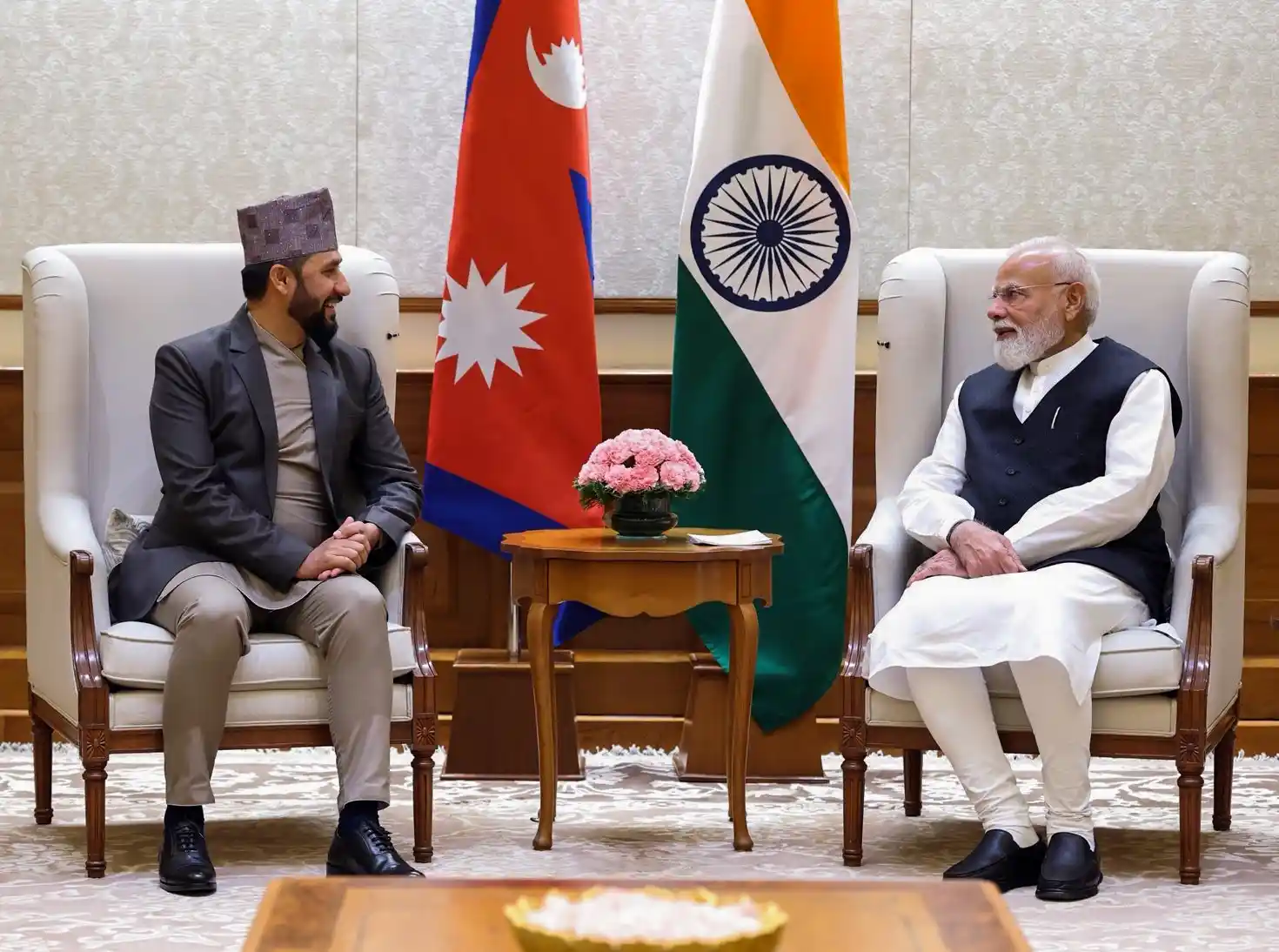
There is a particular kind of diplomatic signal that makes almost no noise and yet carries enormous weight. It does not come in the form of a joint communiqué or a state dinner with choreographed handshakes. It comes, instead, from the simple fact of someone getting on a plane.
When Rabi Lamichhane, Founding Chairman of Nepal’s Rastriya Swatantra Party and one of the country’s most consequential emerging political figures, traveled to New Delhi, the visit generated modest international coverage. It was treated, in most quarters, as a party-to-party courtesy call — the kind of trip diplomats schedule to fill the calendar between crises. That interpretation underestimates what actually happened.
The visit was not ceremonial. It was corrective. It came at a moment of genuine strain in Nepal-India relations, a period marked by border-related political controversy and the ambient unease that tends to accumulate when neighbors with complicated histories allow official channels to go quiet.
In his piece for the Hindustan Times, he wrote, “(Nepal) wishes to shift the entire vocabulary of Nepal-India relations away from geopolitical friction and place it firmly on development diplomacy. Lamichhane’s decision to make the trip — to sit across from Indian counterparts, to be seen doing so, to register his presence in the capital that matters most to Kathmandu’s future — was itself the message. In diplomacy between neighbors with open borders and shared social spaces, the willingness to keep talking is often more meaningful than anything said in the room.
What makes the visit worth examining seriously is what it reveals about a relationship that the world’s foreign-policy commentariat persistently undervalues: the bond between India and Nepal, which is less a conventional bilateral alliance than a condition of existence for one of the parties involved.
Nepal is a landlocked country of roughly 30 million people, tucked between India to the south, east, and west, and China to the north. The geography alone would make India the defining external relationship even if the two countries shared nothing else. But they share a great deal: a 1,751-kilometer open border, deep religious and cultural affinities, intertwined languages, and the kind of social fabric — built from migration, intermarriage, pilgrimage, and trade — that no policy document fully captures and no government entirely controls.
The economic numbers are, in their way, staggering. India accounts for roughly 64% of Nepal’s total trade and serves as its largest export destination. Indian firms are among Nepal’s largest investors. Nepal depends on Indian ports to access global markets, on Indian pipelines for petroleum, on Indian supply chains for medicines and fertilizers. This is not interdependence in the academic sense — it is something closer to structural integration, the kind that doesn’t announce itself because it is simply the background condition of daily life for millions of Nepali citizens.
In geopolitical terms, that means something specific: Nepal does not have the luxury of treating its relationship with India as one option among several, to be calibrated against Chinese overtures or Western development finance according to some abstract ledger of national interest. It can, and should, manage multiple external relationships simultaneously. But it cannot afford to let the central one atrophy. The costs are too immediate, too visible, too felt at the level of fuel prices and hospital supply chains and whether the harvest gets to market.
This is the context that makes Lamichhane’s trip more than a photo opportunity. His outreach signals that Nepal’s emerging political forces understand the strategic logic — and that they are choosing engagement over drift at a moment when drift would have been easy.
Trust between countries is an abstraction until it is tested, and the India-Nepal relationship has been tested repeatedly in the ways that reveal character. After the 2015 earthquake killed nearly 9,000 people and reduced entire districts to rubble, India was the first responder — aircraft and rescue teams arrived within hours, before most of the world had finished processing what had happened. The response was repeated, at smaller scale but with the same instinct, after the Jajarkot earthquake and during the devastating 2024 floods and landslides. In emergencies, India shows up.
That matters in a way that development finance alone cannot replicate. Countries, like people, remember who came when it was bad. The emotional residue of those responses is part of what gives India’s position in Nepal its particular texture — it is not merely powerful, it is, at least in these moments, reliably present.
The quieter forms of investment are also accumulating. India provides more than 1,500 scholarships annually to Nepali students. Thousands of professionals have moved through Indian technical training programs over the decades. These are not glamorous facts, but they create something durable: familiarity, professional networks, and the kind of goodwill that survives political turbulence because it is rooted in individual experience rather than government policy.
More recently, the two countries have moved toward something genuinely transformative in the energy sector. In January 2024, Nepal and India signed a long-term power trade agreement targeting exports of up to 10,000 megawatts over the next decade. That November, the first trilateral electricity transaction — Nepal generating power, India transmitting it, Bangladesh receiving it — was inaugurated. For Nepal, a country that has long recognized its hydropower potential while struggling to monetize it, this represents something close to an inflection point: the possibility of becoming an energy exporter rather than an energy importer, of converting its rivers from a geographic fact into an economic engine.
None of this happens without India. India is the corridor, the market, the transmission infrastructure. The partnership is not charity; it is mutually beneficial. But the benefit to Nepal is structural in a way the benefit to India is not, and that asymmetry shapes the entire relationship.
Nepal’s political landscape has grown more turbulent in recent years, marked by rapid government changes and a growing willingness among politicians to use anti-India sentiment as domestic political currency.
What Lamichhane’s visit suggests — and this is perhaps its most important implication — is that at least one significant political force in Nepal is choosing to engage directly rather than perform outrage for domestic audiences. That is a harder choice than it looks. Anti-India posturing is rewarded by Nepali voters in ways that patient diplomacy is not. The instinct to grandstand is entirely rational in the short term.
But countries that confuse short-term political incentives with long-term national interest tend to pay for the confusion eventually. Nepal’s leverage in its relationship with India is not zero — it has geographic position, hydropower resources, and the ability to calibrate its relationships with other partners. But that leverage is best exercised through dialogue, not hostility. It is exercised by a Kathmandu that India needs to listen to, not a Kathmandu that India has learned to ignore.
There is a phrase in diplomatic practice — “strategic autonomy” — that smaller countries often invoke to describe their aspiration to navigate between great powers without being absorbed by any of them. It is a reasonable aspiration. But strategic autonomy is not achieved by antagonizing one’s most essential partner; it is achieved by being indispensable to enough players that none of them can afford to treat you badly.
Nepal has the raw material for that position. It sits at a hinge between two of the world’s largest economies. It has water, elevation, and a young population. It has a diaspora that sends home significant remittances and accumulates skills abroad. These are genuine assets. Converting them into national advantage requires, among other things, a functional and trusting relationship with New Delhi — not because India deserves deference, but because the alternative is a landlocked country with unrealized potential and a deteriorating relationship with the neighbor it cannot avoid.
Rabi Lamichhane got on a plane and flew to Delhi. It was a small act. But small acts, done at the right moment for the right reasons, are how the space for larger ones gets created. In a relationship as consequential as the one between India and Nepal — dense with history, complicated by grievance, and essential to both sides in ways that neither always admits — the willingness to keep talking is not a concession. It is the work itself.