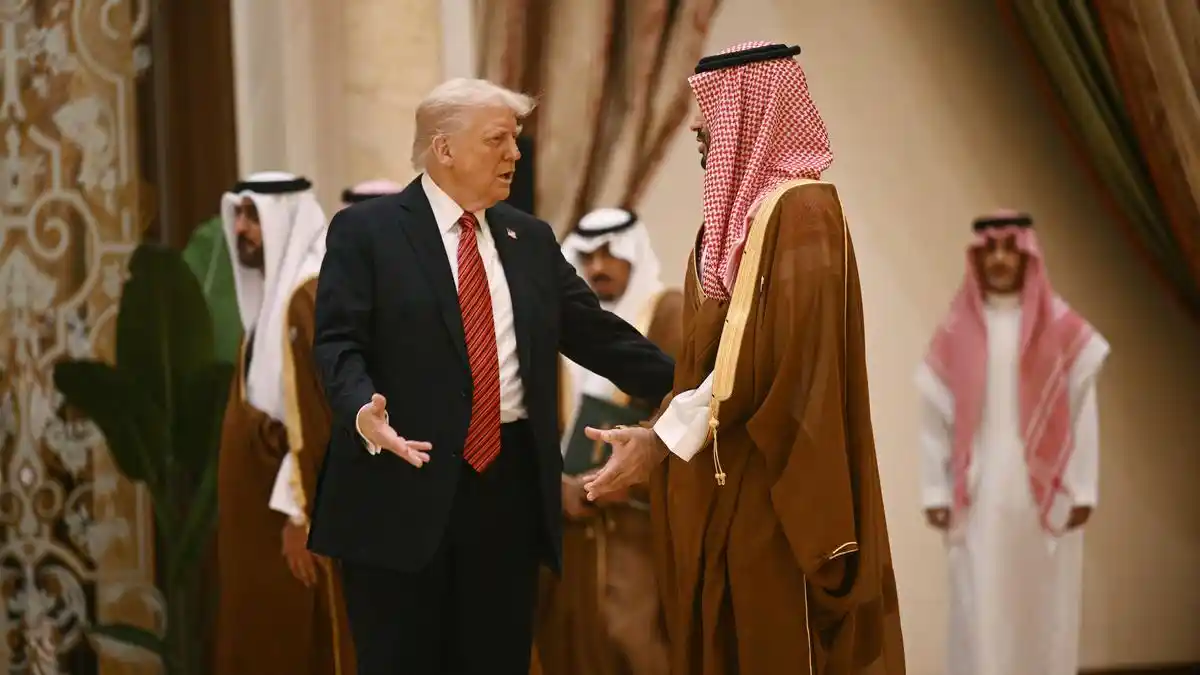
After getting stuck in the fog of war in the Middle East with Iran, the US is again playing a brinkmanship card in the region that will only fan the flames. Recently, the US signed a historic nuclear deal with Saudi Arabia that has pushed the region into another anxiety spin. The US’s strategically risky political manoeuvre appears to be inspired by the desperation of rapidly evolving politics in the Middle East, especially against the backdrop of the ongoing Iran-US conflict.
The Nuclear Deal
A 30-year “123 Agreement” for civilian nuclear cooperation has been approved by the Trump Administration. Worth tens of billions of dollars, the pact positions American companies to build the kingdom’s nuclear infrastructure. While the deal has strong economic value, the strategic value of the deal is the key concern here. The two provisions in the deal require close examination, as they could have a bearing on the region’s strategic security calculus. First, it allows the potential for domestic uranium enrichment in Saudi Arabia, subject to future joint US-Saudi review, rather than requiring the kingdom to permanently forgo enrichment. Second, the deal omits the stringent oversight of the IAEA, which allows Saudi Arabia to adopt the IAEA’s Additional Protocol for enhanced facility inspection. Though the deal has a provision for bilateral oversight, these provisions have failed, as they did with Israel and especially with North Korea.
The U.S. and North Korea bypassed traditional multilateral mechanisms to sign a bilateral freeze agreement. The U.S. provided fuel oil and light-water reactors in exchange for North Korea freezing its plutonium program. The bilateral oversight had weak mechanisms and also gave way for North Koreans to bypass it; as a result, North Korea covertly pursued a highly enriched uranium (HEU) program using technology smuggled from Pakistan.
Another Scramble in Desperation
At the regional geopolitical level, the current situation in the Middle East presents two choices, both of which threaten the US’s sphere of influence in the Gulf. First is the region’s intent to spin the strategic autonomy card. It began with the UAE’s exit from OPEC, signalling a move beyond the clutches of regional conflicts and politics and charting its own course for national interests. While Saudi Arabia had been softly signalling a move beyond US dependency to fulfil its Vision framework, unlike the UAE it wasn’t that hard a steer. Second is Iran’s growing hegemonic power and influence, which is opening a new strategic reality in the region where the US-Iran long-run policy of weakening and isolating Iran has faced a serious challenge, if not a failure. This is not the first time the US has scrambled to secure its influence in the Middle East; it has done so in the past, setting the region on a series of brinkmanship episodes. The US faced tough calls, not once but almost thrice, in the Middle East. First was the rise of Iran after the Islamic Revolution, when the rise of the Shia crescent in the Middle East threatened US influence and gave strategic anxiety to its allies. To counter and contain Iran’s rising influence, the US scrambled towards Iraq, enhancing crucial military support to Iraq by sharing satellite intelligence and supplying economic credits and dual-use technology, primarily to prevent an Iranian victory during the Iraq-Iran War and contain the rise of Iran’s Islamic Revolution. This scramble had its own consequences: by heavily arming Saddam, it inflated his leadership ego and left Iraq with a massive, battle-hardened army, ultimately pushing the region into brinkmanship when Iraq invaded Kuwait in 1990.
While at one end the US was fueling Iraq’s rise to contain Iran, it even launched Operation Staunch to impose an embargo on Iran. On the other hand, the US had to secretly move the needle in desperation to indirectly fund and supply arms to Iran. The US was under immense pressure to resolve the hostage crisis in Lebanon, where the Iran-backed terror group Hezbollah kidnapped American citizens, including the CIA station chief, in Beirut. The then Regan Administration secretly sold weapons to Iran via Israeli intermediaries. When this secret plan was revealed in the media, it seriously damaged the US’s credibility in the Middle East. Arab allies felt betrayed. The crucial setback fueled distrust between Saddam Hussein and the US, which played a crucial role in altering the regional balance of power, as it not only fueled Hussein’s post-war aggression and distrust towards Americans but also provided the Soviets a strategic opening to strengthen its relations with Arab nations.
The JCPOA Brinkmanship
As direct conventional options against Iran’s nuclear programme and strategic sites waned and the risk of Iranian retaliation and proxy terror activities increased, the Obama administration began diplomatic manoeuvres to avoid escalation of regional conflict and to moderate Iran’s rising nuclear ambitions and strategic capabilities that could threaten US influence and the region.
The JCPOA, extensively negotiated, lifted sanctions on Iran and provided a window for limited enrichment in return. While the US thought that containing Iran diplomatically would balance power in the region, it worked contrary, fueling distrust with Arab allies and the strategic ally Israel. Moreover, despite the agreement, Iran continued to strengthen its asymmetric capabilities through missile development and funding a proxy network, thereby enhancing its strategic power and influence in the region. As a result, instead of balancing power, it pushed the region into a slow brinkmanship, where serious security crises began within years of signing the JCPOA, from backing the Bashar al-Assad regime in Syria to strengthening Hezbollah in Lebanon. Iran aggressively utilised the economic concessions granted by the US, around 100 billion in unfrozen assets as per some reports, to fund its proxy network and wage low- to medium-intensity attacks in the region, from tank seizure episodes in the Strait of Hormuz to carrying out proxy-backed drone strikes on Saudi Arabia’s major oil sites.
Interestingly, the US went on with a second round of brinkmanship after seeing Arab allies, especially Saudi Arabia’s, distrust; the then Obama Administration, to appease and strengthen its allies’ regional influence and power, decided to back Saudi intervention in Yemen against the Houthis. The US extensively funded and coordinated strikes against the Houthis, which dragged the region into a new burning conflict and led the Houthis to strengthen their ties with Iran, putting serious questions on US’s security credibility in the Middle East.
Did the US fulfil the strategic objective it was seeking? The answer is negative. Did the deal risk the region’s security? The answer is affirmative.
Trump’s New Brinkmanship With Saudi
After being at the losing end of the war with Iran, the US is reconsidering its approaches to recalibrate its influence and power balance in the Middle East after facing serious security credibility issues and Iran’s rise. However, there is a much larger question that is bothering the US: the region’s strategic autonomy spin, which the US currently fears, and the pivoting mood of Arab allies, especially Saudi Arabia and the UAE. Distrust in Arab allies is core damage to US influence that it cannot afford, especially in the current global order where alternative power and pivoting is a favoured strategy to cut dependencies and readjust to fulfil one’s national interests. The US has taken risks that even have dangerous precedents to secure allies’ trust, and now the US is again doing it by signing a nuclear deal with Saudi Arabia.
The possible brinkmanship that this deal entails for the region is two-fold. First is political and second is strategic. At the political level, the US secured its strong influence with Saudi Arabia through this deal and prevented Saudi Arabia’s pivot threat towards Russia or China for its ambitious Vision 2030 framework, but it comes with costs. It may lead to a nuclear arms race under the garb of tech and civilian nuclear infrastructure. Countries like Turkey and Egypt may seek similar nuclear arrangements, leading to the resurgence of the Sunni bomb doctrine in the Middle East, which was once staunchly used in the context of Pakistan’s development of nuclear weapons to counterweight Iran’s nuclear development. This race again triggers balancing and pivoting dilemmas for the US, as there are strategic limitations even for the US to ensure regional power balance and deterrence politics, as it did during Iran-Iraq by dual containment policy during the Reagan administration in the mid-1990s to contain the rise of both powers. The strategic security concerns would be Iran’s possible escalation of nuclear enrichment and heightened security anxiety for Israel in the region that can again flare a new wave of Gulf security crises. For the US, its core strategic policy in the Middle East remained stuck on the core base of offshore balancing strategy, following containment of a rising single power in the Middle East and balancing regional power in the Middle East, but this strategy always came with high costs.