
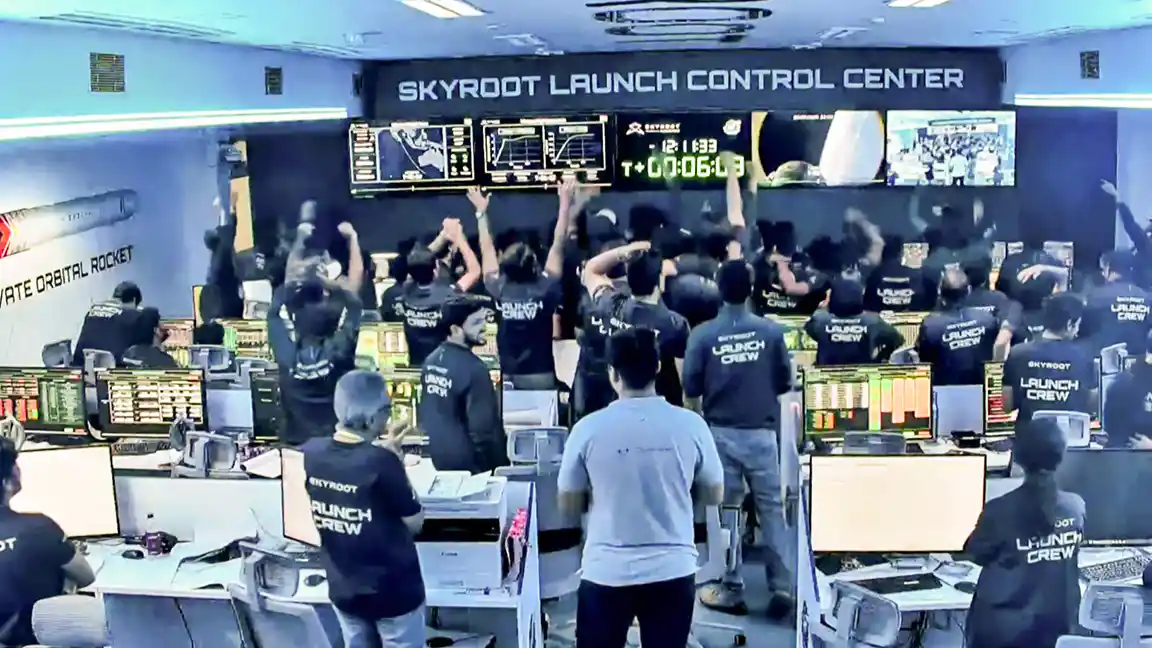
Somewhere in the choreography of countdowns, holds and ignition sequences at Sriharikota, India crossed a threshold it has been approaching for six decades. Vikram-1, built and flown by the Hyderabad startup Skyroot Aerospace, became the first privately developed Indian rocket to reach orbit. The headlines will fade in a news cycle or two. But the shift it represents — from a state monopoly on spaceflight to a genuine private space economy — deserves to be read as a turning point, not a footnote.
For nearly sixty years, every Indian rocket that left the ground belonged to the state. ISRO designed it, ISRO built it, ISRO flew it. That model delivered extraordinary achievements on a shoestring budget — a Mars orbiter, a moon landing near the lunar south pole, a solar observatory — and it made India synonymous with frugal, reliable engineering. But it also meant that India’s capacity to reach orbit was capped by the bandwidth of a single public institution. Vikram-1 breaks that ceiling. A private company, using its own money, its own engineers and its own hardware, put something into space. That has only happened before in a handful of countries. India has just joined that list.
What actually flew
Vikram-1 is not a toy. Standing about 22 metres tall — roughly the height of a seven-storey building — with a liftoff mass of around 40 tonnes, it is a genuine orbital-class launcher capable of carrying up to 350 kilograms into low Earth orbit. Its maiden flight, named “Aagaman,” meaning Arrival, suffered a short technical hold before liftoff, then performed essentially as designed: a clean ascent, four nominal stages, and a final orbit of about 450 kilometres at roughly 60 degrees inclination, with its payloads deployed on schedule.
What is more striking than the flight itself is what went into building it. Skyroot used all-carbon composite motor casings, high-performance solid rocket motors, and in-house propulsion systems that include 3D-printed engines — manufacturing techniques that, until recently, were the preserve of ISRO and a small circle of global aerospace giants. And the rocket did not fly empty. It carried technology demonstration payloads from Grahaa Space in India, from Cosmoserve, from Germany’s DCubed, and from Skyroot itself — proof that Indian private launch capability is already being tested by customers who could have gone almost anywhere else in the world.
The reform that made it possible
Vikram-1 did not appear out of nowhere. It is the clearest proof-of-concept yet for a policy shift that began in earnest around 2020, when the government created IN-SPACe — the Indian National Space Promotion and Authorisation Centre — to regulate and enable private space activity. IN-SPACe is the reason Skyroot could test its hardware and launch from ISRO’s own range at Sriharikota; it exists precisely to fold private launchers, satellite makers and downstream service providers into a single national ecosystem rather than leaving them to build parallel, isolated capability.
The scale of what that reform unlocked is worth pausing on. India went from a single space startup in 2022 to nearly 200 by 2024. Roughly ₹1,000 crore flowed into the sector in just eight months of 2023. Government planners now talk about raising India’s share of the global space economy from about 2 percent in 2021 to 8 percent by 2030, and as much as 15 percent by 2047. Those are not modest ambitions, and Vikram-1 is the first hard evidence that the industrial base to support them might actually exist.
A new division of labour
ISRO itself has described Vikram-1 as a significant milestone and a direct product of the reforms it helped design — language that hints at where this is heading. The most plausible future is not one where private firms replace ISRO, but one where the two divide the work: ISRO concentrating on the hardest, highest-prestige missions — crewed spaceflight, planetary probes, a future space station — while private companies handle the routine, high-volume business of getting small satellites and technology demonstrators into orbit. That is roughly the model NASA adopted with its commercial cargo and crew programmes, and it is the model that let American companies scale so quickly. India now has its first concrete data point suggesting it can be replicated here, adapted to Indian conditions and institutions.
The timing matters. The government has laid out its most ambitious roadmap yet for Indian spaceflight: a crewed Gaganyaan mission around 2027, an indigenous space station by 2035, an Indian crewed lunar landing by 2040, with Mars and Venus missions further down the line. None of that is achievable if ISRO alone has to build every vehicle for every purpose. Small, flexible, frequently-flown private rockets like Vikram-1 are exactly the kind of workhorse that can carry station resupply loads, technology demonstrators and commercial payloads, freeing ISRO’s heavier vehicles for the missions only it can do.
The commercial stakes
There is real money on the table. The global small-satellite launch market is expected to serve tens of thousands of satellites over the coming decade, and much of that demand comes from cost-sensitive customers in Asia, Africa and Latin America — markets where India’s reputation for frugal engineering, built over decades of ISRO missions, already carries weight. If Skyroot and its peers can turn a single successful flight into a reliable, high-cadence launch service, India is well positioned to capture a meaningful share of that business, generating export revenue and keeping more of the space value chain — launch, satellite manufacturing, downstream data services — inside the country instead of paying foreign providers for it.
The fragility beneath the milestone
None of this should be mistaken for a finished story. The very fact that Vikram-1’s launch was held up for 35 minutes before liftoff is a reminder that private orbital rockets are still young, unproven technology, however well the mission ultimately went. A single successful flight is not the same as a track record, and building a spotless safety record across dozens of launches is a far harder task than achieving one clean debut. Startups like Skyroot also remain financially fragile: development timelines are long, costs are high, and one or two failed missions could shake investor confidence in a sector that has only just learned to attract serious capital. Turning India’s 2 percent share of the global space economy into 8 percent by 2030 will require not just more first flights but patient capital, insurance structures and steady demand — from government and private customers alike — that can carry these companies through the inevitable setbacks.
What it means, taken as a whole
Vikram-1 extends a narrative that began with Chandrayaan-3’s landing and Aditya-L1’s solar mission: India is no longer just a low-cost extension of ISRO but a country building a diversified, multi-actor space ecosystem, with its own rockets, satellites and eventually its own crewed missions and space station. For the rest of the world, and especially for developing nations weighing their launch options, an affordable Indian private rocket is a new alternative to Western, Russian or Chinese providers — carrying implications well beyond commerce, into the realm of technology partnerships and strategic alignment.
The real test is not whether Vikram-1 flew once. It is whether India can turn one successful flight into a durable industry — one that survives failures, keeps attracting capital, and compounds its capability year over year. If it can, this modest-looking rocket from Hyderabad will look, in hindsight, less like a single “first” and more like the moment India’s space programme stopped being a story about one agency and became a story about an entire economy.

