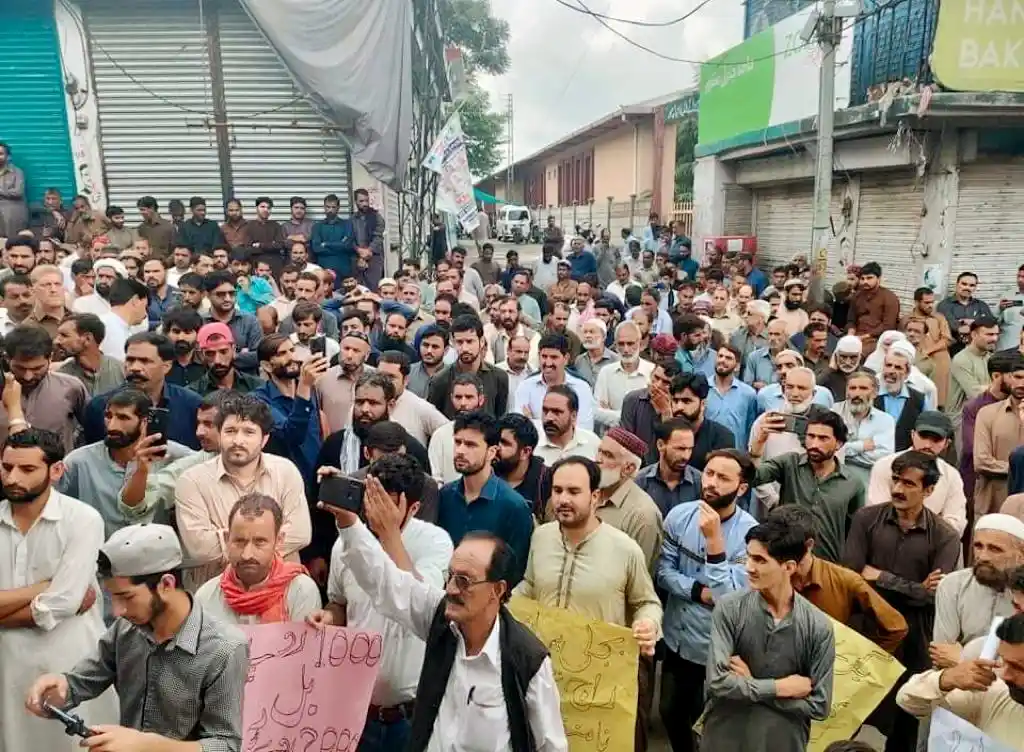
On July 9, 2026, Prime Minister Shehbaz Sharif convened Balochistan’s Provincial Apex Committee in Quetta, Field Marshal Asim Munir at his side, after a wave of attacks that had killed 42 people, four civilians, twenty-seven police officers and eleven security personnel, in the space of five days (Dawn 2026). What followed, Operation Shaban, was described by officials briefing The Diplomat as a sustained campaign to dismantle militant infrastructure across the province, and within a week it had killed more than a hundred alleged fighters (The Diplomat 2026). A thousand kilometres north, the government had just banned the Joint Awami Action Committee and arrested its leadership. Yet, thousands of Kashmiris marched on Muzaffarabad regardless, pressing a 38-point charter Islamabad had signed in October 2025 and then left unimplemented (The Week 2026). Two provinces, two idioms of resistance, one governing reflex: escalate the coercion. Explaining that reflex, and why it keeps failing, is the job of this article. Pakistan’s military now exercises more direct authority over defence, foreign policy, economic governance, the judiciary and internal security than at any point since 1958, and yet that authority has coincided with, not resolved, the most serious simultaneous peripheral crises in the country’s history. None of this is a coincidence. Coercive capacity and political legitimacy are not substitutes for one another, and a state that keeps building the former while neglecting the latter should expect precisely the outcome Pakistan is now living through.
Understanding why requires a framework, not simply a chronicle. Max Weber’s old distinction between naked power and legitimate authority is the place to start: a state that must rely on force to secure compliance is, by definition, failing to generate the voluntary deference that makes governance durable rather than merely present (Weber 1978). Charles Tilly’s account of coercion-intensive state formation supplies the historical mechanism, showing that states which build extractive and repressive capacity ahead of representative capacity tend to reproduce exactly the cycle of resistance and repression now visible in Balochistan (Tilly 1985). Joel Migdal’s “state-in-society” model explains something more specific to Pakistan: how an ostensibly powerful state can also be a weak one (Migdal 1988). GHQ’s reach into economic policy, the judiciary and electoral administration is extensive; its capacity to convert that reach into accepted rule over Baloch and Kashmiri populations is not. Call this coercive substitution: the state answers a legitimacy deficit by deepening the coercive tools available to it rather than by building the representative or distributive institutions that would actually close the deficit. Every new increment of coercion buys short-term order and long-term grievance, and the next crisis restarts the cycle one notch higher.
The institutional shift behind this pattern took shape gradually. Imran Khan’s removal in April 2022, a widely criticised general election in February 2024, and constitutional amendments narrowing the superior courts’ jurisdiction over military and security matters together consolidated GHQ’s primacy over what remained, on paper, a civilian federal structure. The brief but intense confrontation with India in May 2025 entrenched the army’s claim to indispensability further and preceded Asim Munir’s elevation to Field Marshal. Balochistan’s grievances predate all of this by decades, tracing back to the province’s contested 1948 accession and the string of nationalist uprisings that followed; PoJK’s constitutional subordination to Islamabad is older still. Neither grievance is new. It is the simultaneity and intensity since 2023 that mark the real break, arriving exactly as the civilian channels that might once have absorbed such anger were being folded into the military’s remit.
That intensity is easiest to grasp in aggregate, because the scale of it is easy to underestimate from any single attack, however severe. Terrorism-related incidents recorded nationwide rose from 319 in 2020 to 1,720 in 2025, more than a fivefold increase, with the steepest acceleration beginning almost immediately after the Taliban’s return to power in Kabul in August 2021 (Mohanty 2026).
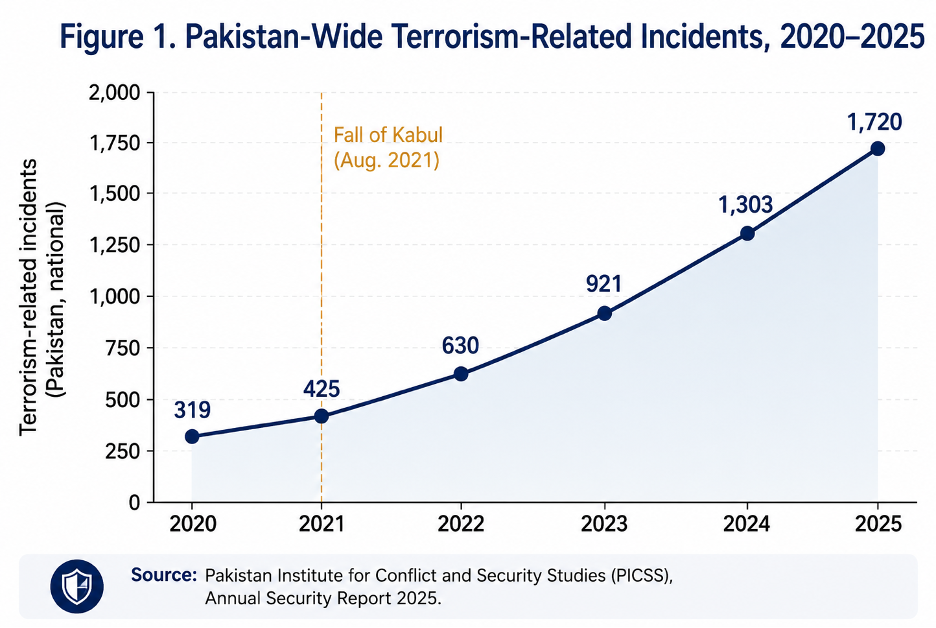
This trend line anchors everything that follows: the years of Pakistan’s most rapid military institutional consolidation are also, on the state’s own security data, the years of its fastest-deteriorating internal security. The correlation does not on its own prove causation, but it should at minimum discourage any easy assumption that expanding military authority has actually been a stabilising force. Three overlapping domains show how far that authority now extends. Security and foreign policy remain GHQ’s preserve outright: India policy, Afghanistan policy and nuclear command sit with the army chief rather than the Foreign Office, a pattern long documented in Pakistan’s civil-military relations literature and, if anything, reinforced since 2025. The military’s economic footprint has become structural rather than incidental: the Fauji Foundation, Army Welfare Trust and National Logistics Cell already spanned banking, fertiliser, real estate and logistics, and the 2019 CPEC Authority and 2023 Special Investment Facilitation Council layered formal investment-approval power for serving and retired officers on top of that commercial base, a governance opacity that successive IMF programme reviews have flagged among Pakistan’s broader state-owned enterprise and quasi-fiscal risks (IMF 2024). And the machinery of population management, intelligence-linked judicial appointments, election oversight and protest policing, has migrated further inside the military’s orbit. The July 2026 Apex Committee meeting, where a serving Field Marshal, not the chief minister, effectively set the province’s security posture, was not an aberration. It was the clearest illustration yet of how ceremonial civilian sign-off has become.
Balochistan and PoJK are usually filed as separate problems in Islamabad’s threat assessments, and at the level of tactics they are. Balochistan’s is a sustained, escalating armed insurgency; PoJK’s is a banned but unbroken civic movement. The scale of the Balochistan escalation is worth isolating from the national trend, because on a proportional basis it has outpaced even Khyber Pakhtunkhwa, the other main theatre of Pakistan’s internal conflict.
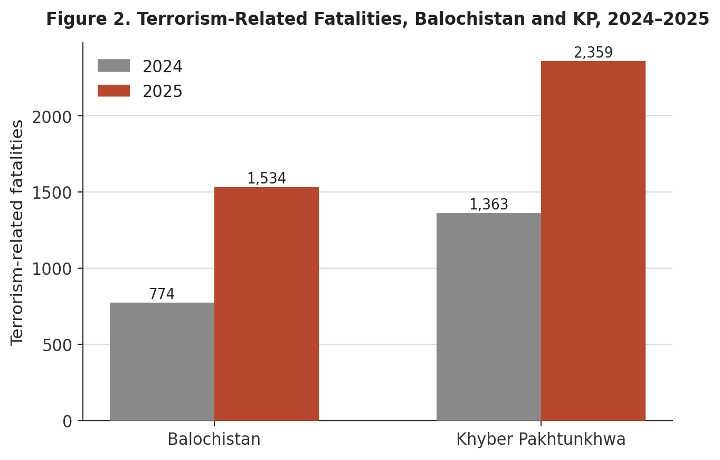
Balochistan’s terrorism-related fatalities rose from 774 in 2024 to 1,534 in 2025, a 98 percent increase and the highest annual toll since SATP began compiling nationwide figures (Mohanty 2026). The proportional jump in Balochistan actually exceeds Khyber Pakhtunkhwa’s over the same period, even though KP’s absolute toll remains higher. It is the trend line, not the level, that marks Balochistan as the more rapidly deteriorating theatre, driven by a loose operational alliance among the Balochistan Liberation Army, the Balochistan Liberation Front and Tehreek-e-Taliban Pakistan remnants operating across an Afghan border that has grown more porous since 2021 (Singh 2026). PoJK’s Joint Awami Action Committee, in sharp contrast, has no insurgent lineage at all. Its 38-point charter, agreed with the AJK and federal governments in October 2025 after a communications blackout and a wave of deadly clashes, sought the abolition of the twelve assembly seats reserved for non-resident representatives, relief from wheat and electricity costs, and an end to enforced disappearances, framed throughout in the language of equal citizenship rather than separation (Al Jazeera 2025; Wikipedia 2026). When Islamabad failed to implement what it had signed, the response was proscription rather than negotiation: JAAC was banned, its leaders arrested, and its 2026 long march to Muzaffarabad met with the same paramilitary posture typically reserved for armed insurgents (The Week 2026).
Political opportunity structure, not some essential difference in Baloch and Kashmiri political culture, explains the difference in repertoire (Tarrow 2011). Balochistan’s mountainous, border-adjacent geography, its history of failed accommodations reaching back to 1948, and the state’s own reliance on enforced disappearance as a tool of counter-mobilisation together foreclosed a civic channel and left armed resistance as the path of least institutional resistance. PoJK’s ambiguous constitutional status, precisely because it is neither a full province nor a genuinely autonomous unit, has instead produced a movement arguing that it seeks inclusion in the Pakistani constitutional order on equal terms rather than exit from it, a claim that retains domestic and international sympathy an armed movement would forfeit, and that is itself one reason the repertoire has stayed civic even as repression has intensified. The tactics differ; the cause does not: a centre that manages both peripheries as security problems rather than represents them as constituencies.
The pattern is not unique to South Asia, and the comparisons sharpen the point rather than merely decorate it. Spain’s answer to Catalonia’s 2017 independence referendum, prison sentences for the organisers rather than negotiation, radicalised a movement that had until then worked entirely within constitutional channels, the same channel PoJK’s charter movement is now testing against Islamabad’s patience. Turkey offers a live version of the same experiment, still running. After the PKK’s own leadership called for full dissolution in February 2025 and formally disbanded that May, burning weapons in a public ceremony in July and withdrawing its remaining fighters from Turkish territory by October, the process had stalled by the following spring, precisely because Ankara had not matched the group’s disarmament with the legal and political reforms the Kurdish side had been promised in return (The New Arab 2026). Pakistan’s PoJK policy runs the identical risk in miniature: a civilian, constitutional opening met with proscription rather than reciprocity. Aceh remains the clearest case of the opposite path. Jakarta had already spent plenty of coercive capacity in Aceh before 2005; what actually ended the insurgency was pairing that capacity with a credible offer of political inclusion under the Helsinki memorandum, the scope condition under which coercive states actually convert power into legitimacy, rather than coercion on its own (Stokke, Tørnquist, and Sindre 2017). Sri Lanka and Northern Ireland mark the same test failing and succeeding in turn: the former crushed its insurgency militarily in 2009 and left Tamil grievance unresolved beneath what the literature on post-conflict settlements calls a hollow peace (Terpstra and Frerks 2017), while the latter found no durable answer across three decades of coercion-led containment and settled only after the negotiated power-sharing of the 1998 Good Friday Agreement. Pakistan’s simultaneous handling of Balochistan and PoJK in 2026 has so far applied the Sri Lankan logic to both peripheries at once, and has not yet tested the Acehnese or Northern Irish one in either. Laid side by side, the asymmetry between the two provinces turns out to be constitutional and economic as much as tactical.
Table 1. Comparative Analysis: Balochistan vs. PoJK
| Variable | Balochistan | PoJK (incl. Gilgit-Baltistan) |
| Repertoire of resistance | Armed, ethno-nationalist insurgency (BLA, BLF, BRAS); rising tempo since 2021 | Civic, constitutional mobilisation (JAAC); banned in 2026 but sustained |
| Political opportunity structure | Porous Afghan border; failed accommodations since 1948; disappearances foreclose civic channel | Ambiguous constitutional status invites claims to equal citizenship rather than exit |
| Principal grievances | Denied provincial autonomy; resource control; enforced disappearances | 12 non-resident reserved assembly seats; unimplemented 38-point charter (Oct. 2025) |
| State response, 2026 | Operation Shaban; 100+ militants killed within a fortnight of July attacks | JAAC banned; leadership arrested; paramilitary deployment against marchers |
| Strategic assets | Gwadar port, Reko Diq, Saindak, Sui gas, CPEC western route | CPEC northern corridor, Karakoram Highway, LoC-adjacent geography |
None of this happens in an economic vacuum. Balochistan holds roughly two-fifths of Pakistan’s landmass and most of its untapped mineral and gas reserves, including the Reko Diq copper-gold deposit and the Gwadar deep-water port, yet records the country’s highest multidimensional poverty rate by a wide margin, a disparity that is starkest set directly against the other provinces.
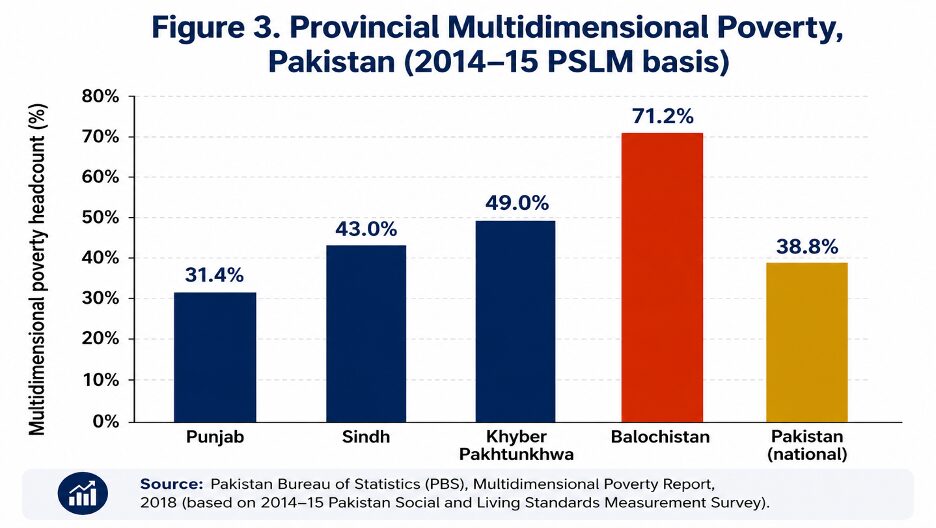
The 2016 UNDP and Oxford Poverty and Human Development Initiative assessment, still the most authoritative provincial breakdown available, put Balochistan’s multidimensional poverty headcount at 71.2 percent against 31.4 percent in Punjab, 43.0 percent in Sindh and 49.0 percent in Khyber Pakhtunkhwa, with a national rate of 38.8 percent; Balochistan was also the province where poverty fell most slowly over the preceding decade (UNDP and OPHI 2016). In PoJK and Gilgit-Baltistan, the CPEC’s northern corridor transits territory without a dedicated local revenue allocation under the early-harvest agreements, even as chronic wheat and electricity shortages supplied the immediate grievances behind the 38-point charter. Layered on both is fiscal contraction: Pakistan’s three IMF arrangements since 2019, an extended fund facility, a stand-by arrangement and a second extended fund facility, have imposed consolidation whose costs, in subsidy withdrawal and constrained provincial transfers, fall hardest on the peripheries with the least capacity to absorb them and the least voice in how the burden is distributed (IMF 2024). Albert Hirschman’s exit-voice framework captures the resulting split precisely: where institutional voice has been foreclosed, as it has for Baloch nationalists since the state’s earliest years, populations exit into insurgency; where voice remains nominally available, as PoJK’s constitutional status implies it should be, populations escalate voice into mass mobilisation instead (Hirschman 1970). Balochistan and PoJK are not two separate economic stories. They are the same story: resource extraction without distribution, fiscal adjustment without representation, producing two different but equally legible responses. Set next to the fatality trends already discussed, the poverty gap and the conflict trend turn out to move together, not separately.
Table 2. Security and Poverty Indicators, 2024–25
| Indicator | Balochistan | Khyber Pakhtunkhwa | Pakistan (national) |
| Terrorism-related fatalities, 2024 | 774 | 1,363 | 2,236 |
| Terrorism-related fatalities, 2025 | 1,534 (+98.2%) | 2,359 (+73.1%) | 4,001 (+78.9%) |
| Multidimensional poverty headcount | 71.2% | 49.0% | 38.8% |
| IMF arrangements since 2019 | — | — | 3 (2019 EFF, 2023 SBA, 2024 EFF) |
The claim that coercion cannot manufacture consent has a substantial empirical record behind it. Paul Staniland’s comparative work on insurgent-state relations finds that durable settlements have historically required states to offer credible political inclusion, not merely superior firepower (Staniland 2014). Pakistan’s counter-insurgency doctrine in Balochistan and its counter-mobilisation approach in PoJK have both tested the opposite proposition, and both have failed the test. The escalation curve shown earlier already makes the point: each successive year of intensifying counter-terrorism operations has coincided with, not reversed, a higher national incident count than the year before. Both cases show the same confusion at work. Pakistan’s security establishment keeps mistaking the suppression of one attack, or one protest, for the resolution of the grievance that produced it, a confusion Weberian legitimacy theory would predict is unsustainable and Tilly’s coercion-intensive state-building model would predict is self-reinforcing. Each cycle of repression raises the coercive floor needed to maintain order without lowering the underlying resentment, which commits the state’s own model to an ever-rising security budget with no visible exit.
The strongest defence of the current approach draws on a real and serious strand of civil-military relations scholarship, from Samuel Huntington’s case for objective civilian control of the military to Samuel Finer’s warning that praetorian intervention becomes more, not less, likely in states with weak civilian institutions (Huntington 1957; Finer 1988), and argues that Pakistan’s civilian institutions are simply too fragile to manage either crisis without military backstopping. It notes, correctly, that Afghan sanctuary for the TTP and long-alleged Indian support for Baloch separatists add a genuine external dimension to the Balochistan conflict that cannot be waved away as purely domestic. A related challenge comes from the political economy of civil war itself: Paul Collier and Anke Hoeffler’s influential argument that access to lootable resources, not grievance, best predicts insurgent violence would locate Balochistan’s conflict in opportunity rather than legitimacy at all, and the province’s mineral wealth gives that argument surface plausibility (Collier and Hoeffler 2004). Yet the BLA and BLF’s operational pattern, attacks concentrated on security forces, infrastructure and Chinese nationals rather than attempts to seize or monetise resource sites themselves, fits a grievance-driven account far better than a resource-capture one. All three challenges have real force, and none is dismissed here. But none of them explains PoJK, where a civic platform with no insurgent lineage, no plausible external patron and no lootable resource base to fight over produced a mass, sustained, cross-district mobilisation, triggered by Islamabad’s own failure to implement an agreement it had itself signed months earlier. External support and resource opportunity, where they exist in Balochistan, are best read as accelerants working on a legitimacy deficit Pakistan’s own governance choices created; neither is a substitute explanation for that deficit, and removing either would not, on the PoJK evidence, resolve the underlying crisis.
Three trajectories are available to Pakistan from here, and the current approach is compatible with only the least stable of them. The first is negotiated accommodation on the Acehnese model, trading meaningful provincial fiscal and administrative autonomy for a wind-down of both the Baloch insurgency and PoJK’s protest cycle; nothing in the 2026 record suggests the security establishment currently regards this as necessary. The second is durable coercive suppression on something closer to the Sri Lankan model, which would require force levels and fiscal commitments well beyond what Islamabad has so far sustained, and would still leave the underlying grievances, and the external actors willing to exploit them, fully intact. The third, and the one the trend lines above currently support, is an escalatory spiral in which every militant attack, every banned protest and every counter-insurgency operation raises the coercive floor without touching the legitimacy deficit beneath it. For India, that trajectory means deterrence along the Line of Control increasingly rests on Pakistani internal fragility rather than strength. For China, it means CPEC stays contractually intact but persistently exposed to the very populations whose consent the corridor’s design never sought. For Pakistan’s own federation, it means the slow conversion of a political problem into a permanent security one, at a cost the state’s own military-led model has no mechanism to reduce.