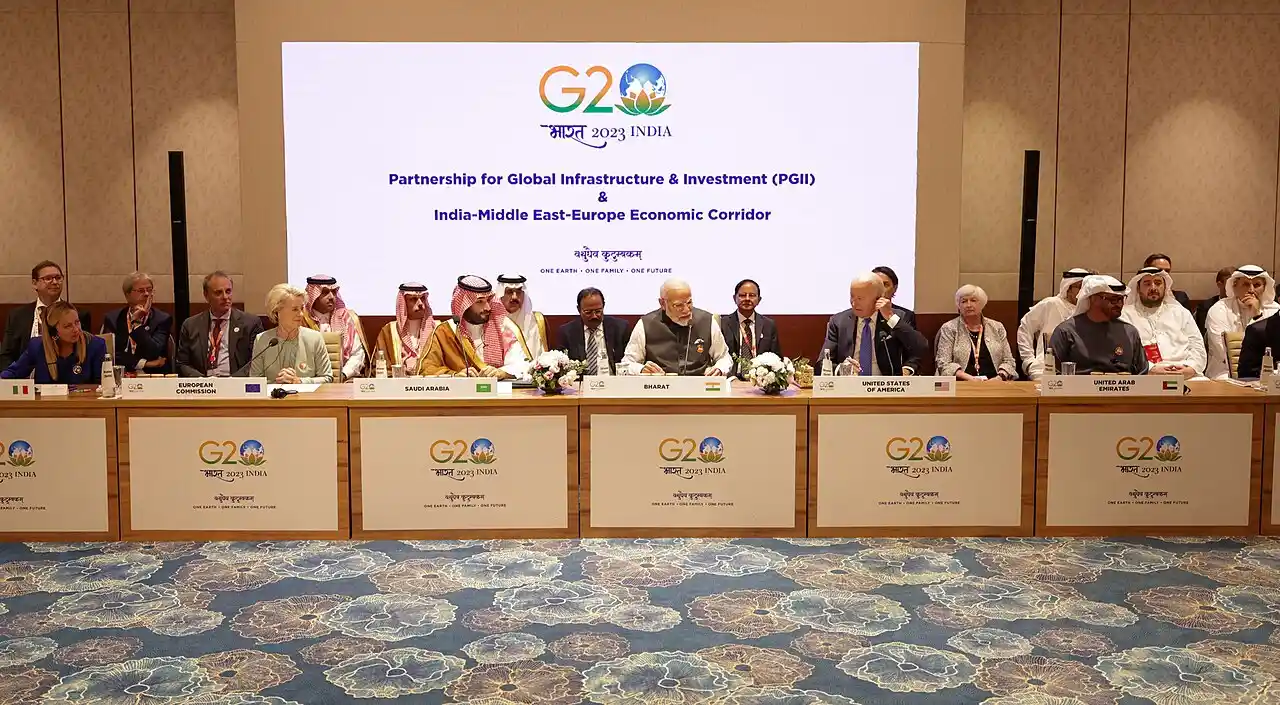
The India-Middle East-Europe Economic Corridor (IMEC) is one of the most ambitious connectivity initiatives of the 21st century. This corridor was conceived not merely as a transport corridor but as a strategic framework linking Asia, the Middle East, and Europe through an integrated network of ports, railways, energy pipelines, digital infrastructure, and logistics hubs. IMEC was announced during the G20 Summit in New Delhi in 2023; the corridor aimed to establish a multimodal trade route connecting India’s western ports with the United Arab Emirates (UAE), Saudi Arabia, Jordan, Israel, and eventually Europe through Mediterranean ports. Beyond facilitating faster movement of goods, IMEC seeks to reshape global supply chains by reducing transportation costs, diversifying trade routes, enhancing energy cooperation, and promoting digital connectivity. However, while the project is fundamentally beneficial for India as well as other partner countries, its implementation has become difficult due to the ongoing volatile geopolitical situation in the West Asian region. So, IMEC today stands at the intersection of commerce and geopolitics, where strategic competition, regional conflicts, and shifting alliances determine its future as much as economic feasibility.
The commercial rationale behind IMEC is compelling. Global trade has traditionally depended upon maritime routes passing through the Suez Canal, the Strait of Hormuz, and the Bab-el-Mandeb Strait. These choke points collectively handle a substantial share of global energy exports and container traffic. The current crisis in the West Asian region has shown that any disruption in these waterways immediately affects shipping costs, insurance premiums, delivery schedules, and leads to global inflation. Further, the attacks on commercial shipping in the Red Sea, instability around the Strait of Hormuz, and prolonged conflicts in West Asia have also highlighted the vulnerability of existing supply chains. The aim of IMEC was to provide an alternative connectivity architecture capable of reducing excessive dependence on these strategic maritime bottlenecks. By combining maritime transport with modern railway infrastructure across the Arabian Peninsula and the Levant, this corridor promises shorter transit times between India and Europe while improving logistical efficiency and supply chain resilience.
The project also fits into the broader transformation of the global economy. Governments and multinational corporations have increasingly emphasized supply chain diversification, resilience, and redundancy rather than exclusive dependence on a single production hub or transport route. The concepts of “China Plus One,” friend-shoring, near-shoring, and trusted supply chains have gained prominence as nations seek to reduce strategic vulnerabilities. In this scenario, IMEC offers participating nations an opportunity to establish reliable trade networks connecting manufacturing centers in Asia with markets in Europe through politically aligned partners. This corridor therefore complements emerging trends in global economic restructuring.
For India, IMEC is of great strategic significance. It aligns closely with India’s aspiration to become a leading global manufacturing and logistics hub while strengthening its connectivity with Europe and the Gulf region. The Gulf region has emerged as one of India’s most important economic partners, in terms of trade, investment, remittances, and energy supplies. At the same time, the European Union (EU) remains one of India’s largest export destinations and technology partners. Improved physical connectivity between these regions would lower transportation costs, increase export competitiveness, attract foreign investment, and strengthen India’s role in global value chains. This corridor also reinforces India’s aspiration to become a bridge connecting the Indo-Pacific with Europe through stable and diversified connectivity networks. The economic benefits extend beyond trade. IMEC is envisioned as an integrated infrastructure ecosystem integrating electricity transmission, green hydrogen pipelines, fiber-optic cables, data connectivity, logistics parks, industrial clusters, and smart ports. Such integration reflects the changing nature of global connectivity, where physical transport infrastructure increasingly converges with digital and energy infrastructure. IMEC therefore has the potential to facilitate not only trade in goods but also energy transition, digital commerce, technological cooperation, and cross-border investment.
Still, the geopolitical environment surrounding IMEC has become considerably more complicated than when the initiative was first announced. The corridor traverses through one of the world’s most politically unstable regions, where longstanding rivalries, territorial disputes, proxy conflicts, regional polarisation and ideological divisions continue to shape regional politics. These issues have raised serious questions about the corridor’s operational viability. The strategic geography of IMEC itself illustrates this dilemma. The proposed overland segment depends upon seamless rail connectivity linking various West Asian nations before reaching Mediterranean ports. This planning requires sustained political cooperation among participating countries, secure borders, and uninterrupted infrastructure operations. However, political normalization in West Asia remains incomplete and fragile. Regional conflicts have complicated diplomatic engagement and increased domestic political sensitivities across this region. As a result, infrastructure projects requiring deep strategic coordination have inevitably become vulnerable to political fluctuations. In all of this, Iran occupies a particularly significant position. Although excluded from IMEC, Iran remains geographically central to West Asian connectivity. It controls the northern coastline of the Strait of Hormuz, through which a substantial portion of global oil and LNG exports pass. Sporadic military confrontations and threats to maritime navigation have constantly highlighted the risks associated with this narrow maritime passage. While such disruptions strengthen the strategic rationale for alternative connectivity corridors like IMEC, they also create instability across the very region through which this corridor must pass. Thus, the geopolitical conditions that justify IMEC also impede its implementation.
China’s influence adds another dimension to IMEC’s geopolitical significance. This corridor is widely viewed as an alternative connectivity framework to BRI, although the two projects differ considerably in terms of structure and financing. Whereas the BRI has established an extensive network of infrastructure projects across Asia, Africa, and Europe, IMEC seeks to create connectivity partnerships among like-minded economies emphasizing transparency, sustainability, and diversified supply chains. As global competition increasingly revolves around infrastructure diplomacy, technological standards, and logistics networks, connectivity corridors have become instruments of strategic influence rather than merely commercial enterprises. IMEC, therefore, reflects the broader geopolitical competition shaping the international order. The United States and European partners also visualize IMEC through a strategic lens. For Washington, the corridor supports efforts to deepen cooperation among India, Gulf partners, and Europe while promoting economic integration that complements broader Indo-Pacific and transatlantic strategies. European countries, meanwhile, see the initiative as an opportunity to diversify supply chains, strengthen energy security, and reduce logistical dependence on vulnerable maritime routes. Thus, this kind of commercial infrastructure has become an important component of geopolitical strategy, where investments in ports, railways, energy systems, and digital networks simultaneously advance economic and strategic objectives.
Despite these challenges, IMEC retains considerable long-term potential. Infrastructure projects of this magnitude will take longer to complete, particularly when multiple sovereign states with diverse political priorities are involved. Historical experience has demonstrated that major connectivity initiatives often evolve through incremental implementation rather than comprehensive execution. Bilateral agreements on ports, railways, logistics integration, and energy cooperation can gradually create the scenarios for wider regional connectivity. Flexibility in route creation, phased implementation, and diversification of transport intersections can further strengthen the corridor’s resilience against future geopolitical disruptions.
IMEC is far more than a transportation connectivity network for India. IMEC illustrates how connectivity has become an essential instrument of national power, influencing trade patterns, energy security, technological cooperation, and geopolitical alignments simultaneously. Yet its future will depend upon the political capacity of participating countries to manage regional tensions, sustain diplomatic engagement, and build mutual trust. Its eventual success or failure will shape not only regional connectivity but also the evolving architecture of global trade and strategic cooperation for decades to come.
The views expressed are those of the author and do not represent the institution.