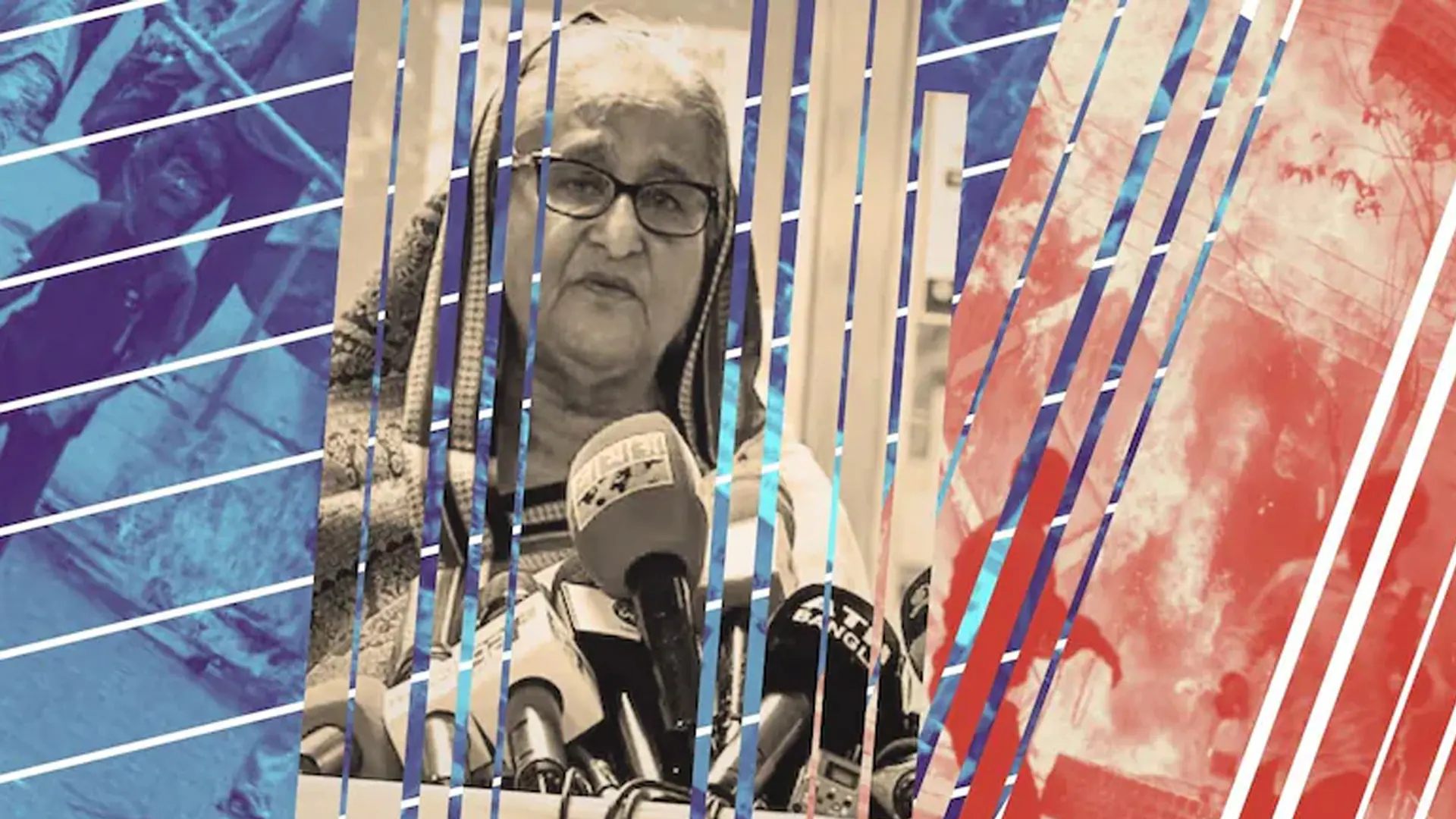
On August 5, in an audio address organized by New Delhi’s Foreign Correspondents’ Club of South Asia, Sheikh Hasina told Bangladesh she is coming home (Associated Press 2026). The staging was deliberate: the same date, two years on, that she had left Dhaka by helicopter as her government dissolved beneath her. This time she named a season rather than a date—December—and let the anniversary do the rest of the talking. What she is testing is not her own popularity, which by every available measure has not recovered, but something more structural: whether a political order built explicitly on the premise of her removal can absorb her physical return without cracking. A war-crimes tribunal has convicted her in absentia. Her party’s registration is suspended. An elected government now governs with a mandate that rests, in part, on her exclusion from it. Most exiled leaders return into a vacuum left by an opponent’s collapse. Hasina would be returning into an opponent’s success—a two-thirds parliamentary majority, an election the European Union’s observer mission judged credible and competitive, a government barely six months into consolidating itself. That inversion is the real puzzle, and it says more about the durability of Bangladesh’s institutions than about the seventy-eight-year-old former prime minister trying to walk back into them.
The outline is familiar. Protests against civil-service job quotas widened into a mass uprising in July 2024; security forces killed close to 1,400 people by United Nations count, though the interim government’s own tally, using a different cutoff, put the toll nearer 800 (CBS News 2025). Hasina fled on August 5, 2024. An interim administration under Muhammad Yunus suspended the Awami League’s registration in May 2025 (Peoples Dispatch 2025). Bangladesh’s International Crimes Tribunal convicted her that November on charges of crimes against humanity and sentenced her to death in absentia, a verdict Amnesty International and Human Rights Watch criticized on due-process grounds without disputing the underlying violence (Amnesty International 2025; Human Rights Watch 2025). An elected government under Tarique Rahman’s Bangladesh Nationalist Party took office in February 2026 (Kathmandu Post 2026). In July, Hasina told Reuters that she and senior colleagues intended to return “around December” and surrender voluntarily (Das 2026).
Table 1. Timeline of Key Political Developments, August 2024–August 2026
| Date | Development |
| Aug. 5, 2024 | Sheikh Hasina resigns and flees to India as mass protests topple her government; an interim administration under Muhammad Yunus takes charge three days later. |
| May 12, 2025 | The interim government bans Awami League activities; the Election Commission suspends the party’s registration, barring it from future elections. |
| Nov. 17, 2025 | The International Crimes Tribunal convicts Hasina in absentia on charges of crimes against humanity and sentences her to death. |
| Dec. 30, 2025 | BNP chairperson Khaleda Zia dies in Dhaka; her son Tarique Rahman, who had returned from London weeks earlier, inherits the party’s leadership. |
| Feb. 12, 2026 | Bangladesh holds its 13th parliamentary election; the BNP wins a landslide with the Awami League excluded from the ballot. |
| Feb. 17, 2026 | Tarique Rahman is sworn in as prime minister, ending eighteen months of interim rule. |
| Jul. 10, 2026 | Hasina gives her first interview since fleeing, telling Reuters she intends to return to Bangladesh around December 2026. |
| Aug. 5, 2026 | Hasina delivers an audio address from New Delhi on the second anniversary of her fall, reiterating her intent to return. |
Source: Associated Press; CBS News; Human Rights Watch; Kathmandu Post; Peoples Dispatch; Reuters (see References).
Exile has restored South Asian leaders before, but rarely on these terms. Benazir Bhutto came back to Pakistan in 2007 through a negotiated amnesty with a military ruler who needed her legitimacy more than she needed his permission, and was assassinated that December—her comeback completed only posthumously, through her party’s ballot-box victory weeks later (Council on Foreign Relations 2007). Khomeini returned to Iran in 1979 into a state whose government had already ceased to function: a vacancy to fill, not a rival to unseat (Britannica 2026). Tarique Rahman himself went home only in December 2025, after seventeen years in London, arriving days before his mother’s death and while the interim administration was already winding down—a vacuum of his own. Hasina’s closest precedent is not any of these. It is her own biography. She returned to Dhaka in 1981, after her family’s 1975 assassination, into an Awami League with no rival dynastic claimant and the moral claim of a founder’s daughter. Nearly every condition that made 1981 work has since reversed: a functioning rival government has replaced the vacuum, a capital conviction has replaced the clean legal record, and the anti-incumbency accumulated over fifteen years in power—compounded by a 2024 election contested without genuine opposition—has replaced the inherited martyrdom that carried her home the first time. If exile politics runs on time restoring what repression erased, Hasina is wagering that two years suffice; the more familiar cases suggest leaders wait five to seven, and not only for tactical reasons.
Table 2. Comparative Pathways of Exiled Political Leaders
| Leader | Country | Years in Exile | Conditions of Return | Outcome |
| Sheikh Hasina (1981) | Bangladesh | ~6 years | Returned after her family’s 1975 assassination; no rival dynastic claimant to the Awami League. | Rebuilt the party from opposition; became prime minister in 1996 and again in 2009. |
| Benazir Bhutto (2007) | Pakistan | ~8 years | Negotiated amnesty with a military ruler seeking her party’s electoral legitimacy. | Assassinated weeks after returning; her party won the following election in her absence. |
| Ayatollah Khomeini (1979) | Iran | ~14 years | Returned as the incumbent government collapsed entirely; no functioning rival to negotiate with. | Established a new political order within months. |
| Tarique Rahman (2025) | Bangladesh | 17 years | Returned as an interim administration wound down and his mother’s health failed. | Became prime minister roughly three months after returning. |
| Juan Guaidó | Venezuela | 2019–2022; U.S. since 2023 | Parallel government never controlled state institutions or territory. | No return to power achieved; recognition did not translate into office. |
| Sheikh Hasina (proposed, 2026) | Bangladesh | 2 years to date | Would return to a functioning elected rival government and an active death sentence. | Outcome pending. |
Source: Associated Press; Britannica; Council on Foreign Relations; Kathmandu Post (see References).
The Awami League’s dilemma follows from this. Fifteen years in power left it structurally dependent on one figure—no successor of comparable stature emerged even at its peak—which is exactly why her absence has proven so corrosive to the party’s organization, and why her return now reads as closer to existential than optional. But reviving the League requires more than her presence; it requires Bangladeshis forgiving, or forgetting, a governing record that had already accumulated heavy anti-incumbency before the uprising. Whether that arithmetic has shifted during two years of enforced absence is genuinely unknowable in advance. It is the uncertainty the return is designed to resolve, not a foregone conclusion in either direction.
Table 3. Bangladesh’s Principal Political Actors Since February 2026
| Actor | Position after February 2026 | Stated stance on Hasina’s return |
| Bangladesh Nationalist Party (Tarique Rahman, PM) | Governing party; won roughly two-thirds of parliamentary seats. | Non-committal in public; cites due legal process and has not itself pressed the extradition request. |
| Jamaat-e-Islami | Largest opposition bloc; 68 seats in its first election since an earlier ban was lifted. | Hardline; has publicly backed the death sentence being carried out. |
| National Citizen Party | Parliamentary opposition, formed out of the 2024 protest movement. | Hardline; has demanded extradition and accountability. |
| Awami League (Hasina, in exile) | Extra-parliamentary; registration suspended, barred from contesting elections. | Seeks reinstatement; treats Hasina’s return as central to organizational survival. |
| Government of India | Host of Hasina’s exile since August 2024. | States the extradition request remains “under examination”; no decision announced. |
Source: International Institute for Strategic Studies; Kathmandu Post; Peoples Dispatch; wire reporting (see References).
The legal route home runs through the same tribunal that convicted her. Bangladesh’s Supreme Court sits above the International Crimes Tribunal, and Hasina’s camp is wagering that an in-person appeal—which absentia proceedings do not permit—carries better odds than continued exile. That wager only holds if Dhaka’s courts remain separable from Dhaka’s politics, which is precisely what rights monitors doubt: the same tribunal sentenced Jamaat-e-Islami leaders to death under Hasina’s own government on similarly contested procedural grounds, a precedent Bangladesh’s rights community has not forgotten now that the defendant has changed. Transitional justice here has functioned, so far, less as a settled mechanism than as an instrument that changes hands along with the government.
For India, the 2013 extradition treaty, streamlined in 2016, complicates rather than resolves the choice: it excludes murder and mass-casualty offenses from its political-offense exception, and precedent runs in both directions, from Bangladesh’s extradition of ULFA’s Anup Chetia to India’s 2020 handover of two men convicted in the 1975 killing of Hasina’s father. The more plausible shelter, legal analysts note, is a thinner, more discretionary clause permitting refusal where a request is not made in good faith or a trial would fall short of fair-process standards (Business Standard 2024)—defensible, and genuinely awkward to sustain indefinitely against a government that has so far sent its prime minister to Malaysia and China before Delhi. Allegations from Hasina’s camp of deepening Pakistani intelligence influence inside Bangladesh remain unverified by any independent body—yet they have entered India’s calculus regardless.
The wider region offers no single template. Sri Lanka’s Rajapaksas, forced out by mass protest in 2022, re-entered parliamentary politics without facing prosecution on a comparable scale. Nepal’s Gen Z uprising last September produced a caretaker government and a transition to elected leadership within seven months, faster than Bangladesh’s eighteen. Myanmar shows the opposite outcome: five years after its coup, the junta has simply legitimized itself through a stage-managed election, Aung San Suu Kyi still detained, no return in sight (International Crisis Group 2026). Bangladesh sits between Nepal’s speed and Myanmar’s freeze, which is itself informative—post-uprising states either normalize quickly enough that old scores go moot, or harden until return is foreclosed entirely. Bangladesh’s hybrid of tribunal and ballot box is the least-tested of the three paths.
What deserves watching is narrower than whether Hasina physically lands in Dhaka: whether the Supreme Court accepts an in-person appeal at all, whether Rahman can keep Jamaat-e-Islami and the National Citizen Party from setting the terms of her reception, and whether Rahman visits India at all in the coming months. Any one of those would answer more than the return itself. Whether Hasina ultimately comes home may matter less than what the attempt has already exposed: a tribunal verdict no appellate court has yet tested, a ruling party managing rivals to its right more than its left, and a neighbor whose patience with ambiguity is not unlimited. The next six months will show whether a completed regime change can still be negotiated with after the fact—or whether, in South Asia, exile remains the only door that reliably swings both ways.