During the first two decades of the new millennium, Bangladesh’s economy has undergone a remarkable transition from an aid-dependent agricultural economy to a manufacturing and export-oriented economy. Its transition was widely cited as a success of its development model to be emulated. In the process, the country has significantly reduced poverty, improved social indicators, and emerged as the second-largest exporter of ready-made garments (RMGs) in the world.
Macro-economy
The country’s GDP grew at an average annual rate of 6.6% between 2010 and 2019, reaching its peak of 7.9% in 2019.1 Its per capita income also soared as a result, even surpassing India’s per capita income temporarily between 2019 and 2023.2 As a development milestone, in November 2021, the UN General Assembly approved its graduation from the category of Least Developed Country (LDC) to a Developing Country after a preparatory period of 5 years. But the intervening years have exposed the fault lines in this development trajectory. The impressive headline growth rates masked serious structural problems such as high inflation, dwindling foreign-exchange reserves, fragility of the banking sector, weak tax collection, insufficient private investment, and rising balance-of-payments stress. The political convulsions of July-August 2024, which ended Sheikh Hasina’s fifteen-year rule and brought Muhammad Yunus to the helm of an interim administration, plunged Bangladesh into a deep state of political instability and economic precariousness. The social chaos and the growing economic instability that followed the regime change severely damaged the country’s institutions and impeded its economic progress.
The elections in February 2026 brought in a government headed by the Bangladesh Nationalist Party (BNP), but the change of government did little to bring a turnaround in the economy. In its October 2023 forecast, the World Bank projected Bangladesh’s real GDP growth to decelerate to only 3.4% in FY2026, a significant slowdown from its historically strong growth trajectory.3 Bottlenecks in the energy sector persist, the banking sector remains fragile, and low domestic incomes limit investment, consumption and overall economic participation, all constraining the economic recovery. On October 29, 2026, the UN General Assembly extended its preparatory time by three years to November 24, 2029, at the government’s request. The decision was made due to the country’s structural vulnerabilities and need for more preparation – if designated as a Developing Country, Bangladesh will progressively lose access to special trade agreements and other LDC-specific privileges, so this reprieve was crucial for the country.
Though low growth rate is Bangladesh’s most visible economic problem, it isn’t the only one. The present decline is not the result of a single cyclical shock but reflects macroeconomic volatility, institutional weaknesses, and declining investments. As of September 2026, the headline inflation remained at 8.3%, and since 2022-23, inflation has remained above 9%, reaching 10% in 2024-25. In September 2026, international reserves stood at US$31.20 billion, worth only 4.8 months of imports. Bangladesh was already under the IMF bailout program, negotiated by the Sheikh Hasina government in 2023, and received $2.48 billion in assistance during 2024 and 2025 out of a total negotiated package of $ 4.7 billion.4 These are mainly to finance imports, while the country continues to suffer from investment challenges, high inflation, high borrowing costs, and banking system uncertainty, which together impede industrial productivity. The IMF’s Article IV assessment in January 2026 projected gross investment to fall to 24.1% of GDP in FY26 from 28.5% in FY25.5
Poverty, Inequality and Unemployment
Between 2010 and 2022, the country’s rapid economic growth, driven by export-oriented industrialisation, lifted 34 million people out of poverty, but the benefits of such growth have remained highly uneven. 6 World Bank data shows that the proportion of people living below the national upper poverty line (Tk 3821 per person per month or $1.49 per day, against $3.90 in lower middle-income countries) fell from 37.1% in 2010 to 26.4% in 2016 and further to 18.7% in 2022, while the share of people living in extreme poverty (US$1 per person per day) fell from 12.2% to just 5.6%. But since then, the pace of poverty reduction has decelerated, indicating a decline in the inclusiveness of economic growth. The World Bank’s Bangladesh Poverty and Equity Assessment 2025 projections show that national poverty rose from 18.7% in 2022 to 21.2% in 2025, due to persistent inflation, insufficient job creation, and falling real wages for low-skilled workers. 7 About 62 million people, almost one third of the population, are still vulnerable to falling back into poverty due to illness, natural disasters to which the country is particularly prone, or other economic shocks.
The more serious problem is inequality. Economists use a parameter called the Gini coefficient to measure inequality—a coefficient equal to 0 means absolute equality, while a coefficient equal to 1 implies absolute inequality. The Household Income and Expenditure Survey (HIES) 2022 conducted by the Bangladesh Bureau of Statistics shows that the income Gini coefficient has increased from 0.458 in 2010 to 0.482 in 2016 and 0.499 in 2022. The Gini coefficient for urban income rose from 0.498 in 2016 to 0.539 in 2022, while the rural Gini coefficient fell from 0.454 to 0.446. The concentration of income was indeed striking: the richest 5% of households received 30.04% of national income in 2022, whereas the poorest 5% received a mere 0.37%. The richest 10% accounted for 40.92% of household income.8 Clearly, the benefits of economic expansion have not percolated to the lower-income sections. 35% of the richest households received social protection benefits in 2022, while half of the poorest households received none.9
Unemployment and the crisis of job creation constitute perhaps the most serious structural challenges facing the country today. As per the Labour Force Survey 2024 of the Bangladesh Bureau of Statistics, the unemployment rate climbed to 3.66% in 2024, up from 3.53% in 2022. At 4.4%, the urban unemployment rate was also much higher than the rural unemployment rate of 3.4%. The headline unemployment rate, however, understates the magnitude of the employment problem. Approximately 84% of employed people were engaged in informal employment, characterised by low wages, limited or no job security and inadequate or no social protection. Agriculture still accounted for 44.67% of employment, while industry provided only 17.37%.10
Youth unemployment is of particular concern. The Bangladesh Bureau of Statistics Labour Force Survey 2023 estimated that 1.94 million people aged 15–29 were unemployed. Nearly 79% of all the unemployed belonged to this age group. Even more disturbing was the fact that 31.5% of unemployed young people with the requisite labour-market availability had completed tertiary education, pointing to a serious mismatch between educational qualifications and employment opportunities.11 The youth NEET (not in education, employment, or training) population was approximately 8.56 million in 2024, with women being disproportionately represented. The World Bank’s November 2025 assessment estimates that one in five young women remained unemployed, rising to one in four among educated young women. Employment declined by nearly two million between 2023 and 2024, with a further decline of 0.8 million estimated for 2025. The burden has fallen disproportionately on women and young people—half the young people aged 15–29 were employed in low-paying jobs.12 Bangladesh’s experience demonstrates that high growth and falling poverty alone do not automatically ensure equitable development. Without a stronger employment base and a more equitable distribution of the gains from growth, even impressive growth loses much of its social and economic momentum.
Industrial Sector
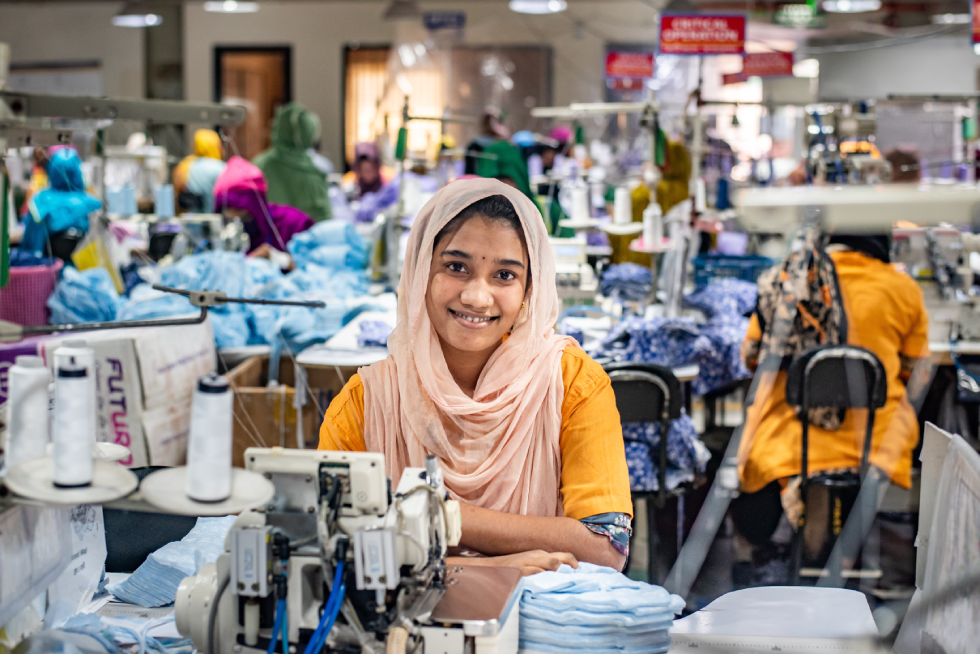
Bangladesh has undergone a significant industrial transformation over the past three decades, moving from an agrarian economy towards a manufacturing-oriented one. Industry accounted for 37.44% of GDP in FY2024–25, with manufacturing alone contributing 24.99%.13 The industrial landscape, however, remains heavily dominated by the ready-made garments (RMG) industry. The country’s previous success was due to the growth of labour-intensive manufacturing—particularly RMG, rising worker remittances, and public and private investments in infrastructure, all of which have helped to boost domestic consumption and move labour out of subsistence agriculture. Bangladesh is the world’s second-largest garment exporter after China. Of the total exports of US$46.96 billion in FY 2026, RMG exports alone constituted US$38.97 billion (83%). Other merchandise exports amounted to only US$ 7.99 billion (17%).14 RMG industry has always accounted for 80–85% of merchandise export earnings and employs around four million workers, predominantly women. Its extensive backward linkages with textiles, spinning, dyeing and accessories have created an integrated manufacturing ecosystem.15
Beyond garments, Bangladesh has developed a range of promising industries, though their contribution to GDP is rather limited. Most non-garment industries are relatively small and struggle with inadequate technology, skills, access to finance, infrastructure bottlenecks and international compliance standards. However, they are nonetheless domestically very important; pharmaceuticals meet approximately 98% of domestic medicinal demand. Leather and footwear constitute the second-largest export-oriented industrial segment, earning around US$1.5 billion in 2024. Other important industries include jute and jute products, steel, cement, ceramics, plastics, fertilisers, shipbuilding, food processing and light engineering. The plastics industry, with over 6,000 manufacturing units, is increasingly serving both domestic and export markets.16
The RMG sector’s share of nominal GDP declined to 7.82% in FY26 from 8.52% in FY25.17 The overwhelming dependence on garments exposes the economy to changes in global demand, trade preferences, labour costs and protectionist policies. The United States remained Bangladesh’s largest export destination, and Bangladesh lost approximately $280 million in US garment export earnings during the first nine months of 2026 compared with the corresponding period of 2025 due to Trump’s tariff disruptions. However, it did not lose much of its comparative advantage vis-à-vis other major exporters like India, China and Vietnam. Exports to the US market reached $9.04 billion during FY2025-26, an increase of 4% from the previous fiscal year.18
The key question is whether Bangladesh can now move away from dependence on low-cost garment exports, remittance inflows and politically controlled finance to a more diverse, productive and institutionally sustainable development model. The RMG sector has been the engine of its export-led industrialisation, generating foreign exchange, providing employment to millions, mostly women, and integrating textiles, transport, logistics and financial services. But in recent times, worker protests over demands for a higher minimum wage from Tk 12,500 to Tk 30,000 have led to roadblocks, police violence, and factory closures. On November 4, Reuters reported that hundreds of firms have halted operations, affecting supply plans during a crucial time for overseas customers. The government has a six-person wage board to review the workers’ demands. Bangladesh’s international competitiveness is largely due to cheap labour, but rising living costs have made it harder for workers to maintain their earnings. Manufacturers are also facing growing energy, transportation, and financing expenses and international customer pressure to keep prices low. Industry margins are often a paltry 2–3%. Diversification from the RMG is an urgent need for the country.
External Sector
Bangladesh has achieved considerable export growth without much diversification, leaving its foreign-exchange earnings highly vulnerable to fluctuations in global apparel demand, trade preferences, and competitiveness. Leaving out the RMG, the remaining export basket is relatively small and fragmented. Leather and leather products contributed 2.4%, jute and jute goods 1.9%, and home textiles 1.6% to total exports, while footwear and agricultural products contributed smaller shares. Pharmaceuticals, plastics, engineering products, and frozen seafood offer opportunities for diversification but remain relatively insignificant.19
Unlike exports, Bangladesh’s import structure is much more diversified. Merchandise imports stood at US$67.3 billion in FY2024-25, an increase over US$63.2 billion in FY2023-24. Capital goods alone accounted for 14% of imports, while textiles and textile articles accounted for 13.1%. China remains the largest supplier, accounting for approximately 27% of imports (US$18.2 billion), followed by India at 14.2% (US$9.6 billion). Other important suppliers include Indonesia (5.3%), Singapore (4.3%), the USA (4%), Brazil (3.9%), Malaysia (3.4%), Qatar (3.2%), and Japan (2.8%). The geographical pattern reflects distinct supply relationships: China dominates machinery, electrical equipment, steel, and manufactured industrial inputs; India is a major source of cotton, yarn, food products, and other intermediate goods, and also electricity. Indonesia and Brazil supply palm oil, coal, sugar, and agricultural commodities, while Qatar and other Gulf countries are important energy suppliers. Singapore serves as a significant petroleum and trading hub.20
Power
A crucial factor for the industrial economy of Bangladesh is the easy availability of cheap energy, but it has been facing major supply-side restrictions. Electricity-generation capacity has increased from 12,365 MW in FY 2016 to 29,593 MW in FY 2026, but gas and other fuel shortages have led to suboptimal utilisation of capacity. The power sector subsidies also strain governmental finances. The Bangladesh Power Development Board’s average bulk supply cost was Tk 12.34 per kWh in FY25, compared to Tk 6.80 selling price, according to Bangladesh Policy Lab data. Despite government subsidies of Tk 38,637 crore, the BPDB lost Tk 17,021 crore.21 Clearly, capacity expansion has not been matched by primary energy availability, fuel import affordability, or power distribution system financial viability. Bangladesh must first diversify its energy sources by investing more in solar and other renewable energy and boosting power plant efficiency. Its current gas reserve is estimated to last only 12 years at the current rate of consumption.22
During Muhammad Yunus’s interim government (August 2024–February 2026), Bangladesh subjected its 25-year, 1,496 MW electricity purchase agreement with Adani Power, signed in 2017 under Sheikh Hasina, to scrutiny. A government-appointed review committee found the electricity approximately 40% pricier than that of its nearest private-sector competitor. It identified the coal-pricing and tax provisions as questionable, as well as alleged procurement irregularities. Bangladesh also disputed outstanding payments, prompting Adani to halve supplies in October 2024. Although payments subsequently improved and full supplies resumed in March 2025, the agreement remained intact, with renegotiation or international arbitration under consideration.23
Financial Sector
In the financial sector, the various indicators are pointing to a grim economic situation. Since January 2024, the Taka has depreciated from 110 to 124 per dollar, causing increases in the domestic cost of imported petroleum, fertilisers, food, industrial raw materials, and capital goods. Energy shortages and transportation delays have driven up manufacturing and distribution costs. The banking sector is also facing an acute crisis; politically motivated lending, credit concentration, poor governance, regulatory tolerance, and insufficient loan recovery have plagued the banking industry for years. The gross Non-Performing Loan (NPL) ratio has increased from 10.1% in December 2023 to 32.8% in June 2026.24 The system-wide capital-to-risk-weighted-assets ratio dropped to -2.64% in December 2025, way below the Basel III minimum requirement of 10%. The banking system, which makes up 90% of Bangladesh’s financial industry, is now severely undercapitalised. Bangladesh Bank has instituted certain reforms, and in June 2026, the World Bank granted $450 million to improve deposit protection, banking oversight, bank resolution, and state-owned bank restructuring.
Public Finance
With a narrow tax base due to the presence of a large informal sector and the consequent limited fiscal capacity, Bangladesh has little room for fiscal manoeuvring. Its taxes constituted just above 7% of GDP in FY 2026, which dropped below 7% the previous year, the lowest in 15 years. This was among the world’s lowest revenue performances and severely limited the government’s ability to fund public investments, social protection, education, healthcare, and infrastructure. A narrow direct-tax base, exemptions, tax evasion, informal economic activity, inadequate property taxes, and tax administration deficiencies have limited revenue mobilisation. In its January 2026 Article IV review, the IMF warned that fiscal and financial reform delays posed considerable economic risks.25 Table 1 shows a snapshot of its public finances.
Table 1: Government revenue and expenditure (Tk billion)
| Indicator | 2022–23 | 2023–24 | 2024–25 | 2025–26 Est. |
|---|---|---|---|---|
| Total revenue | 3,699 | 4,171 | 4,382 | 5,161 |
| Tax revenue | 3,277 | 3,697 | 3,773 | 4,512 |
| Non-tax revenue | 395 | 424 | 573 | 613 |
| Total expenditure | 5,670 | 6,020 | 5,999 | 7,864 |
| Current expenditure | 3,572 | 3,912 | 4,449 | 5,195 |
| Interest payments | 921 | 1,148 | 1,248 | 1,450 |
| Annual Development Programme (ADP) | 1,912 | 1,935 | 1,258 | 2,154 |
| Non-ADP capital expenditure | 215 | 231 | 230 | 452 |
| Fiscal Deficit | 1971 | 1849 | 1617 | 2703 |
| Primary Deficit | 1050 | 701 | 369 | 1253 |
| Fiscal Deficit as % of GDP | -4.4 | -3.7 | -2.9 | -4.3 |
| Primary Deficit as % of GDP | -2.3 | -1.4 | -0.7 | -2.0 |
| GDP Growth Rates | 5.8 | 4.2 | 3.7 | 4.7 |
| GDP | 44,908 | 50,027 | 55,029 | 62,637 |
| Outstanding Debt | 17,828 | 20,511 | 23,167 | 26,558 |
| Tax: GDP Ratio (%) | 7.3 | 7.4 | 6.9 | 7.2 |
| Debt: GDP Ratio (%) | 39.7 | 41.0 | 42.1 | 42.4 |
Source: IMF Country Report No. 26/024, Table 3a, IMF’s January 2026 Article IV report.
The fiscal deficit came down from 4.4% of GDP in FY 2023 to 3.7% of GDP in FY 2025, but not as a result of fiscal consolidation or additional revenue mobilisation. The lowering of the fiscal deficit was primarily due to a sharp reduction in capital spending in FY25. ADP expenditure, or expenditure for the creation of income-generating capital assets in the economy, decreased by as much as 35%, from Tk 1,935 billion in FY24 to Tk 1,258 billion in FY 2025, which would have a long-term impact on the country’s growth.
Chart 1 shows the sustainability of the public debt of the Bangladesh government. None of the two necessary conditions for debt sustainability, i.e., (1) the GDP growth rate must exceed the interest rate and (2) the primary balance should be positive, have been satisfied since 2022-23. As a result, the debt ratio has increased from 39% in FY 2022 to 42% of GDP in FY 2025 and has remained so in FY 2026. Interest payments increased from 2.0% to 2.3% of GDP between FY22 and FY25. Although the primary deficit narrowed to 0.7% in FY25, it is projected to widen to 2% in FY26. Both do not augur well for the public finances of the Bangladesh government and indicate that the future sustainability of public debt is at risk and needs urgent attention from the government.
Chart 1: Sustainability of Public Debt

Source: IMF Country Report No. 26/024, Table 3a, IMF’s January 2026 Article IV report.
Summing up, Bangladesh is at a crucial economic crossroads. Recent problems have highlighted the limits of a development paradigm that achieved strong headline growth but failed to address the basic structural deficiencies like inequality, skewed industrial production and exports, narrowness of the tax base, and the risk of unsustainability of public debt. Bangladesh’s economy and production structure urgently require diversification and the implementation of long-delayed institutional and structural changes. The immediate goal should be to rebuild trust in banking, control inflation, increase energy supplies, and stimulate private investment. The ultimate test of Bangladesh’s economic transformation will not be its ability to achieve 6-7% GDP growth but whether such growth flows from higher productivity, more diversified manufacturing, stronger public institutions, and more equitable economic distribution.
The copyright of this article remains with the Politeia Research Foundation ©️PRF.
Endnotes
- World Bank and OECD national accounts, from Bangladesh Bureau of Statistics, via World Bank WDI (NY.GDP.MKTP.KD.ZG). Processed by DEEPLAB, https://de3plab.org/data-gdp-growth (data updated October 19, 2026). ↩
- World Bank. “DataBank.” Accessed November 10, 2026. https://databank.worldbank.org/reports.aspx? ↩
- The IMF (Jan 2026) forecasts were a little more generous at 3.7% and 4.7% in FY 2025 and FY 2026 respectively. Please see Table 1. ↩
- “IMF Executive Board Concludes Bangladesh Combined Third And Fourth Reviews Under The Extended Credit Facility, Extended Fund Facility, And Resilience And Sustainability Facility.” International Monetary Fund, June 23, 2025, https://ebs.publicnow.com/view/4B33281906E075318DB0534BE1CF8403F83B9054? ↩
- International Monetary Fund. Bangladesh: 2025 Article IV Consultation. IMF Country Report No. 26/[24]. Washington, DC: International Monetary Fund, January 2026, https://www.imf.org/-/media/files/publications/cr/2026/english/1bgdea2026001-source-pdf.pdf ↩
- World Bank. Bangladesh: Poverty and Equity Brief. Washington, DC: World Bank, October 2026. IDU-c56b9657-74d2-45ab-ba59-3dd8d12ff803.pdf ↩
- Jean Pesme, “Going beyond growth: How Bangladesh can tackle poverty and inequality through job creation.” World Bank Blog on End Poverty in South Asia, December 03, 2025, https://blogs.worldbank.org/en/endpovertyinsouthasia/going-beyond-growth–how-bangladesh-can-tackle-poverty-and-inequ ↩
- Bangladesh Bureau of Statistics. “Household Income and Expenditure Survey (HIES) 2022.” (Dhaka: Bangladesh Bureau of Statistics, April 12, 2023). https://buhn.org/uploads/files/resources/reports/national/13_Household%20Income%20and%20Expenditure%20Survey%20%28HIES%29%202022.pdf ↩
- World Bank 2025. “Bangladesh’s Poverty and Equity Assessment Navigating The Road To Prosperity.” (Washington, DC: World Bank, 2025) P501761-dfa72c79-9394-4291-83e1-ea462da8221f.pdf ↩
- “BD Jobless Rate Hits 3-Yr High at 3.66pc in 2024.” Financial Express, 12 September 2025, https://today.thefinancialexpress.com.bd/print/bd-jobless-rate-hits-3-yr-high-at-366pc-in-2024-1757610230 ↩
- “1.94 Million Youth Unemployed: BBS Survey.” The Business Standard, December 22, 2024, https://www.tbsnews.net/bangladesh/194-million-youth-unemployed-bbs-survey-1025001 ↩
- World Bank. “Job Creation Key to Equality and Faster Poverty Reduction in Bangladesh, Says World Bank.” Press release, November 25, 2025. https://www.worldbank.org/en/news/press-release/2025/11/25/job-creation-key-to-equality-and-faster-poverty-reduction-in-bangladesh-says-world-bank ↩
- Bangladesh Bank. “Annual Report 2024–2025.” (Dhaka: Bangladesh Bank, 2025). https://www.bb.org.bd/pub/annual/anreport/ar2024-2025.pdf ↩
- “RMG Faces Stiffer Competition, Rising Cost: BB.” Daily Star. August 26, 2026. https://www.thedailystar.net/business/economy/news/rmg-faces-stiffer-competition-rising-cost-bb-4256921 ↩
- Bangladesh Investment Development Authority. “Leather and Footwear.” Invest Bangladesh. 2026. https://investbangladesh.gov.bd/investment-sector/leather-footwear ↩
- Ibid ↩
- “RMG Faces Stiffer Competition, Rising Cost: BB.” Daily Star. August 26, 2026. https://www.thedailystar.net/business/economy/news/rmg-faces-stiffer-competition-rising-cost-bb-4256921 ↩
- “Bangladesh Closes FY2025–26 with $ 48.00 Billion in Exports.” Textile Today, July 02, 2026. https://www.textiletoday.com.bd/bangladesh-closes-fy2025-26-with-4800-billion-in-exports ↩
- Bangladesh Bank. “Balance of Payments & International Investment Position of Bangladesh 2024–25.” (Dhaka: Bangladesh Bank, 2025). https://www.bb.org.bd/pub/annual/bop/bop%2024-25.pdf ↩
- Bangladesh Bank. “Country–wise import payments 2024-2025.” https://www.bb.org.bd/econdata/import/yearly/top_tweenty_import_countries.pdf ↩
- Short of Fuel, not of Plants Bangladesh’s Electricity in 2025-2026, Bangladesh Policy Laboratory, 23 October 2026, https://www.bdpolicylab.com/publications/2026-10-23-electricity-bad-equilibrium ↩
- “Bangladesh’s Remaining Gas Reserve 7.63 TCF, Enough for 12 Years: Energy Minister.” United News of Bangladesh, April 19, 2026. https://unb.com.bd/category/Bangladesh/bangladeshs-remaining-gas-reserve-763-tcf-enough-for-12-years-energy-minister/183997?utm_source=chatgpt.com ↩
- Ruma Paul and Sudarshan Varadhan, “Bangladesh panel says Adani power deal overpriced, flags procedural flaws,” Reuters, January 26, 2026 https://www.reuters.com/business/energy/bangladesh-panel-says-adani-power-deal-overpriced-flags-procedural-flaws-2026-01-26/ ↩
- “One in every three taka of bank loans now in default,” Dhaka Tribune, September 03, 2026, https://www.dhakatribune.com/business/419008/bangladesh-ranks-1-globally-for-npls ↩
- International Monetary Fund. “Bangladesh: IMF Executive Board Concludes 2025 Article IV Consultation.” Press release no. 26/29, January 30, 2026. https://www.imf.org/en/news/articles/2026/01/30/pr-26029-bangladesh-imf-executive-board-concludes-2025-article-iv-consultation; World Bank. “Bangladesh Needs Urgent Financial, Energy and Revenue Reforms to Restore Growth, Create Jobs” Press release, October 6, 2026. https://www.worldbank.org/en/news/press-release/2026/10/06/bangladesh-needs-urgent-financial-energy-and-revenue-reforms-to-restore-growth-cre ↩