
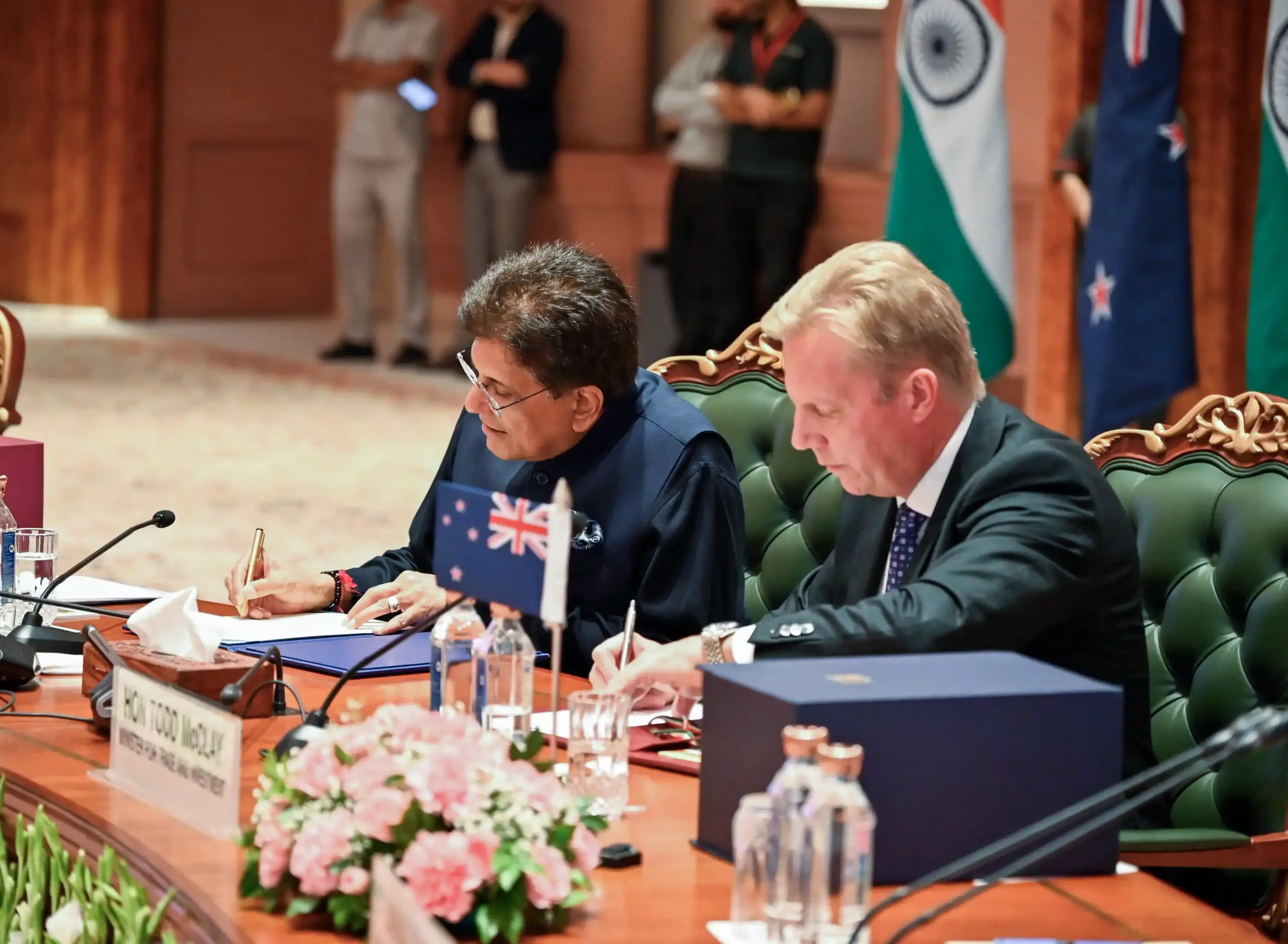
The India–New Zealand Free Trade Agreement is a broad trade deal designed to expand goods trade, services, investment, and professional mobility while protecting sensitive sectors on both sides. Its core logic is simple: India gets much wider access to New Zealand’s market, New Zealand gets improved access to India’s huge consumer base, and both governments use the pact to deepen economic ties beyond tariffs alone.
The agreement goes far beyond lower customs duties. It includes trade in goods, services access, education and mobility arrangements, investment cooperation, rules for MSMEs, and commitments on organic products and regulatory coordination. New Zealand also committed to facilitate USD 20 billion in investment into India over 15 years, which gives the pact a long-term economic dimension rather than just a tariff-cutting one.
Benefits for India
For India, the biggest gain is immediate zero-duty access for 100% of exports to New Zealand, which removes tariff barriers across the full export basket. That matters especially for labor-intensive sectors such as textiles, apparel, leather, carpets, and auto components, which can become more price-competitive in a high-income market. The deal also opens services opportunities across 118 sectors and creates new pathways for students and skilled professionals, including temporary work routes and mobility provisions.
India also protected its most sensitive domestic interests, especially dairy and other vulnerable agricultural products, by excluding them from concessions. That is important politically and economically because it shields millions of small farmers from sudden import pressure. In practical terms, India gained market access without giving up the sectors it considers strategically non-negotiable.
Benefits for New Zealand
New Zealand’s biggest win is preferential access to one of the world’s fastest-growing large markets. The agreement gives New Zealand tariff-free or preferential access for about 95% of its current exports over time, with more than half seeing full elimination immediately and more than 80% benefiting over time. That should help New Zealand exporters in sectors like forestry, horticulture, manufacturing inputs, meat, and services compete better in India.
The deal also improves New Zealand’s longer-term economic position in Asia. India’s scale gives New Zealand a chance to diversify away from narrower export markets, which is valuable in a period of global trade uncertainty. Even where India has retained protection, the agreement still creates a more predictable framework for New Zealand firms to plan investment, distribution, and partnerships.
Trade balance and market access
This FTA is not symmetrical in every detail, and that is intentional. India has opened roughly 70% of tariff lines while excluding around 30% of sensitive items, whereas New Zealand has offered much broader access to Indian goods. In other words, India used the negotiation to gain export and services benefits while preserving policy space in agriculture.
A useful way to think about it is that India’s gains are strongest in exports and jobs, while New Zealand’s gains are strongest in market entry and diversification. The deal is therefore less about equal tariff concessions and more about complementary strengths: India’s labor- and services-driven export base versus New Zealand’s high-quality goods and niche services.
Services, skills, and students
One of the most important parts of the agreement is the movement of people, especially for education and professional services. Indian students get better mobility terms, while Indian professionals in fields like IT, engineering, healthcare, yoga, and hospitality get clearer access routes into New Zealand. That is strategically significant because India’s comparative advantage is increasingly in services, not just manufacturing.
For New Zealand, this can help fill skill shortages and strengthen links with a large pool of qualified workers and students. For India, it creates better overseas opportunities, remittance potential, and stronger international exposure for talent. These people-to-people channels often matter as much as tariffs because they build business networks, education partnerships, and long-run trust.
Why it matters strategically
The agreement also has strategic value beyond commerce. India is steadily broadening its trade partnerships, and New Zealand gains a stronger foothold in South Asia through a rules-based arrangement with one of the region’s biggest economies. For both countries, this reduces dependence on a narrow set of markets and creates a more resilient economic relationship.
It also sends a signal that middle powers can still build practical trade coalitions even in a fractured global trading environment. The FTA combines openness with protection, which is why it has been described as a “balanced” deal rather than a sweeping liberalization pact. That balance is likely to shape how both governments defend the agreement domestically and how businesses use it in the years ahead.
An example
Consider an Indian textile exporter selling to New Zealand. Under the FTA, that firm can ship goods without the tariff burden that previously raised prices and reduced competitiveness. At the same time, a New Zealand food or forestry exporter can access the Indian market with better tariff treatment than before, though not in protected sectors like dairy.
The India–New Zealand FTA is therefore best understood as a trade-and-cooperation package rather than a narrow tariff deal. It helps India scale exports and services, helps New Zealand enter a vast and growing market, and creates structured channels for investment, education, and skilled mobility.

