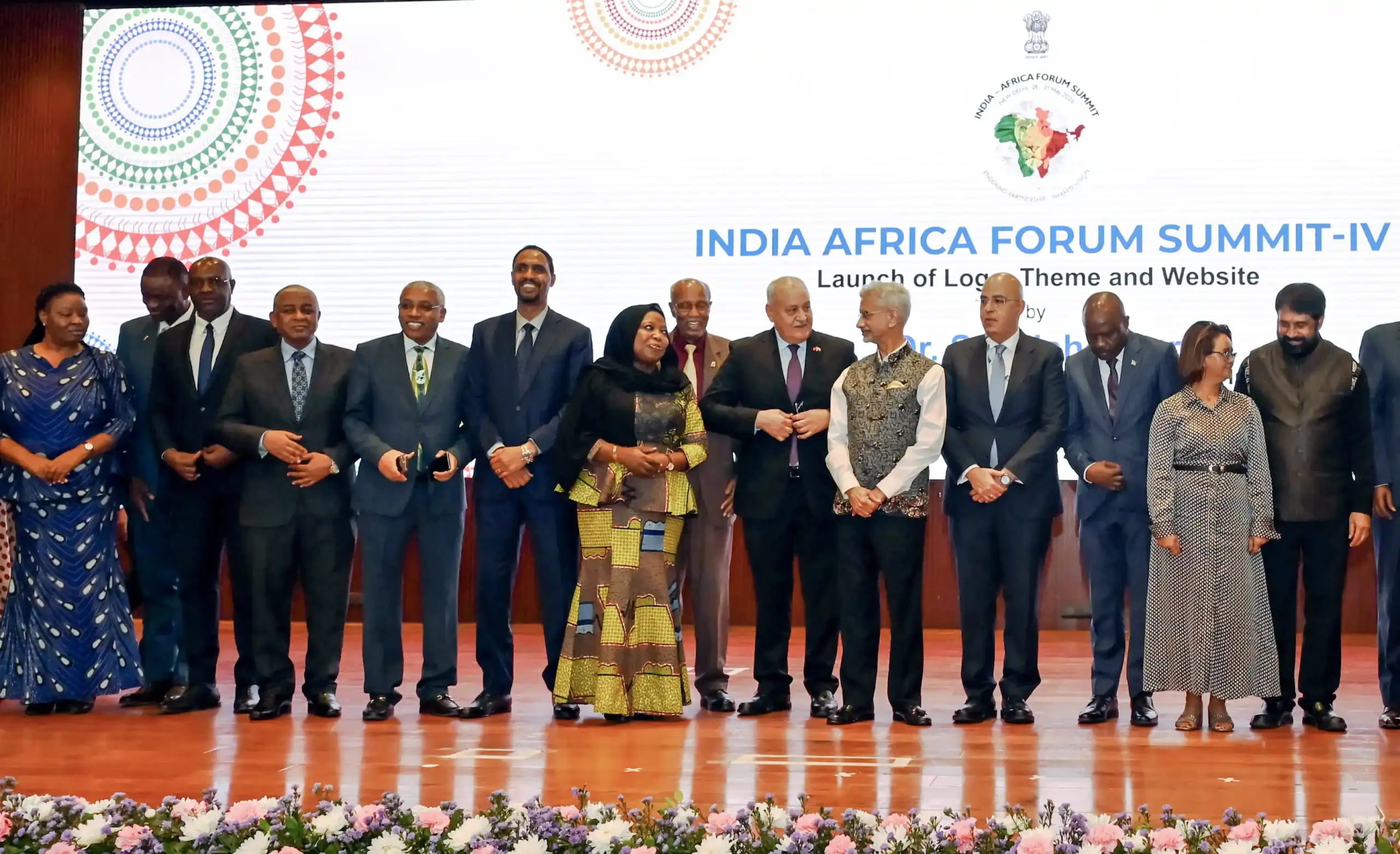
On 31 May 2026, leaders from across Africa and India will gather in New Delhi, India, for the fourth India-Africa Forum Summit — the first such convening in over a decade. The timing could scarcely be more significant. The summit has been held three times before: in New Delhi in 2008, Addis Ababa in 2011, and again in New Delhi in 2015. That eleven-year gap speaks to how crowded and chaotic the intervening years have been. But it also makes what is about to happen more meaningful. This is not routine diplomacy. It is a renewal, and the foundations for something genuinely transformative are already in place.
The theme chosen for the summit captures that ambition well: “IA SPIRIT — India Africa Strategic Partnership for Innovation, Resilience, and Inclusive Transformation.” Ambitious language, perhaps. But the numbers behind it are real.
India-Africa bilateral trade has grown from around $4.45 billion in 2000-01 to over $103 billion in the 2024-25 financial year — a roughly twenty-fold increase. India is now Africa’s third-largest trading partner after the European Union and China. Both sides have set their sights even higher: a target of $164 billion by 2030 was announced at the CII India-Africa Business Conclave in August 2025, requiring sustained annual growth of around 12%. That is an ambitious goal — but it reflects a genuine convergence of interests rather than wishful thinking.
The case for a deeper partnership has been sharpened by global disruption. The ongoing crisis in the Persian Gulf has sent tremors through energy markets worldwide. For Africa’s import-dependent economies, rising fuel costs cascade quickly into higher food prices, transport costs, and pressure on already-stretched public finances. For India, the crisis has exposed the risks of excessive dependence on West Asian energy — nearly half its crude oil imports and the bulk of its LNG pass through the Strait of Hormuz. Both sides, facing the same volatile world from different angles, have strong reasons to look to each other.
And Africa’s energy picture is changing. India, as a major energy consumer seeking to diversify its supply sources, presents a stable and growing market for African oil and gas producers such as Nigeria, Angola, and Algeria. Long-term energy agreements could provide these countries with more predictable revenues, while also incentivizing investments in infrastructure and production capacity. These are supply chains that bypass the Hormuz chokepoint entirely. African maritime routes — including, if necessary, the Cape of Good Hope — offer India logistical alternatives that are less vulnerable to regional conflict. In a world of concentrated supply risks, geography has suddenly become a very valuable asset.
Beyond energy, the complementarity runs deep. Indian pharmaceutical companies have established production facilities in African countries like Nigeria, Kenya, and South Africa, contributing to more affordable healthcare. Indian pharmaceutical exports to Africa stood at $3.8 billion in 2023, with significant potential to expand affordable healthcare solutions across the continent. This is not charity — it is a partnership. African patients gain access to medicines they could not otherwise afford; Indian manufacturers gain growing markets and local manufacturing footholds. Everybody wins.
The same logic applies to agriculture and digital infrastructure. India has invested in agri-tech initiatives for African smallholder farmers, deploying technologies including drones and artificial intelligence for agricultural production, yield prediction, and soil health monitoring. North African countries, meanwhile, are major producers of phosphates and fertilizers — inputs that India needs desperately as it seeks to reduce its own agricultural vulnerability to supply shocks. India and Africa have also been deepening collaboration through the International Solar Alliance, the Global Biofuels Alliance, and the Coalition for Disaster Resilient Infrastructure — institutions that position both sides as architects of the clean energy transition, not just spectators of it.
Then there is the digital dimension, which may prove to be the most exciting frontier of all. India’s digital public infrastructure — from the Unified Payments Interface (UPI) to the Aadhaar identity system — has transformed financial inclusion at home at a speed and scale the world has rarely seen. India is now collaborating with African nations on digital infrastructure, payment platforms, energy projects, and more — from tech stack adoption in countries like Ghana and Angola to partnerships between Indian public sector firms and African energy providers. Expanding UPI-style payment infrastructure across Africa could reduce transaction costs dramatically, bringing millions of unbanked citizens into formal economies for the first time.
Capacity building has also been a quiet but significant pillar of the relationship. More than 40,000 African students have benefited from the ITEC program, with training provided in India, and more than 15,000 students from 22 African nations have received scholarships under the e-Vidya Bharti and e-Arogya Bharti tele-education projects. These are not statistics. They are engineers, doctors, and entrepreneurs who carry Indian-built skills home and apply them in African contexts. Human capital transfers of this kind outlast any individual trade deal.
None of this should be taken to mean that the partnership is without challenges. Africa’s infrastructure financing gap remains vast. Logistics costs are high. Translating summit commitments into ground-level delivery has been uneven in the past. Both sides will need to be honest about that at the New Delhi table. The India-Africa Forum Summit has the potential to become a key summitry mechanism, but it must go beyond dialogue and symbolism toward actionable outcomes.
But the foundations have never been stronger. The inclusion of the African Union as a permanent member of the G20 during India’s presidency in 2023 marked a milestone for Africa in terms of becoming a more integral part of global discourse. That was not a symbolic gesture — it was India using its platform to amplify African voices at the highest table in global economic governance. In a world where multilateral institutions are fraying, that kind of solidarity has real value.
Bilateral trade has exceeded $100 billion and there is a credible roadmap toward $200 billion, with the relationship moving toward value addition, digital services, and green growth. The 4th India-Africa Forum Summit will not solve all the problems that a fractured world has created. But it can mark the beginning of a more deliberate, more resilient, and more equal partnership between two of the world’s most consequential rising forces. After eleven years, the moment has arrived — and both sides are ready for it.