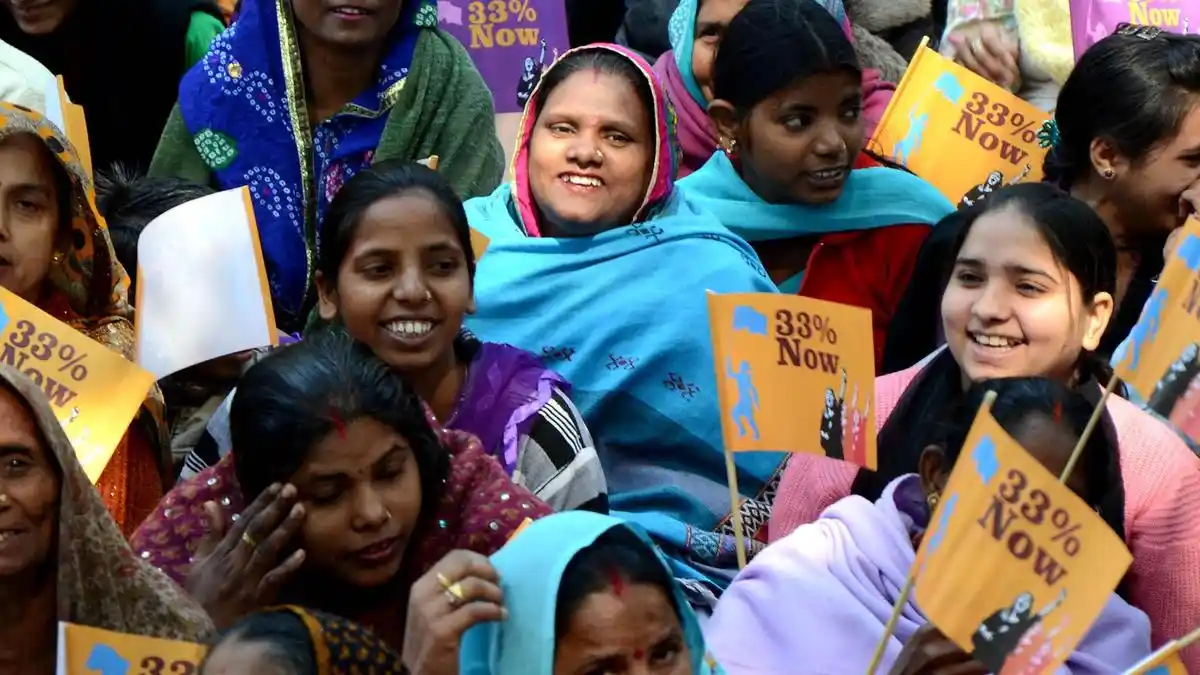
India’s Women’s Reservation Bill—formally the Constitution (One Hundred and Sixth Amendment) Act, 2023, and its latest follow‑up in 2026—seeks to reserve 33% of seats in the Lok Sabha and state legislative assemblies for women, with sub‑reservation for women from Scheduled Castes (SCs) and Scheduled Tribes (STs). After decades of debate, the core norm—that one‑third of parliamentary and assembly seats should go to women—enjoys broad political support; the real battle today is over how, when, and under what conditions the quota is implemented.
What the bill aims to achieve
The government argues that lopsided women’s representation—around 14–15% in the Lok Sabha and roughly 9% in state assemblies—distorts policymaking and sidelines issues central to women’s lives such as safety, health, childcare, and education. By reserving 33% of seats, the bill intends to institutionalise women’s presence in legislatures, not just as symbolic tokens but as lawmakers shaping laws, budgets, and appointments.
The design also includes sub‑reservation for SC/ST women, so that a portion of the 33% quota is reserved within reserved constituencies, and provisions for rotation of reserved seats across constituencies every few Lok Sabha terms to prevent “dynastic fortresses.” Largely, the stated goal is structural empowerment: to change the composition of power so that women’s voices are systematically embedded in decision‑making, rather than left to individual goodwill or party discretion.
Why the government wants this reform
The Union government have framed the bill as a long‑delayed correction of democracy’s gender deficit, arguing that India cannot call itself a fully representative republic while women remain under‑represented in its core law‑making bodies. The 2023 constitutional amendment, passed with wide support in Parliament, was presented as a culmination of a decades‑old demand first floated in the 1990s and revived in 2010 under the UPA‑II.
The current government’s latest push in 2026 aims to remove the original bill’s linkage to delimitation and the next census, so that the 33% quota can be implemented before the 2029 general elections, without waiting for a fresh seat‑redistribution exercise. Officials argue that this would translate the “idea” of women’s reservation into immediate numerical impact, raising women’s share from under a sixth of MPs to potentially one‑third, which they contend will reshape policy priorities and deepen women’s political leadership at all levels.
Why the opposition is blocking it
The opposition parties say they do not oppose women’s reservation in principle; several have supported earlier versions of the bill in 2010 and in 2023. Their objection in 2026, however, focuses on how the government is trying to amend the 2023 law, particularly its stance on delimitation, seat‑increase, and federal balance.
First, many opposition leaders argue that linking or delinking the bill from a future delimitation exercise and possible expansion of Lok Sabha seats is politically loaded. They warn that redrawing boundaries after a new census could shift parliamentary weight away from southern and western states toward high‑population northern states, altering the existing federal compact. Southern regional parties, in particular, fear that combining women’s reservation with a seat‑increase and new delimitation could dilute their representation, even if the quota itself is not directly their concern.
Second, some opposition factions have long demanded additional sub‑reservation within the 33% quota for women from Other Backward Classes (OBCs), arguing that otherwise the benefits will disproportionately go to women from upper‑caste or socially dominant groups. They accuse the government of using the women’s reservation debate as a pretext to rush through a broader delimitation and seat‑restructuring plan that serves electoral interests, instead of first agreeing on a pan‑India consensus on OBC‑within‑women reservation.
Stalled momentum for women in politics
This latest deadlock over the Women’s Reservation Bill is widely seen as a significant setback for women’s political empowerment in India. Despite broad agreement that women remain grossly under‑represented in the Lok Sabha and state assemblies, the failure to convert the 2023 constitutional amendment into an implementable, time‑bound scheme means the status quo of tokenism and marginal representation will continue for at least another electoral cycle.
The bill was meant to give women a predictable, structural pathway into legislative power, not contingent on party whims or alliance bargains. By blocking the government’s move to operationalise 33% reservation before the 2029 elections, parties have effectively delayed the moment when women’s presence in Parliament could rise from roughly 14–15% to about one‑third, a shift that research suggests would influence policy priorities on issues like gender‑based violence, childcare, health, and education.
For many women activists, feminists, and grassroots leaders, the political brawl over delimitation and seat‑increase feels like a sacrifice of women’s substantive gains at the altar of partisan and federal calculations. They argue that the arguments over “when” and “how” to implement the quota are being used to postpone the “if,” leaving millions of women voters once again waiting for a reform that is already on paper but not in practice.
Impact on representation and role models
Without the bill’s early implementation, the number of women in legislatures will grow only incrementally, relying instead on party nominations, electoral campaigns, and individual breakthroughs rather than a guaranteed structural floor. This slows the creation of a critical mass of women lawmakers who can shape debates, mentor younger women, and normalize the idea that women are as much “default” decision‑makers as men.
Moreover, the stalemate undermines the symbolic power of the very law that was hailed as a historic step for women’s rights. When a widely advertised constitutional reform is repeatedly frustrated in Parliament, it sends a message that women’s representation is still negotiable, secondary, and subject to higher‑priority political horse‑trading—feeding cynicism among women voters about whether politics will ever truly respond to their interests.