
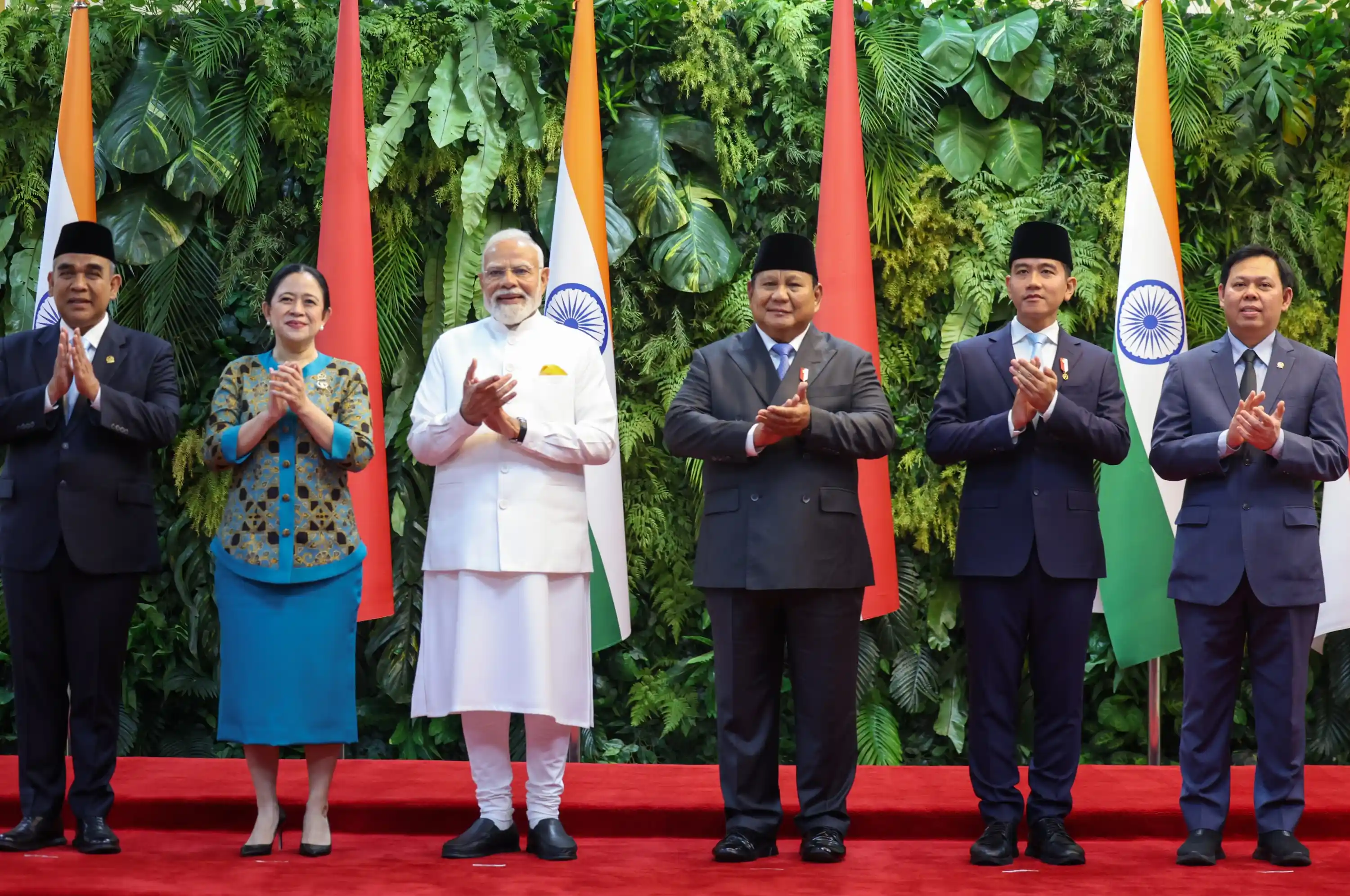
India’s new defence and cooperation package with Indonesia is significant because it combines hard power, industrial diplomacy, and maritime strategy in one move. Signed during Prime Minister Narendra Modi’s visit to Jakarta, the headline items are agreements on India’s BrahMos and Astra missile systems, along with a push to jointly develop Sabang Port near the Strait of Malacca — a move that could deepen India’s footprint in Southeast Asia.
The agreements arrive as India and Indonesia look to widen strategic cooperation across defence, critical minerals, maritime security, and technology. Reports describe a broad package that also touches electronic voting machine cooperation and investment in steel, nickel, and rare-earth magnet manufacturing. For India, the Indonesia deals matter because they strengthen its profile as a defence exporter at a time when New Delhi is trying to diversify away from being predominantly an arms importer — a status it has held for years even as its “Atma Nirbhar Bharat” (self-reliant India) push tries to change that story.
For Indonesia, the deal broadens its military options and strengthens ties with a major Indo-Pacific partner. The timing matters too: Jakarta is balancing economic growth, maritime security, and regional competition in a crowded and contested sea-lane environment, and diversifying its defence suppliers gives it more room to maneuver.
BrahMos: An Export Breakthrough
BrahMos is India’s supersonic cruise missile, developed jointly with Russia, and it has become something of a flagship product for Indian defence diplomacy. Under the new agreements, Indonesia is set to expand its existing BrahMos inventory with additional missile batteries — building on a defence relationship that has grown over recent years through joint exercises and industry collaboration. That expansion matters because BrahMos exports have long served as a test case for whether India can sell advanced weapons systems abroad and sustain that relationship over time, not just close a one-off sale.
The missile’s appeal is straightforward: it’s fast, versatile, and combat-tested in India’s own inventory, having reportedly proven itself during Operation Sindoor. It can be launched from land, sea, and air platforms, which makes it attractive to countries wanting flexible deterrence options rather than a single-use system. A deepening BrahMos relationship with Indonesia adds to the missile’s growing export footprint across Asia.
Astra’s Export Value
Astra is India’s indigenous beyond-visual-range air-to-air missile, built with a range of roughly 80-110 km and an indigenous radio-frequency seeker — with a longer-range Mk-2 variant, expected to reach around 160 km, already approved for the Indian Air Force. Astra’s appeal to Indonesia is partly about its proven performance during Operation Sindoor, and partly about fit: Bharat Dynamics Limited, which manufactures Astra, is expected to integrate the missile onto Indonesia’s Russian-made Su-30 fighters. That makes this more than a simple missile sale — it’s a systems-level integration into Indonesia’s existing air fleet.
The symbolic weight here may be even bigger than the technical one. If Indonesia becomes Astra’s first confirmed foreign customer, it marks a genuine milestone in India moving from technology demonstrator to international supplier — a step beyond BrahMos, which already had export precedent.
Sabang’s Strategic Role
Sabang Port is the third pillar of the story, and arguably the most geostrategically interesting. Located at the northern tip of Sumatra near the Strait of Malacca — one of the world’s most important maritime choke points, carrying a large share of global trade and seaborne oil — Sabang is now the subject of a joint task force between India and Indonesia focused on port infrastructure and connectivity.
Notably, Sabang sits roughly 100 miles from India’s own Great Nicobar transshipment hub project, meaning the two ports could function as complementary nodes rather than competitors. For India, that’s attractive because it extends maritime reach into Southeast Asia without requiring sovereignty over foreign territory. For Indonesia, the arrangement brings investment and stronger maritime connectivity to its western archipelago, linking Aceh and Sumatra more closely with India’s Andaman and Nicobar Islands.
A Wider Indo-Pacific Shift
The broader picture is that India and Indonesia are turning a bilateral relationship into something closer to a comprehensive Indo-Pacific partnership. Alongside the missile and port deals, the two sides discussed critical mineral supply chains, industrial cooperation, and maritime security — a mix suggesting both countries want to diversify their strategic relationships rather than lean on any single external partner.
These deals also reflect a changing balance in Southeast Asia, where defence exports and port access can translate into durable long-term influence. If the BrahMos and Astra agreements convert into finalized contracts, they would show that India’s defence diplomacy is becoming a serious tool of statecraft rather than a side project. Indonesia, meanwhile, gains access to capable systems that strengthen its deterrence and maritime security without fully locking it into any one external patron.
Taken together, the BrahMos, Astra, and Sabang agreements point to a deeper strategic convergence between India and Indonesia. They combine weapons sales, maritime access, and industrial cooperation in a way that strengthens both countries’ regional leverage. In the language of Indo-Pacific geopolitics, this looks less like a single deal and more like a platform for longer-term alignment.

