
AI Summary
Indian Prime Minister Narendra Modi’s 80th Independence Day address combined a forward-looking economic and technological roadmap — from Fortune 500 ambitions and AI innovation to nuclear energy and mineral self-reliance — with tangible welfare measures like free exam coaching and continued poverty alleviation, all framed within the larger vision of a Viksit Bharat by 2047.
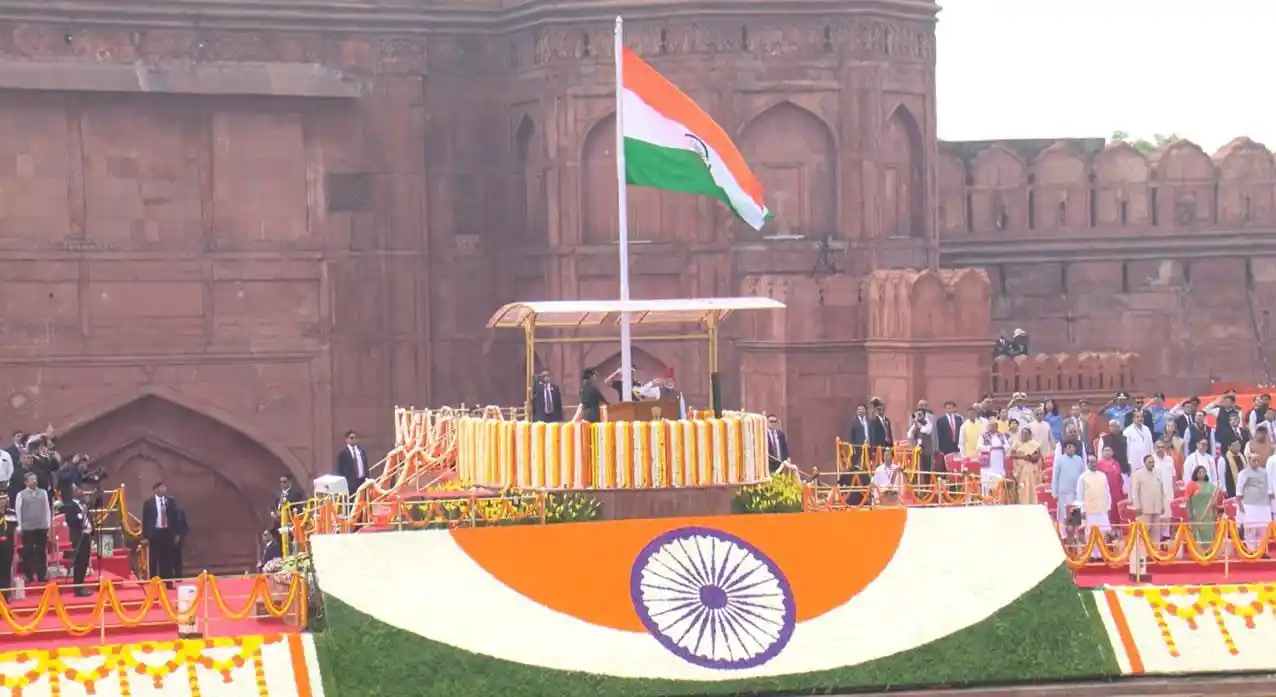
On August 15, 2026, Prime Minister Narendra Modi hoisted the national flag at the Red Fort for the 80th Independence Day celebrations, marking the occasion with a red bandhani-print turban, a white kurta-pajama, and a Tricolour pocket handkerchief. Assisted by Captain Sonia Singh Chauhan during the flag hoisting, the Prime Minister used his address to lay out an ambitious vision for India’s future, anchored around the goal of a “Viksit Bharat” — a developed India — by 2047.
The “Shakti Ki Sapt Dhara” Vision
At the heart of the speech was a new framework PM Modi called “Shakti ki Sapt Dhara” (Seven Streams of Strength), identifying seven key areas for national development:
- Manufacturing
- Agriculture and food processing
- Technology and innovation
- Gati-Shakti (infrastructure connectivity)
- Raksha Shakti (defence capability)
- The green and blue economy
- Soft power
This was paired with a seven-point reform agenda, “Saptdhara,” designed to give shape to the Viksit Bharat vision over the coming decades.
Economic Ambition: 50 Indian Firms in the Fortune 500
PM Modi set a bold national target: getting 50 Indian companies into the Fortune 500 list, framing it as a call for greater ambition in driving the country’s economic growth. He urged the manufacturing sector to compete globally on cost, quality, and scale, while paying attention to details like packaging and precision, positioning India as a hub for global supply chains.
A Milestone Against Poverty
Perhaps the most striking claim of the address was that 25 crore (250 million) Indians have lifted themselves out of poverty over the past 12 years — a statistic PM Modi presented as evidence of collective national progress. “When dreams are bigger, our capabilities also grow,” he said, tying this achievement to the country’s expanding ambitions.
Investing in Students: Free Online Coaching
In a move aimed directly at easing the financial pressure on families, PM Modi announced free online coaching for students preparing for competitive exams, intended to broaden access to quality exam preparation regardless of economic background.
Powering the Future: Energy and Innovation
The Prime Minister outlined a sweeping energy and technology agenda:
- A target of 200 GW of nuclear power, supported by five new reactors
- 1.75 crore households now connected to piped gas
- Over 50 lakh households using solar energy
- Trials of India’s first hydrogen-powered train, which PM Modi called the “most powerful” of its kind
- The opening up of 98% of India’s offshore areas for oil and gas exploration, marking a shift from a passive to a proactive approach in energy security
On the innovation front, PM Modi called for India to become a global hub for artificial intelligence, robotics, space technology, quantum computing, and data centers, positioning the country to compete at the frontier of emerging technology.
Self-Reliance and Critical Minerals
Reinforcing the theme of “Aatmanirbhar Bharat” (self-reliant India), PM Modi said the country cannot afford dependence on other nations and highlighted progress in semiconductor manufacturing. He also pointed to the launch of the National Critical Mineral Mission and a Critical Mineral Corridor, noting that other countries are increasingly relying on India for critical minerals — a sign of growing global trust and strategic importance.
Standing with Citizens in Crisis
Amid the celebratory tone, PM Modi also struck a note of empathy, offering words of support to families affected by recent floods and landslides in India’s northeastern states, and assuring them of continued government assistance.
Reflecting on the Covid-19 period, PM Modi spoke about the rumor-mongering and fear that spread during the pandemic, contrasting it with what he described as the positive, long-term results now emerging from the government’s pandemic-era planning and policies.
Addressing the nation from the ramparts of the Red Fort, PM Modi said, “Becoming an ‘Atmanirbhar Bharat’ is crucial. That is why, over the past few years, our conviction has been that India should no longer live in dependence on other nations; we must become self-reliant. We must enhance our own capacities and safeguard our interests ourselves. With this resolve, we are moving forward firmly towards an ‘Atmanirbhar Bharat.’ Every Indian is connecting with initiatives like ‘Make in India,’ ‘Swadeshi’, and ‘Local for Local.”

