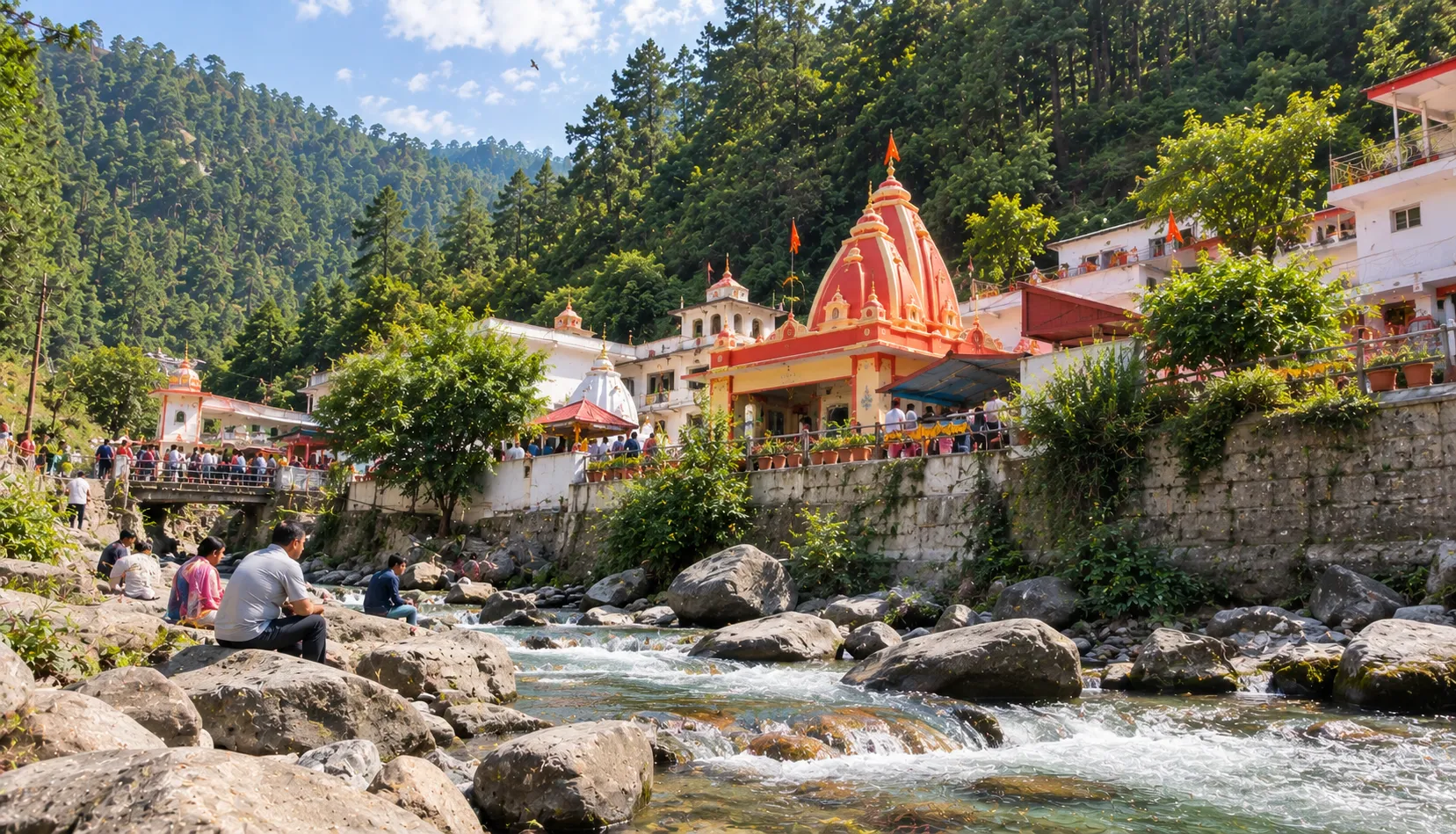
The Hindi word ‘Kainchi’ means ‘scissors’. Kainchi Dham, in Uttarakhand’s Nainital district in the Himalayan region of North India, is located where two hills intersect along the Shipra River.
For years, the place has drawn thousands of pilgrims from across the country to pay obeisance at the Hanuman temple, which shares its premises with an ashram—a religious retreat associated with spiritual guru Neem Karoli Baba.
A 20th-century saint, Neem Karoli Baba was an ardent devotee of Lord Hanuman. He established Kainchi Dham in 1964, having found the place spiritually significant and suitable for meditation, prayer, and service to devotees. Another reason, according to his followers, was the site’s spiritual history, linked to earlier saints, including Sombari Maharaj and Sadhu Premi Baba, who performed sacred rituals there.
Since then, the shrine has drawn crowds, much like other prominent pilgrimage destinations, including the Char Dham shrines—Kedarnath, Badrinath, Gangotri, and Yamunotri—and Har Ki Pauri in Haridwar. What has changed recently, however, is the surge in pilgrims visiting the shrine following the release of the Hindi film Hanuman Ansh, directed by filmmaker Vishal Chaturvedi, which depicts the life of Neem Karoli Baba.
His followers regard him as an incarnation of Lord Hanuman. Some also attribute the current surge in visitors to the global reach of his teachings.
But this growing popularity has brought an uncomfortable question to the forefront: Can a sacred place retain its serenity when thousands arrive every day?
Ketan Pal, a social media influencer, says, “The place is not fully equipped to handle the surge. The challenge for the local administration is to accommodate this surge without allowing traffic congestion, overcrowding, and commercial activity to overwhelm the small mountain settlement. It also raises concerns about environmental degradation in the fragile mountain ecology.”
Uttarakhand Tourism Minister Satpal Maharaj has also raised concerns about growing traffic congestion and the need to expand parking facilities for pilgrims. He held a meeting with senior officials to review plans for the seamless movement of visitors and improvements to infrastructure, including roads, water supply, and sanitation facilities.
There is also a proposal for an 18-km Ratighat bypass to divert traffic away from the Kainchi stretch and separate pilgrims travelling to Kainchi Dham from those heading towards Almora, Ranikhet, and other hill destinations.
Daily footfall figures suggest that more than 35,000 pilgrims visited Kainchi Dham on peak days during the second and third weeks of October 2026, compared with around 15,000–20,000 in 2025. A report in The Indian Express revealed that 24.34 lakh devotees visited the shrine in the first six months of 2026, compared with around eight lakh during the entirety of 2025.
For the local economy, the influx of pilgrims has brought new opportunities. Hotels, homestays, restaurants, taxi operators, and small shopkeepers have benefited from the steady stream of visitors. Religious tourism can generate employment and attract investment to mountain communities that often struggle to sustain livelihoods.
Yet the ecological cost cannot be ignored. Narrow hill roads are becoming increasingly congested, vehicles are adding to pollution, and the growing demand for accommodation, food, and sanitation is putting pressure on limited civic infrastructure.
The figures point to an unprecedented surge in footfall, placing immense pressure on the shrine’s limited infrastructure and prompting the administration to explore measures to regulate the flow of devotees and ease congestion.
Media reports also suggest that the Nainital district administration has devised a new, multi-pronged crowd-control plan, initially to be implemented on weekends before being gradually extended to weekdays.
The proposed system will be modelled on the registration mechanisms in place for Uttarakhand’s Char Dham pilgrimage and the Mata Vaishno Devi Shrine in Jammu and Kashmir. Until now, Kainchi Dham has had no such registration system. The move is aimed at regulating the growing influx of devotees and ensuring better crowd management.
The Nainital District Magistrate and Superintendent of Police have already submitted a joint report to the state government in this regard, following consultations with local stakeholders, including taxi operators, traders, and temple management officials.
Videos circulating on social media have shown long queues of vehicles—cars, buses, and two-wheelers—around Bhimtal, Bhowali, and Kainchi. Some pilgrims have reportedly left their vehicles behind and continued on foot to avoid being stranded in traffic for hours.
Lalit Mohan Rayal, Nainital District Magistrate, said, “The administration is considering a new standard operating procedure (SOP) under which a bypass connecting the Kainchi area towards Almora and Ranikhet could be opened to divert traffic.”
Neem Karoli Baba’s legacy rests on simplicity, compassion, and service, not spectacle. Protecting the Himalayan landscape around Kainchi Dham must become an essential part of honouring that legacy.
Uttarakhand Chief Minister Pushkar Singh Dhami has also acknowledged that the unprecedented rush at Kainchi Dham requires tighter crowd management, better road connectivity, and improved facilities for pilgrims. He underlined the need for pilgrim registration and a daily visitor limit of 20,000–25,000 to manage the growing crowds.