Deteriorating air quality in India’s capital, New Delhi, may not directly affect Himachal Pradesh. But the growing air pollution crisis and environmental degradation in the Himalayan state, where millions of tourists arrive seeking a serene, cool-climate escape, may definitely impact many, not within its boundaries but also far beyond.
The small mountain state, already facing the perils of climate change, rising temperatures, and growing air and water pollution, is now poised to develop its own model of a green state. Vehicular pollution is one of the key areas Himachal Pradesh has chosen to address, given its heavy dependence on road transport. Rail and air connectivity remains underdeveloped and, in many parts, practically unfeasible because of the state’s challenging mountainous terrain.
Starting in 2023, the state government inducted its first fleet of a dozen electric cars, one for the chief minister, Sukhvinder Singh Sukhu. It later began switching over to EVs for government departments, beginning with the state’s transport department. By now, there are more than 5000 EVs of all categories registered in Himachal Pradesh.
By now, Himachal Pradesh has already mandated all departments to gradually replace their existing fleet of official vehicles and develop a seamless and efficient transport system that cuts down emissions and reduces environmental pollution, besides affecting savings on fuel.
The State Economic Survey for 2025-26 states that the Transport Department’s own fleet has more than 250 electric vehicles, while another 500 privately owned e-taxis serve various government departments. This is just one segment of the state’s broader shift towards sustainable transport. Under its newly introduced e-taxi policy, which offers a range of incentives to unemployed youth, the government also plans to engage automobile manufacturers to explore replacing petrol and diesel vehicles with electric vehicles (EVs).
To meet this growing demand, Himachal Pradesh has already notified six highways as green corridors, and efforts are underway to install charging stations at petrol pumps, government premises, HPTDC hotels, and private hospitality units.
Next came the shift to the Himachal Road Transport Corporation (HRTC), the state-owned public transport network serving even the remotest, high-altitude, and snow-bound areas. The first effort to introduce e-buses in the HRTC came in 2027, after the National Green Tribunal (NGT) capped tourist vehicles at 1200 (800 petrol and 400 diesel) per day at Rohtang Pass (13,059 feet), warning that the arrival of more than 5,000 vehicles could have a disastrous impact on the fragile ecosystem, glaciers, and rare biodiversity.
But after the commissioning of the Atal Rohtang Tunnel in 2020, the world’s longest tunnel at a height above 10,000 feet, the tourists’ footfall has broken all records. During peak summer season, 9,000 to 11,000 tourists are crossing the tunnel.
This itself underlines the fact that tourist spots in Himachal Pradesh are not only bearing the brunt of mass tourism but are also becoming increasingly vulnerable to air pollution caused by rising vehicular emissions.
“Studies have shown that pollution levels at Sissu, the popular tourist hub beyond Rohtang Pass, have also risen significantly with the surge in tourist traffic, highlighting the growing environmental cost of mass tourism in the fragile Himalayan region.” Says Dr C. M. Parseera, a professor at the Institute of Vocational Studies (Tourism), HP University, Shimla.
Since tourism happens to be the mainstay of the state’s economy, contributing 7.9 per cent to the state’s Gross Domestic Product, and also a source of livelihoods for several families, the government rules out capping the mobility of vehicles to the state or its tourist hotspots.
“We are exploring ways to increase the number of e-vehicles, both in the public and private sectors. Soon, the government will come out with its EV policy on the lines of the Delhi government,” informs Sushil Kumar Singla, principal secretary (environment)
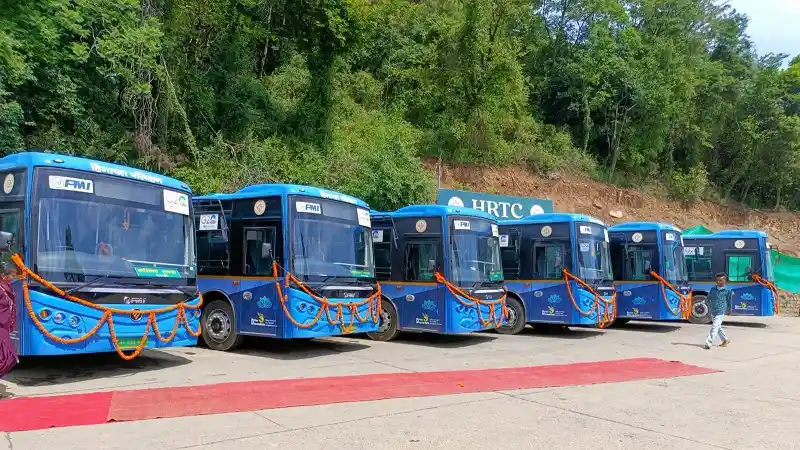
On July 30, 2026, Chief Minister Sukhvinder Singh Sukhu launched 297 new electric buses at Kiarighat in Solan. This took the operational HRTC electric-bus fleet to 407. The new buses are planned for 318 routes covering about 75% of the state.
This is significant because Himachal’s e-mobility transition is being driven primarily through public transport, rather than private-car adoption. HRTC buses carry an estimated 6 lakh passengers a day, making electrification of the corporation’s fleet potentially far more consequential than simply encouraging individual EV ownership.
Sukhu said at the launch that the government was discussing the procurement of another 1,000 e-buses and was also considering 100 hydrogen buses, with the stated objective of protecting Himachal’s environment and climate.
This is also because mountains are vital to a nation’s ecology. They support rivers, forests, glaciers, lakes, and natural heritage and play a crucial role in maintaining groundwater discharge. Protecting the fragile ecosystems of hills is therefore not merely an environmental responsibility but also essential for the country’s water, climate and economic security
“For Himachal Pradesh, the green-transport story is not simply about introducing EVs but also a transition to proactively prevent vehicle emissions from damaging a much more fragile Himalayan environment”, claims Himachal’s Deputy Chief Minister Mukesh Agnihotri, who holds the transport portfolio.
The government is simultaneously developing the supporting infrastructure. Recent state tenders cover civil and electrical charging infrastructure at HRTC workshops, and bus stands across 11 districts, including Bilaspur, Hamirpur, Kullu, Mandi, Kangra, and Una.
According to him, this is more than a fleet replacement program. It represents a shift from treating pollution on Himalayan roads as a problem to be controlled to redesigning the state’s public transport system around electric mobility. The government has an ambitious plan to convert 74 to 77 per cent of its public transport fleet to e-buses to cut down environmental pollution and make the transport sector eco-friendly.