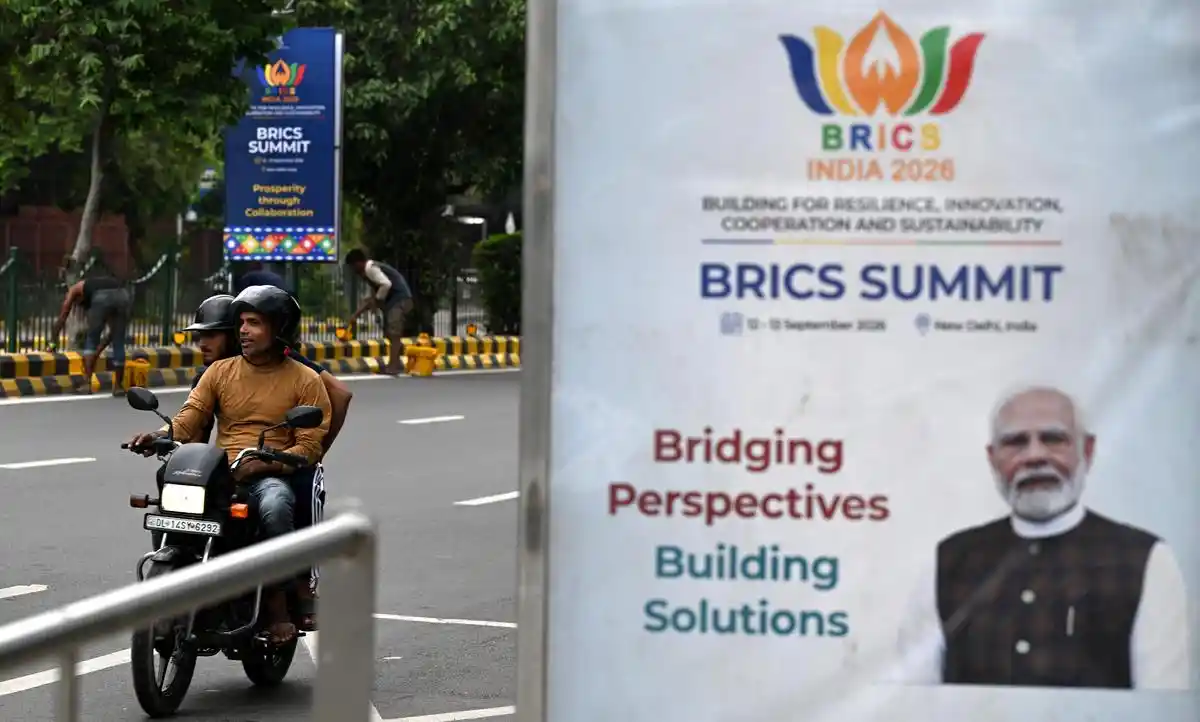
India will host the 18th BRICS Summit in New Delhi next week and has already set the tone by re-anchoring the acronym BRICS to mean “Building for Resilience, Innovation, Cooperation and Sustainability”. The groundwork is in place to steer BRICS out of the shadows of weaponised plurilateralism, but India’s grand strategy also faces a high-stress test.
Setting The Stage
New Delhi’s strategy in BRICS is a clear push to advance its grand strategy, send a global message, and increase its strategic relevance, instead of letting the summit become a geopolitical showdown or a centre of power games by big powers, especially Russia and China. Three key shifts are essential to ensure its strategic autonomy works on both fronts: national and global interests. First, make multilateralism practical by pushing institutional and structural reforms in global governance rather than echoing bloc politics. Second, India’s BRICS vision, as enshrined in its re-anchored acronym, must be promoted by becoming a strategic enabler to strengthen cooperation and resilience. Third, project India as a global major player, providing strategic and sustainable alternatives to navigate global crises, by concretising supply chain and economic security through diversification and greater inclusivity.
Rather than pushing a speculative standalone BRICS currency, India’s agenda emphasises expanding trade in existing national currencies and strengthening interconnected cross-border payment platforms; similarly, it seeks to export its Digital Public Infrastructure (DPI) model to empower tech integration. Promoting human security-centric solutions further solidifies its commitment to sustainability and resilience against global health and environmental issues.
The Stress Test
Geopolitical headwinds and conflict cast a serious shadow over the BRICS summit, where apprehensions about power contestation and political weaponisation remain high. In May this year, the meeting of the 11 nations’ Deputy Foreign Ministers and Special Envoys ended without a joint statement; instead, the Chair issued a statement. The key reason was high-level friction between the UAE and Iran. During the BRICS summits hosted by India, Iranian Foreign Minister Abbas Araghchi and NSA officials openly accused the UAE of direct complicity in military aggression against Tehran. Iran alleged that the UAE allowed its territory, airspace, and military infrastructure to be used as an “operational nest” by the United States and Israel to launch strikes against Iranian infrastructure. The UAE rejected these allegations, and its minister took a counter stance, stating it has been the victim of repeated and unjustified Iranian drone and missile attacks since the regional conflict escalated. This led to a deadlock, completely derailing the bloc’s ability to release a joint consensus statement. Beyond the conflict’s shadow, power politics between Russia and China is another headache.
Both nations have strategically normalised and advanced their bilateral relationship, marked by a border settlement and a significant increase in trade, which reached nearly $240 billion. Both are actively building an eastern geopolitical front to challenge the western frontier by paralysing international organisations and staging an anti-West narrative in the UN and UNHRC. Similarly, they are weaponising multilateral bodies like SCO and BRICS to consolidate a counterbalance strategy against Western influence. The recent SCO joint statement( 2026 Bishkek Declaration) is a key example, with a crystal-clear anti-Western stance and references to the recent conflict in West Asia. The 2024 BRICS summit is another case in point, where the Russia-China axis pushed hard to create an alternative to Western institutions, especially economic ones such as BRICS Pay and BRICS Clear, designed to bypass the US dollar and the Western-dominated SWIFT network.
The no-limit partnership between Russia and China, signed in 2022, serves as the ideological foundation of this frontier. It explicitly rejects Western concepts of global governance, universal human rights, and democratisation, replacing them with a framework that prioritises absolute state sovereignty and “indivisible security.”
One key strategy of the Russia-China axis is to consolidate the Global South to concretise the idea of an eastern frontier. This projection of championing developing nations, gradually opening the envelope of bloc politics with the Global South, is a serious strategic threat to India’s geopolitical position and its grand strategy of Strategic Autonomy, because even if it manages to successfully navigate between the China-Russia axis and ensure its traditional and extended spheres of influence remain afloat, it cannot avoid entering a highly contested space when China begins to effectively transgress into India’s traditional sphere of influence, which already remains vulnerable at this time.
India faces the twin challenge of political weaponisation against the West, which led to deadlock a few months back, and the sphere of influence in both multilateral and regional positions. But despite serious challenges, India has navigated such situations in the past and currently has a decent edge to tide it over.
The BRICS Strategy
India has to focus on strategic de-hyphenation to make this multilateral event practical, looking beyond conflict, tensions, and geopolitical contestations. This must be complemented by strategic autonomy to ensure convergence of interests that helps not only to shift the narrative to economics but also to further the goal of BRICS set by New Delhi. Together, these strategic manoeuvres will, to some extent, help manage political tightness in the event and create room to negotiate and bring everyone to the table, especially the Global South, for consensus-building on a declaration or key statement. The same mix of de-hyphenation and autonomy worked effectively at the G-20 Summit three years back, under the shadow of the Russia-Ukraine War. Apprehension did revolve around the summit, and many feared failure to reach a declaration. Still, India managed to shift the narrative, converge national and global interests, and ensure the Global South was represented, so the spirit of the set agenda and values prevailed. India’s recent decision to sign the SCO declaration, which toes Iran’s stance, saw the joint declaration strongly condemn military strikes on Iranian territory and criticise unilateral Western economic sanctions.
This is a clear exercise in strategic differentiation and a multilateral-focused diplomatic strategy, carefully crafted by India, which signed it but projected strategic autonomy by successfully negotiating the language. Unlike previous draft statements or the 2025 Tianjin Declaration, the Bishkek Declaration stopped short of explicitly naming the United States or Israel. There is no full-throttle condemnation, and India’s mix of de-hyphenation and autonomy strategy helped India maintain its Central Asian and Eurasian footprint, securing energy trade and strategic interests, especially with Iran, without completely reflecting an anti-Western stance.
The same room to exercise the G-20 playbook with more refined autonomy and de-hyphenation tactics is still there for India, with increased strategic normalisation with China after establishing more enhanced initiatives for cross-border talks and strategic depth in understanding and maturity have increased between Russia and India and India’s proactiveness in consolidating voice of global south with three variables impacting Summit is almost in India’s favour India has the opportunity to script another diplomatic victory and successfully project its power of diplomacy and rising strategic relevance.