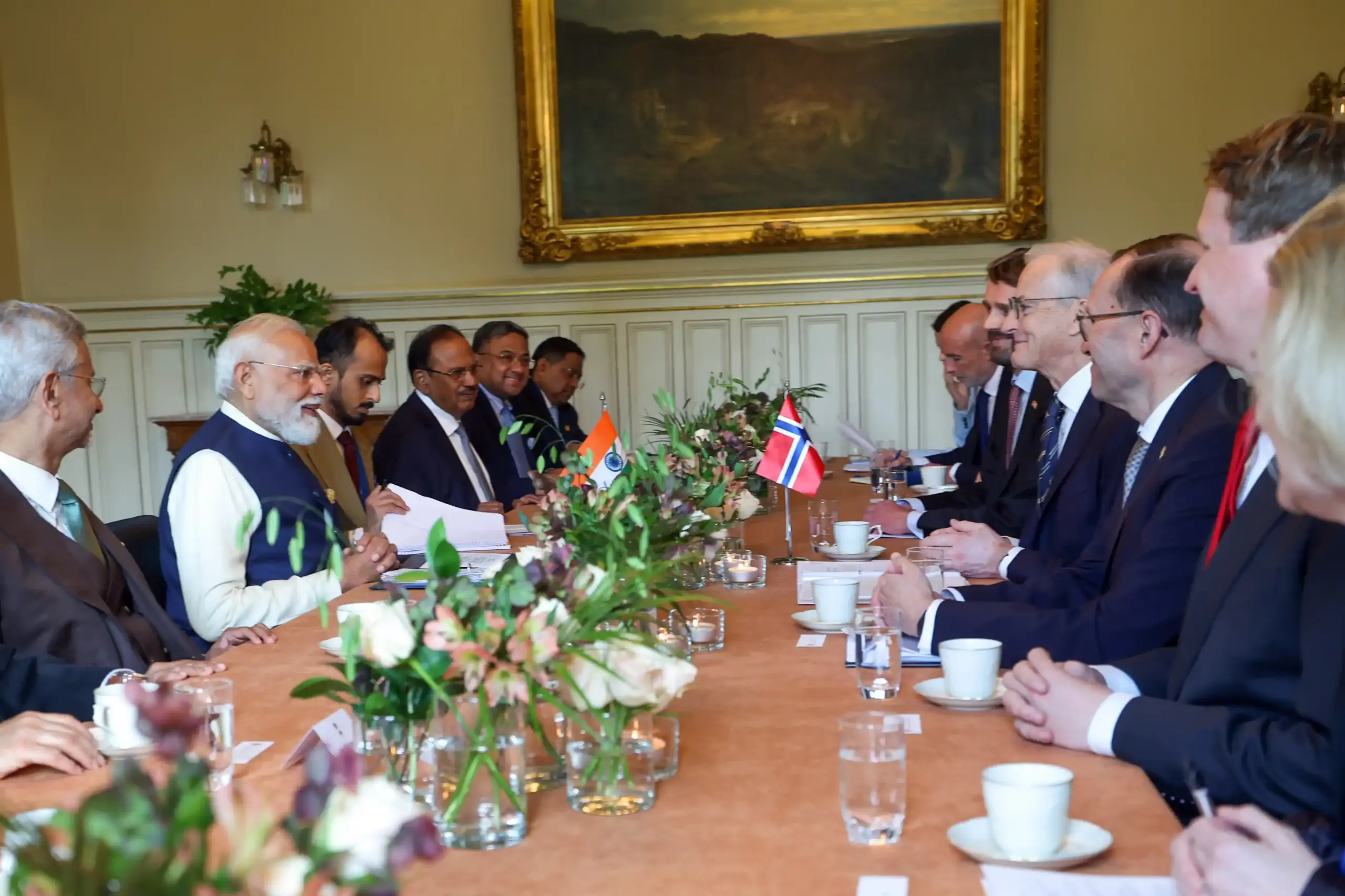
In an era defined by climate anxiety and geopolitical fragmentation, meaningful cooperation between nations often feels elusive. Yet, every so often, a partnership emerges that suggests a different trajectory—one grounded not in rivalry, but in shared purpose. The evolving green strategic partnership between Norway and India is one such example, and it deserves far more global attention than it currently receives.
At first glance, Norway and India make for an unlikely pair. Norway is a small, wealthy nation whose prosperity has long been tied to oil and gas, even as it has positioned itself as a global leader in sustainability. India, by contrast, is a vast, rapidly industrializing country still grappling with the fundamental challenge of lifting millions into economic security. And yet, it is precisely these differences that make their partnership so compelling. Each country possesses what the other needs.
For India, the path to economic growth cannot be disentangled from the question of energy. The country’s ambitions are staggering: 500 gigawatts of non-fossil fuel capacity by 2030, a rapid expansion of green hydrogen, and a steady shift away from coal without compromising development. These are not incremental adjustments; they are structural transformations. Achieving them will require not only political will, but also capital, technology, and institutional expertise on a global scale.
Norway, for its part, is uniquely positioned to contribute. With the world’s largest sovereign wealth fund and decades of experience managing energy resources responsibly, it has both the financial depth and the technical sophistication to support large-scale transitions. Norwegian companies are already deeply involved in offshore wind, hydropower, and maritime decarbonization—fields that are directly relevant to India’s future. This is not aid in the traditional sense; it is strategic alignment.
What distinguishes the Norway–India partnership is its focus on sectors that matter most for the next phase of globalization. Consider green shipping. The maritime industry accounts for nearly 3 percent of global emissions, yet it remains one of the hardest sectors to decarbonize. Norway has quietly become a pioneer in this space, deploying electric ferries, investing in hydrogen-powered vessels, and rethinking port infrastructure. India, with its long coastline and expanding trade networks, offers both a testing ground and a scale multiplier for these innovations. A green shipping corridor connecting Indian ports to global routes would not just reduce emissions; it would redefine how sustainable trade operates in practice.
The same logic applies to renewable energy more broadly. India’s scale makes it indispensable to any serious global climate effort. If its transition succeeds, it will shift the trajectory of global emissions. If it falters, no amount of progress elsewhere will compensate. Norway’s investments in India’s renewable sector, therefore, are not just bilateral transactions—they are interventions with global consequences.
What makes this partnership particularly noteworthy, however, is its tone. In a world where climate cooperation is often entangled in debates over historical responsibility and financial obligation, Norway and India are quietly advancing a more pragmatic model. Their collaboration is not framed as a moral compromise, but as a mutual opportunity. It is less about negotiating burdens and more about aligning incentives.
This matters. Much of the paralysis in international climate politics stems from a mismatch between rhetoric and reality. Developing countries demand growth; developed countries demand sustainability. The Norway–India partnership suggests that this dichotomy may be overstated. With the right combination of investment, technology transfer, and policy coordination, growth and sustainability can reinforce rather than undermine each other.
Of course, this is not to suggest that the partnership is without its tensions. Questions of affordability, technology access, and long-term commitment will inevitably arise. India cannot be expected to adopt green technologies at any cost, nor can Norway be assumed to indefinitely underwrite large-scale transitions. But these are precisely the kinds of challenges that make the partnership meaningful. It is not a symbolic gesture; it is a working relationship that must continuously negotiate the balance between ambition and practicality.
There is also a broader geopolitical lesson embedded here. At a time when global alliances are increasingly shaped by competition—whether between great powers or economic blocs—the Norway–India partnership offers a quieter, more constructive alternative. It is not driven by the logic of containment or dominance, but by the recognition that certain challenges, climate change foremost among them, are simply too large to be addressed in isolation.
If the 21st century is to avoid the worst consequences of climate change, it will not be because of a single grand agreement or technological breakthrough. It will be because of a dense network of partnerships like this one—partnerships that translate abstract commitments into concrete action. In that sense, the Norway–India relationship is not just a bilateral success story; it is a prototype.
The world would do well to pay attention. Not because Norway and India have solved the climate crisis—they have not—but because they are demonstrating how it might be approached: collaboratively, pragmatically, and with a clear-eyed understanding of what is at stake. In a moment when optimism is often in short supply, that alone is worth noting.