
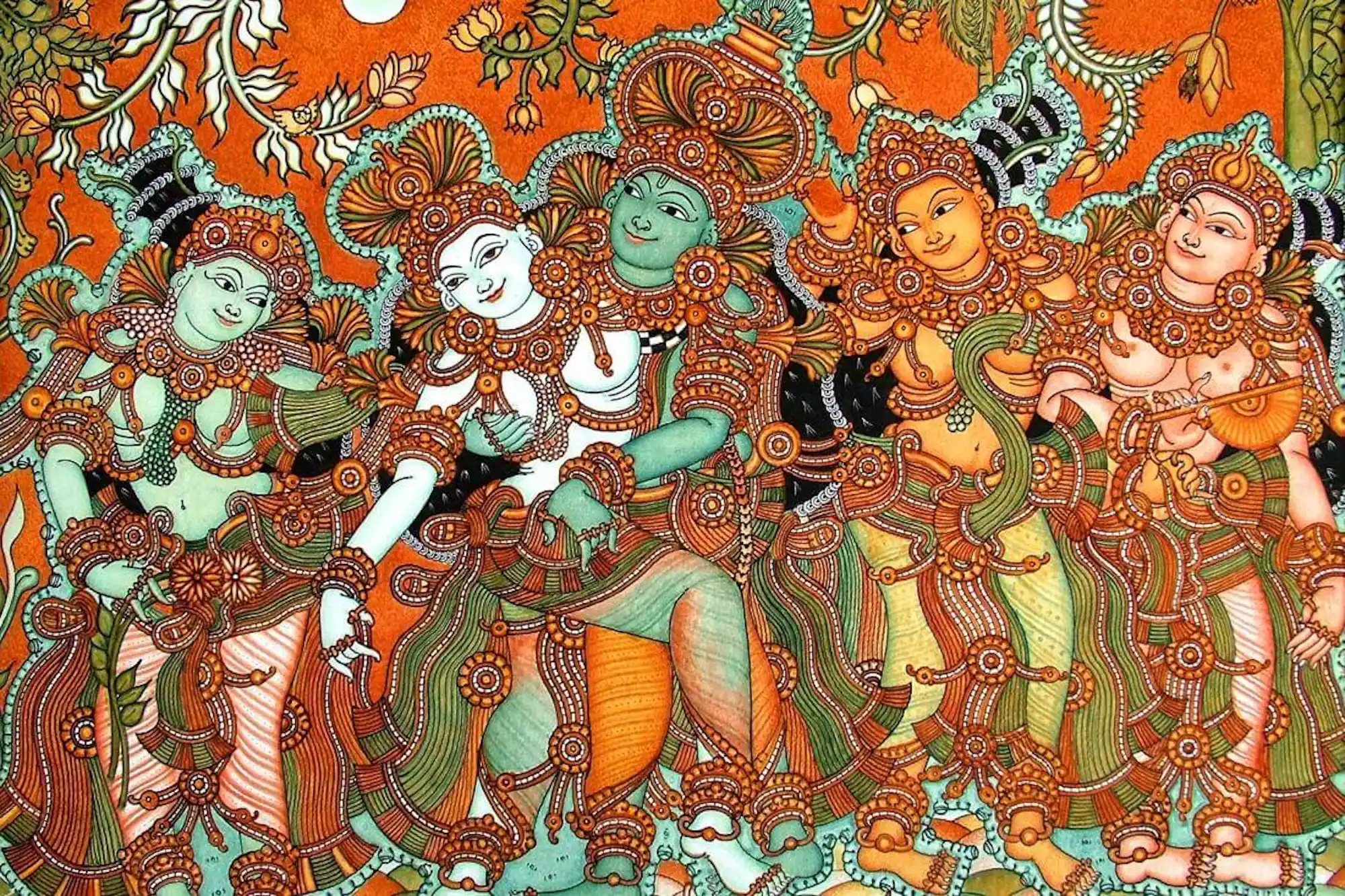
Kerala’s mural paintings are among India’s most striking visual traditions, where temple walls become storybooks of colour, devotion and myth. These murals are not just decoration; they are a sacred grammar of line, form and pigment that has evolved over more than a millennium, yet still feels alive today.
Travel through Kerala’s older temples, palaces and churches and the architecture often recedes behind the human presence of the murals themselves: wide-eyed gods, lush forests, stylised animals and celestial beings that seem to hover just above the plaster. Many scholars trace this tradition back to at least the 8th–10th centuries CE, with early examples at sites like the Thirunandikkara cave temple near present-day Kanyakumari, then part of Kerala’s cultural sphere. Over time, the walls of shrines in Thiruvananthapuram, Thrissur, Kochi and beyond became densely layered with narratives from the Puranas, the Ramayana and the Mahabharata, turning sacred architecture into immersive visual epics.
From the 16th to the 19th centuries, under the patronage of Travancore rulers, zamorins and local landholding elites, mural painting flourished into a sophisticated court and temple art. Patronage was never neutral: commissioning a mural was an act of public piety and political messaging, placing a ruler literally in the visual company of gods. As the Bhakti movement deepened devotional practice across southern India, Kerala’s painters responded with increasingly elaborate compositions that brought intimate, emotive imagery to previously austere sanctums.
A language of five colours
If the themes of Kerala murals are rooted in pan-Indian mythology, their look is unmistakably local. Artists traditionally work with a restricted palette called Panchavarna—five base colours: red, yellow, green, black and white—prepared painstakingly from minerals and plants, then bound with natural gums. Within this narrow spectrum, they summon an astonishing range of tones and moods, using subtle modulation and layering rather than bright, jarring contrasts.
Colour here is not merely aesthetic; it is symbolic and codified. Characters associated with dharma and spiritual maturity frequently appear in radiant greens, while darker, more conflicted figures may be rendered in combinations of white and black, allowing viewers to “read” moral qualities at a glance. The figures themselves carry echoes of Kerala’s performance traditions—arched brows, elongated eyes and choreographed poses that recall Kathakali and Koodiyattam—making each wall feel like a frozen stage mid-performance.
Behind every serene face on a temple wall lies a demanding process that can stretch across weeks or months. Traditionally, artists begin by preparing the surface with layers of lime plaster, smoothed and cured to create a stable, breathing skin for the pigments. Only then do they move to meticulous charcoal or red-ochre line drawings, locking in the composition’s balance of deities, attendants, flora and fauna.
Colours are applied in stages, from lighter tones to darker outlines, building depth without abandoning the essential flatness that defines the style. Decorative details—jewellery, textiles, architectural elements—arrive last, like the rhythmic percussion in a classical concert, tying disparate visual motifs into a coherent whole. For many practitioners, mural painting is still treated as a quasi-ritual act: artists may observe dietary restrictions, prayers or periods of silence while working, aligning craft with inward discipline.
Beyond temples: a living tradition
While the canonical Kerala mural is imagined on a temple wall, the form has long wandered. By the late medieval period, it had travelled into royal palaces such as Mattancherry and Padmanabhapuram, and later into Syrian Christian churches, where Biblical scenes were rendered in thoroughly local idioms. Today, murals appear in hotels, public buildings, private homes and corporate lobbies, sometimes risking dilution, but also expanding the medium’s audience.
This new visibility has been underpinned by a quiet institutional revival. Government academies, private studios and contemporary artists’ collectives now teach mural techniques in structured courses, documenting traditional iconography while cautiously encouraging new themes. Young artists experiment with canvas, wood and even digital media, yet many still grind their own pigments and adhere to classical proportions, insisting that innovation must converse with lineage, not erase it.
For all their apparent permanence, Kerala’s murals are acutely vulnerable. Moisture, inappropriate chemical paints, neglect and ill-conceived renovations have already damaged or destroyed countless works across the state. Restoration requires a rare mix of art-historical knowledge, chemical sensitivity and humility—knowing when to intervene, and when the most ethical choice is to leave fading pigment undisturbed.
Yet there is also resilience written into this tradition. New murals continue to be commissioned; older ones are being documented, conserved and studied by a growing network of scholars, conservators and practitioners. In an era of hyper-speed digital images, Kerala’s mural painters remain stubbornly slow, layering time onto lime, offering viewers not just spectacle but a long, patient gaze—one that asks us to look, and then to keep looking, until colour turns back into story.

