
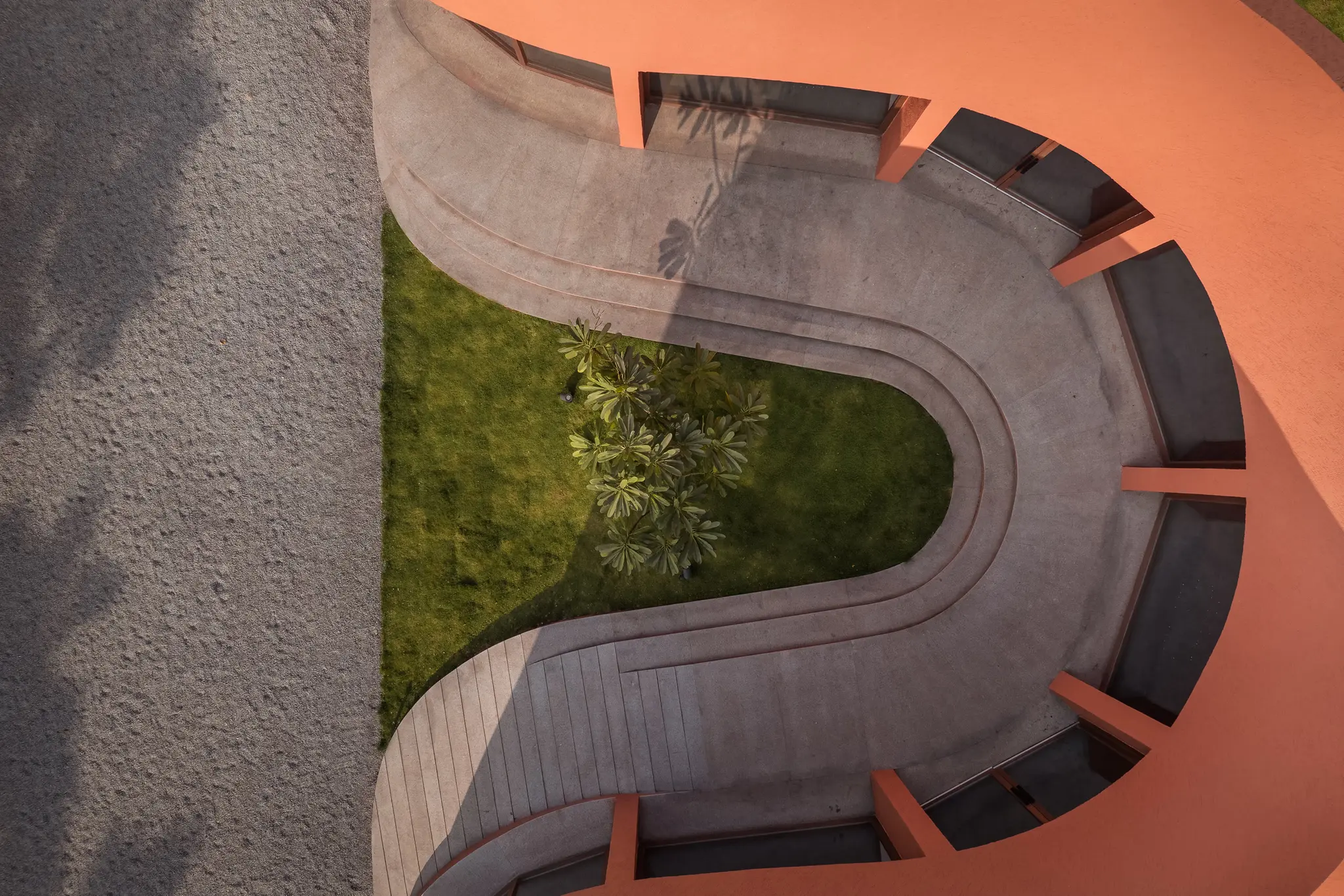
Hampi Art Labs is possibly one of the most striking new cultural institutions to emerge in India in recent years: part art destination, part production site, part retreat. Launched in February 2024 near the UNESCO World Heritage site of Hampi in Karnataka, it has quickly grown into a serious hub for exhibitions, residencies, and public programming.
The setting is inseparable from the story. Hampi Art Labs sits in the Vijayanagar region, close to the ruins of the ancient capital of the Vijayanagara Empire, where art, architecture, and literature flourished between the 14th and 16th centuries. The wider landscape of the Tungabhadra river, rocky hills, and massive boulders helped shape the architecture as well, which was designed by Sameep Padora and his studio to feel rooted in the terrain rather than imposed on it.
That sense of place gives the institution a rare double identity. It is not just a white-cube gallery dropped into a heritage zone, but a cultural project that tries to make the site itself part of the experience.
What makes Hampi Art Labs unusual is its format. The nine-acre campus includes exhibition spaces, studios, apartments for residencies, gardens, and a café, creating a model that combines museum-like display, live artistic production, and immersive residency infrastructure. In practice, that means visitors can encounter finished work in the galleries while artists nearby are making, testing, and refining new projects.
This hybrid structure matters because it changes the rhythm of access. A museum preserves and presents; a residency produces; a gallery circulates work. Hampi Art Labs brings the three together in one place, allowing audiences to see art as a living process rather than only a final object.
The draw for artists is not only the scenery. The center offers advanced facilities such as workshops for ceramics, printmaking, metalwork, and other production needs, which has been described as unusual in the Indian context. The residency program has also been designed to encourage experimentation, research, mentorship, and community engagement, broadening its reach beyond studio time alone.
That combination has helped establish Hampi Art Labs as more than a prestige project. It has become a place where artists can make ambitious work with resources that are hard to find elsewhere in the region.
Its cultural value has also grown through programming. The center has hosted residencies, workshops, and exhibitions that attract both Indian and international attention, while also connecting with schools and local communities in the area. By 2025, it was already presenting major exhibitions such as Blue Futures: Reimagining Indigo, showing that the institution was developing a public-facing calendar with real momentum.
This matters because art spaces in India often struggle to balance ambition with accessibility. Hampi Art Labs appears to be trying to do both: build a world-class platform while staying attentive to local learning and participation.
There is also a larger symbolic story here. Backed by JSW Foundation and founded by Sangita Jindal and Tarini Jindal Handa, Hampi Art Labs extends a longer family legacy of art patronage into a new kind of institutional form. Located beside industrial power and ancient heritage, it reflects a distinctly contemporary Indian question: how can culture grow at the intersection of capital, landscape, labor, and memory?
A couple of years after opening, Hampi Art Labs has become more than an architectural experiment. It is emerging as a cultural waypoint for artists, curators, and visitors looking for a space where making, showing, and thinking about art happen together.

