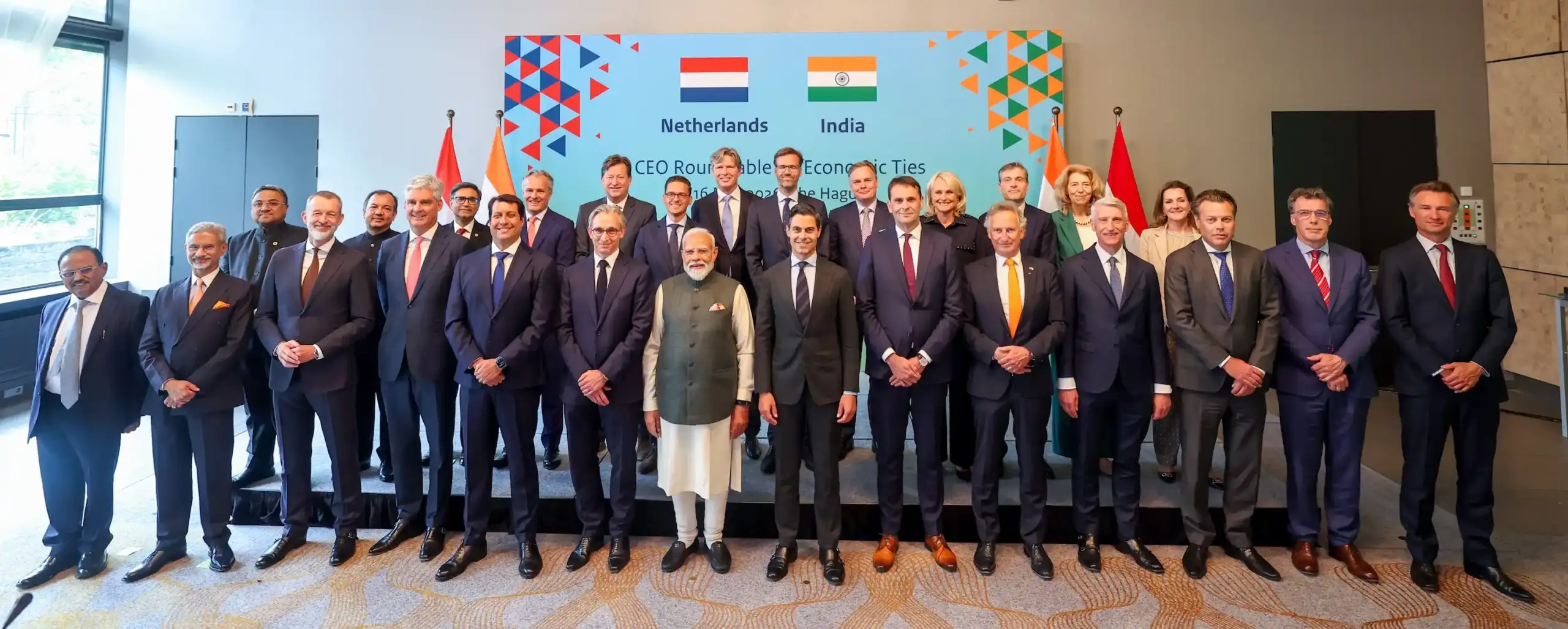
Indian Prime Minister Narendra Modi’s recent visits to the Netherlands and Sweden mark a deliberate push to anchor India much more firmly in Europe’s economic, technological, and security architecture, especially in high‑tech supply chains, green transition, and defense. Together, these stops on his multi‑nation Europe tour translate broad India–EU ambitions into concrete strategic partnerships with two of the continent’s most innovative economies.
The Netherlands and Sweden legs are part of a wider European swing that also includes Norway and Italy, framed in New Delhi as a major geopolitical outreach at a time of shifting global alliances. The tour comes just after India and the European Union concluded a broad trade agreement in New Delhi in January, dubbed the “mother of all deals” and expected to be fully finalised by the end of the year. This agreement, alongside India’s 2025 trade pact with the EFTA bloc, has injected new momentum into India–Europe trade and investment discussions. Against the backdrop of the Russia–Ukraine war and growing concerns about over‑reliance on China, European leaders are increasingly talking of India as their “most trusted democratic partner in Asia”.
The Netherlands Significance
In The Hague, Modi held extensive talks with Dutch Prime Minister Rob Jetten and agreed to elevate India–Netherlands ties to the level of a formal strategic partnership. The two sides unveiled a “Strategic Partnership Roadmap 2026–2030” to deepen cooperation in trade and investment, defence and security, critical and emerging technologies, including semiconductors, space, artificial intelligence and quantum computing. According to India’s Ministry of External Affairs, the visit produced 17 key outcomes ranging from defence and critical minerals to maritime cooperation and green hydrogen. Modi also met King Willem‑Alexander and Queen Máxima, highlighting the symbolism of the visit early in his new government’s term.
The economic context is significant: bilateral trade has reached about 27–28 billion US dollars in 2024–25, making the Netherlands one of India’s largest trading partners in Europe and a top source of foreign direct investment with cumulative FDI of over 55 billion US dollars. Over 300 Dutch companies operate in India, with a similar number of Indian firms using the Netherlands as a European base. The diaspora dimension is also notable, with over 90,000 non‑resident Indians and people of Indian origin, plus a large Surinamese Hindu community, creating deep people‑to‑people ties. Modi underscored these links at an Indian community event, calling The Hague a “living symbol of Indian friendship”.
Technology and Supply Chains: Why the Netherlands Matters
A central, forward‑looking piece of the Dutch leg is semiconductors. The Netherlands is home to ASML, the world’s leading manufacturer of advanced lithography machines used to produce cutting‑edge chips, and Indian officials see collaboration with ASML as vital for the India Semiconductor Mission. Reports ahead of the visit made clear that Modi’s team wanted to widen partnership with ASML and other Dutch high‑tech firms to support upcoming semiconductor fabs in India and reduce dependence on imports. One of the visit’s outcomes was a key step for a semiconductor fab project in Dholera, Gujarat, underlining how this diplomacy connects directly to India’s domestic manufacturing ambitions.
The strategic roadmap also includes agreements on critical minerals, seen as essential for clean energy technologies and advanced manufacturing, thereby helping India secure inputs for batteries, electronics and renewable‑energy infrastructure. Cooperation on green hydrogen, maritime security and a long‑standing Strategic Partnership on Water reflects Dutch strengths in ports, water management and climate‑resilient infrastructure. The decision to return Chola‑era artefacts adds a soft‑power layer, strengthening cultural ties and signalling sensitivity to India’s civilisational heritage. Taken together, the Dutch leg is about embedding India in Europe’s high‑value industrial and green‑tech supply chains while deepening a relationship with a country that is both a logistics hub and a financial gateway into the EU.
The Sweden Significance
From the Netherlands, Modi travelled to Gothenburg in Sweden, the second stop on this European tour, where he met Swedish Prime Minister Ulf Kristersson and European Commission President Ursula von der Leyen. He participated in a European Business Round Table for Industry, hosted by Volvo Group, engaging with European and Indian business leaders on trade, investment and technology cooperation. In his public remarks, Modi stressed that the visit would “deepen investment linkages between India and Europe,” highlighting opportunities in infrastructure, innovation and technology in India.
Modi and Kristersson agreed to elevate India–Sweden ties to a Strategic Partnership and launched several initiatives: Joint Innovation Partnership 2.0 and an India–Sweden Technology and Artificial Intelligence Corridor. They also set an ambitious target of doubling bilateral trade in the next five years. Indian officials described the visit as reflecting a growing “strategic convergence” on trade and investment, innovation‑led growth, trusted partnerships for resilient supply chains, defence cooperation and the green transition. Modi’s Sweden stop is his second bilateral visit there, building on a 2018 trip which hosted the first India–Nordic Summit and established an Innovation Partnership as the basis of the relationship.
Sweden’s Role in India’s Green and Tech Ambitions
Sweden is viewed in New Delhi as a key partner in innovation, clean technology and advanced manufacturing. Nordic countries more broadly specialise in renewable energy technologies, digital solutions and sustainable urban infrastructure, all areas where India is seeking global collaboration to meet its climate goals and development needs. The new Technology and AI Corridor, along with the upgraded innovation partnership, is meant to facilitate joint research, co‑development of solutions and greater participation of Swedish firms in India’s digital and industrial ecosystem.
Defence and security cooperation are also on the agenda, though details remain more general at this stage, with both sides emphasising the importance of a rules‑based order, resilient supply chains and secure digital infrastructure. For Sweden, deepening ties with India offers not only a vast market but also a strategic partner in the Indo‑Pacific as it adjusts to a more contested security environment in Europe. For India, Swedish expertise in green transition, electrified mobility and advanced manufacturing dovetails with “Make in India” and its push for sustainable growth.
Link to the Nordic and EU dimensions
Modi’s Sweden visit is closely tied to the broader Nordic and EU tracks. From Gothenburg he is heading to Oslo for the third India–Nordic Summit, the first visit by an Indian prime minister to Norway in 43 years, where leaders of Norway, Denmark, Finland, Iceland and Sweden will discuss cooperation in technology, renewables, defence, space and the Arctic. India sees the Nordics as partners in cutting‑edge technologies and climate solutions, while the Nordics view India as a crucial Asian partner for innovation and market access.
At the European level, von der Leyen used the Gothenburg engagement to hail a “dynamic new era” in EU–India relations and reiterated commitment to implementing the EU–India trade agreement inked in January. That deal, expected to be finalised by year‑end, is meant to lock in lower tariffs, better market access and closer regulatory cooperation between India and the EU. The Dutch and Swedish legs effectively operationalise this by identifying concrete sectors—semiconductors, AI, green hydrogen, critical minerals, clean mobility—where trade and investment can grow quickly.
Strategic Significance in a Changing World
Underlying the trip is a larger geopolitical calculation on both sides. Europe is seeking to de‑risk its economic exposure to China and cope with the fallout of the Russia–Ukraine war, which has forced a rethink of energy security, supply chains and defence posture. India, for its part, wants to diversify away from dependence on any single bloc, attract high‑quality investment, and secure technology partnerships that support its rise as a manufacturing and innovation hub.
Indian commentators have described the tour as “reshaping India’s strategic ties with Europe”, noting that agreements in the Netherlands, investment talks in Sweden and the Nordic summit in Norway together project India as Europe’s most trusted democratic partner in Asia. The focus on semiconductors, defence, clean energy and long‑term industrial collaboration suggests both sides are thinking beyond short‑term deals towards building durable, resilient value chains. In that sense, Modi’s stops in The Hague and Gothenburg are less about ceremonial diplomacy and more about wiring India into the heart of Europe’s future economic and technological infrastructure.
Ultimately, the visits to the Netherlands and Sweden show how India is using targeted bilateral partnerships to give real substance to its broader engagement with the EU and the Nordic region. By tying together high‑tech collaboration, green transition, defence, cultural diplomacy and diaspora outreach, New Delhi is betting that deeper ties with innovative, mid‑sized European powers can amplify its global influence and support its domestic transformation at the same time.