Bhadrapad gets its name from the nakshatras purva and uttar Bhadra and the constellation associated with Bhadra the fierce sister of Shani (Saturn) the malevolent planet. According to legend she was born to annihilate demons who couldn’t be subdued and incorporated powers of different fierce goddesses. The problem was that what ever she cast her piercing gaze on inevitably suffered harm. In olden times many postponed construction work in this month to avoid damage caused by unpredictable fury of the receding monsoon. Blue sapphire was prescribed by helpful astrologers to ward off the ill effects of Bhadra’s parting kick.
Having rid the mind of fears earthly and supernatural, one can enjoy what bhadon offers – music, colourful festivals and sumptuous feasts.
Miyan ki malhar and Gauda malhar accentuate the somber emotions stirred by dark clouds, lightning and thunder. Lighter semi-classical thumri and dadra based on folksongs bring relief, evoking alternating moods of lovers from ‘hope against hope’ to despair. Nadi nare na jao Shyam pai ya paroon, The nayika wails ‘Don’t go near the turbulent streams!’ Begum Akhtar gives voice to the anguish of the women Tum jao jao mose na bolo sautan ke sang raho! She fears that he may step out disregarding the hazards on way to keep a tryst with another. The plight of one left alone is no less miserable. Will the beloved be able to come?
Time to share happy moments indoors. These are the scenes depicted in barahmasa paintings in Mogul, Rajput and Pahari styles.
An icy cave surrounded by snow in southern Kashmir houses the shrine of ‘Baba Barfani ’, the self-formed Shivling, aka Amarnath. It is an important pilgrimage- one that tests the endurance of the devout over a twenty-two-day trek from the base camp to the shrine. The first batch of pilgrims is flagged off in the first week of July at the cusp of the months Shravan and Bhadrapad. Amarnath Yatra bears testimony to the syncretic heritage of our land. Muslims are the custodians of the chhadi mubarak – the sacred stick that is ceremonially carried in front of the holy procession.
In Keralam at the tip of the peninsula it’s time to celebrate the colourful boat festival that is also called the snake boat festival. Legend has it that more than seven hundred years ago a local chieftain commissioned these ‘ships of war’ – actually long elegant canoes that glide over lakes in the land criss-crossed by backwaters, with serpentine grace. The lyrical movement belies the energetic exertion of the the oarsmen who pack eighty to one hundred strokes per minute to outpace rivals. Vallam Kali is an annual ritual commemorating past hero’s and honoring deities installed in shrines on the lake banks. Each boat is tightly packed with athletic youngsters who train throughout the year swearing abstinence and subsisting on light vegetarianfood. To help them coordinate the strokes the captain chants special boat-songs called vanchi pattu to maintain a frenzied tempo.
The boat race season runs long and coincides with the Onam festivities. This day is marked to gratefully remember the noble king Mahabali who did all he could for the welfare of his subjects. Gods became jealous of his piety and feared that he would oust them from their domain in heaven. Vishnu in the garb of a dwarf asked him to grant land that could be measured in three steps. The moment Mahabali agreed the dwarf transformed into a giant and covered all the real in two strides. When he was looking for space to put his foot down to complete the last step the noble king who had recognized Vishnu placed his head under his descending foot. Mahabali was pushed to paatal (thenetherworld). Pleased with his conduct Vishnu granted him the boon that one day in the year he could return to see how his beloved people are faring.
Mahabali is welcomed with pookalam, rangoli like floral decorations on the floor and variety of entertainments are arranged. One of these is pulinkeli (literally tigers at play) where well trained traditional wearing masks and painted with tiger stripes on their bodies leap and pounce on each other enacting dizzying acrobatic feats.
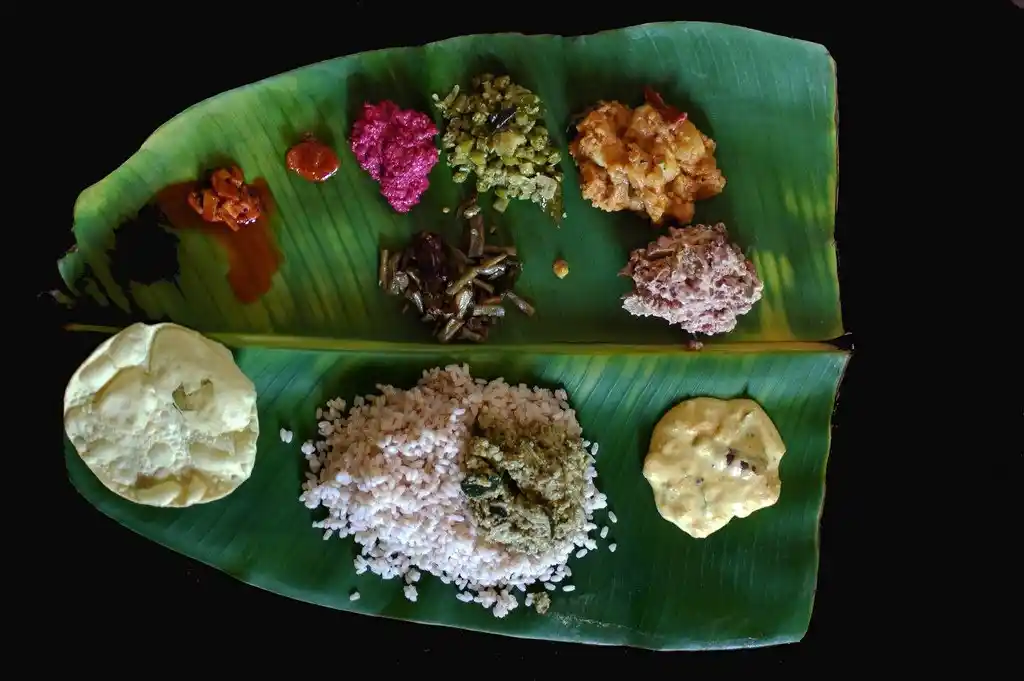
An elaborate feast sadya is prepared for Onam with dozens of delicacies served on a plantain leaf. From assorted chips ( plantain, jackfruit, yam) papad, pickles, chutneys, to banana, olan, upcurry, pachadi, avial, errissari, rasam, local short grain rice with cooling properties to sweets like prathman, parippu payasam its a surfeit of riches. In the coastal areas non vegetarian dishes like pan-grilled fish meen polichattu, erachi ularthiyathu succulent roast tiny chunks of meat and specialties like Suriani clam curry.
Camphor, sandal and rose are fragrances that uplift the mood and dehumidify the environs.