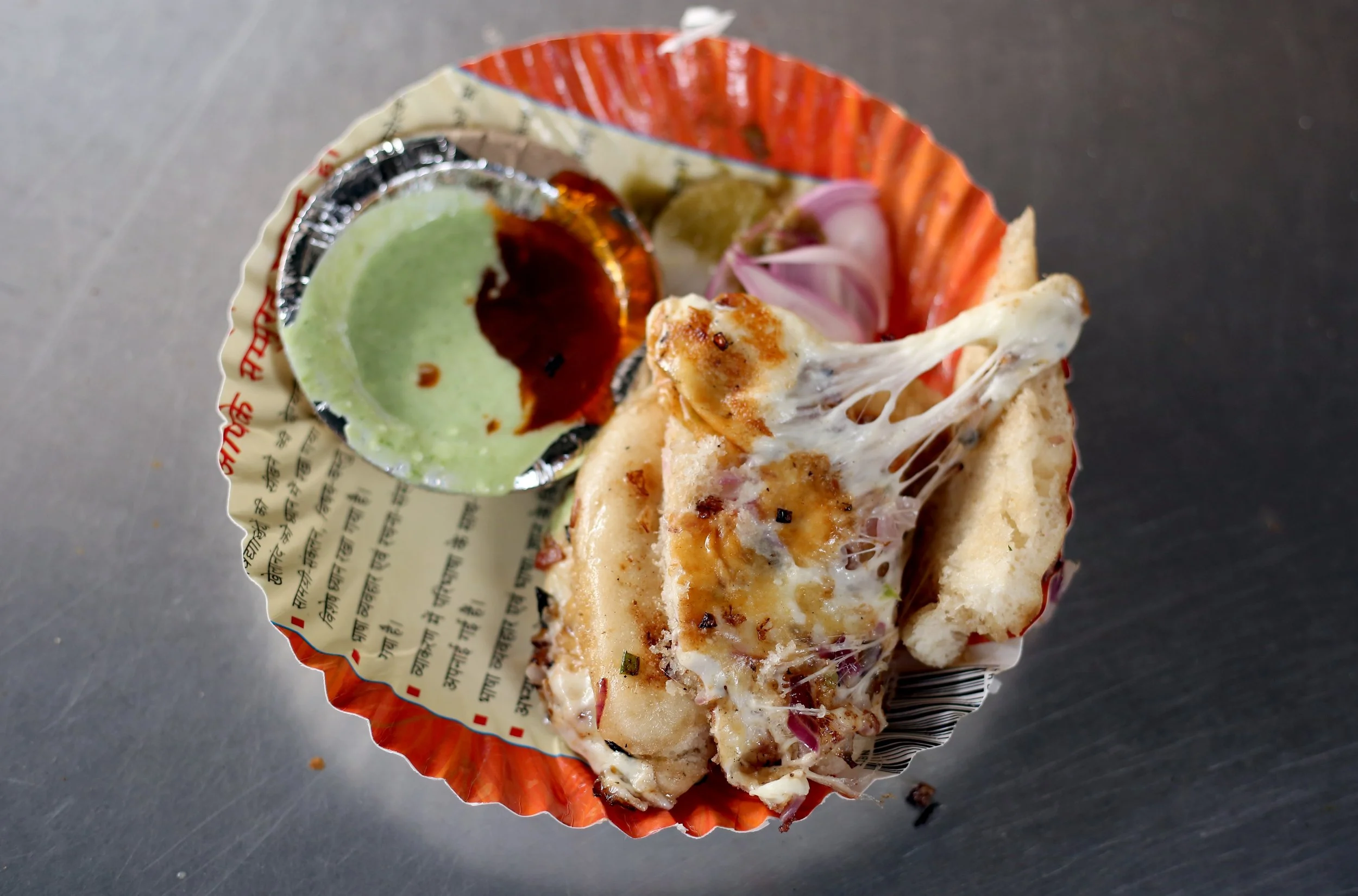
At an age when global fast-food choices such as momos, pizzas, and sandwiches dominate the street food scene and enjoy immense popularity among youngsters, a humble Dogra delicacy—Kaladi — is quietly staging a remarkable comeback, reconnecting people with their culinary roots while competing successfully with contemporary street food trends.
The food lovers in Jammu—the heartland of the Dogras, an ethnolinguistic community sharing a distinct cultural tradition in the Shivalik hills of North India—are relishing the fact that indigenous tastes can be just as irresistible as imported culinary trends.
Enter any corner of Jammu city, and the irresistible aroma of Kaladi, a soft, smoky delicacy roasted on an iron griddle over a gentle flame, is enough to draw street-food enthusiasts to roadside stalls. Many stop to watch its sizzling, on-the-spot preparation and rarely leave without relishing a hot, crisp bun, laced with tangy chutneys.
Often dubbed the “mozzarella of Jammu mountains,” Kaladi is gradually transforming the markets into a new regional food, tending to cross geographical boundaries like Bihar’s signature street food, Litti Chokha, Gujarat’s Dhokla and Fafda; Punjab’s kulcha; and Rajasthan’s delicacies such as Pyaaz Kachori and Mirchi Bada, which are widely popular.
Kaladi Kulcha Corner, a renowned eatery in Jammu’s Old Heritage City, attracts hundreds of street food enthusiasts every day, while many other similar outlets are favorite spots for Kaladi kulcha.
“ It is not merely about relishing a traditional street delicacy; it is also about celebrating and promoting Jammu’s unique cultural identity, which the Dogra community has preserved with pride over generations,” admits Bansi Lal Sharma, a social activist and medical professional at Kacchi Chawni.
Kaladi, said to be an old native of Jammu, originated in the pastoral, hilly terrains of Udhampur, specifically the Ramnagar area, often regarded as the cradle of this traditional Dogra delicacy. Some local traditions also trace its roots to the villages of Samroli and Ramnagar, where dairy-based livelihoods have been sustained for centuries.
Initially serving an ingenious purpose to help pastoralists preserve milk during the hot summer months, Kaladi soon began crossing the boundaries of Ramnagar, Chenani, and Pancheri to reach Jammu, Rajouri, Reasi, and beyond.
Kaladi is said to have flourished under the patronage of Raja Kedar Chand, with consignments regularly sent to Jammu markets, where it rapidly gained popularity as a sought-after delicacy.
The cheese gets its unique fibrous, chewy texture during production. Full-fat cow’s or buffalo’s milk is curdled, hand-pressed, and sun-dried in leaf bowls, allowing the moisture to drip away.
Before it is served in its transformed ways, raw Kaladi is uniquely prepared by pan-searing it in its own natural fat on a hot tawa. It is not flipped until the outside forms a crispy, golden-brown crust while the inside melts into a rich, gooey center.
“Traditionally, Kaladi is lightly salted while being pan-fried, seasoned with indigenous flavors such as anardana (dried pomegranate seeds) and timbur, and then tucked into a warm, freshly baked kulcha. Many households now also prepare Kaladi as part of their regular kitchen fare, incorporating it into a variety of traditional and contemporary dishes,” informs Malu Sharma, who doubles as a housewife and TV anchor in Jammu.
In the 133rd episode of ‘Mann Ki Baat,’ Prime Minister Narendra Modi brought national attention to Kaladi, a traditional cheese from Jammu and Kashmir. PM Modi described Kaladi as a creamy indigenous delicacy and an example of India’s rich dairy heritage. He also acknowledged the contribution of the Gujjar-Bakarwal community in preserving this age-old culinary tradition.
Adding to its popularity and authentic origin, Kaladi is now a GI (Geographical Indication) tag product from Udhampur in Jammu & Kashmir, and it is currently undergoing technological intervention at the world-class “Central Food Technological Research Institute” (CFTRI), Mysuru, Karnataka, informs Dr. Jatinder Singh, MOS in the Prime Minister’s Office, who represents Udhampur in the Parliament.
Dr. Singh, “The results achieved so far include extension of Kaladi’s refrigerated shelf life up to 21 days, without compromising quality, texture or nutritional value.”
According to him, the next step would be to convert this traditional food product into a commercially scalable product that can be used in various recipes by professional food chains.
The CFTRI Mysuru is the same institute that previously helped develop the Millet recipes currently served, among others, by McDonald’s.
“Kaladi is not just a dish, Dogra delicacy, or street food, but an emotion and identity. It is hygienic, an incredible, unmatched bite connecting the people across India,” Dr Singh explains the bond.
Bring Jammu’s heritage to any foodie’s table.