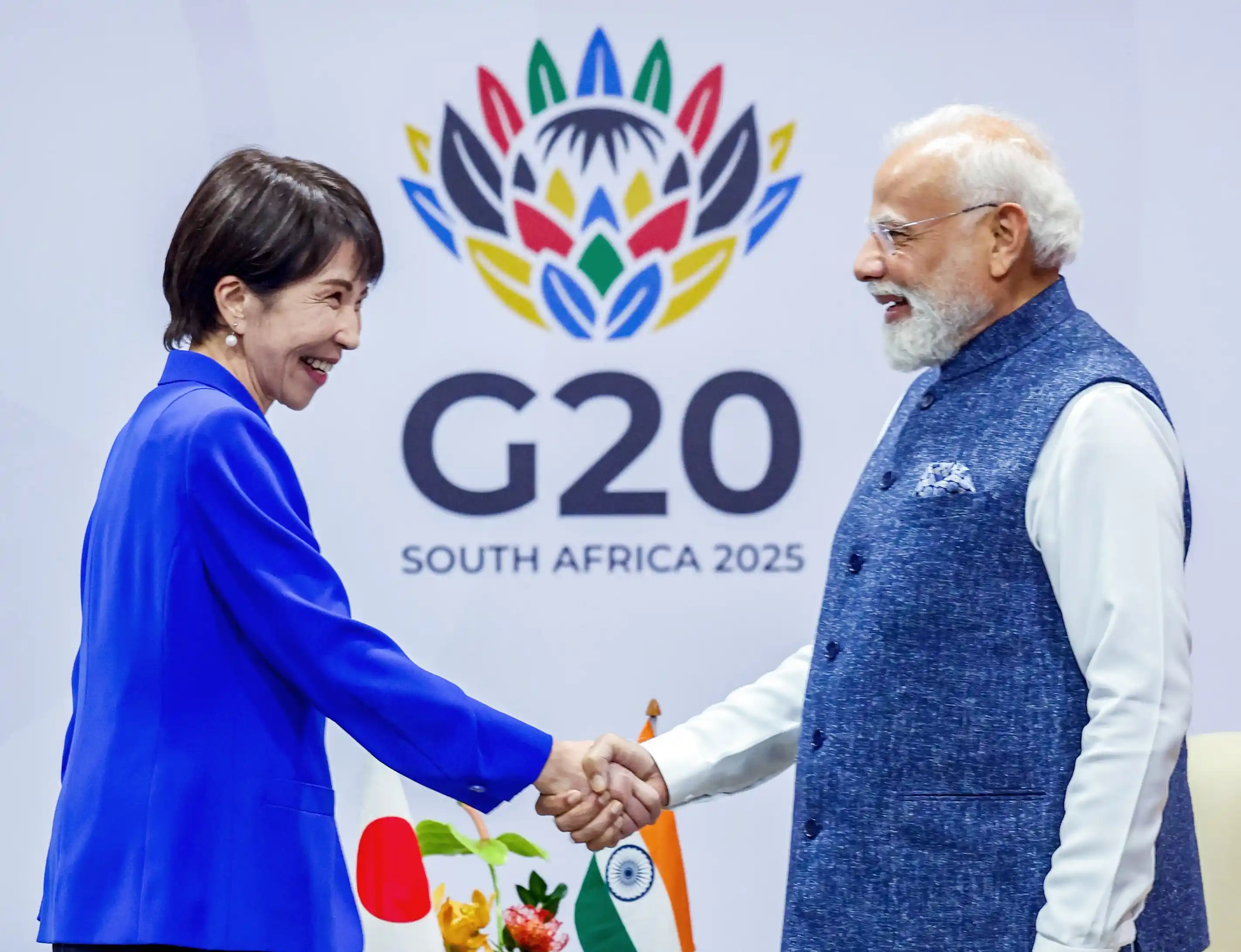
Japan’s Prime Minister Sanae Takaichi arrives on 1 July 2026 for a three-day official visit to India, her first as prime minister, for the 16th India-Japan Annual Summit. A protégé of Abe Shinzo, the former prime minister who had a special bond with Prime Minister Narendra Modi and was instrumental in building a constructive partnership with India, Takaichi is accompanied by a large delegation of top Japanese business leaders. The Modi-Abe “bromance,” which began when Modi was Gujarat Chief Minister, deepened during Modi’s prime ministership until Abe’s unfortunate assassination in 2022. That bonhomie has continued under successive prime ministers – Yoshihide Suga, Fumio Kishida, Shigeru Ishiba and now Sanae Takaichi.
The India-Japan relationship is a ‘Special Strategic and Global Partnership’ rooted in a long history of cultural and civilizational ties and honed by contemporary economic, trade and investment ties, defence and security complementarities, and shared economic security initiatives. The journey is one of the most beautiful, defined by friendship and fellow-feeling. Across every dimension, the relationship has flourished, making it robust. The consolidation of the bilateral relationship is underpinned by geopolitical challenges in the Indo-Pacific region and emerging threats to the existing regional order, compelling both countries to remain engaged.
One of the primary objectives of the Modi-Takaichi summit, therefore, is to advance the Joint Declaration on Economic Security Cooperation, signed in 2025, which focuses on both countries’ contributions to each other’s defence capabilities and readiness by promoting interoperability and synergy between their forces. This framework is designed to strengthen collaboration in sectors considered vital for national resilience. This dimension of the relationship assumes greater salience after Japan lifted the ban on arms exports to countries with which Japan has defence cooperation agreements, opening up further prospects for deepening and expanding defence ties between the two countries. Of the 17 such countries, India is a key player in Japan’s consideration.
Defence cooperation is one side of the relationship, and prospects are promising. However, during the present summit, economic security is likely to dominate the agenda. During Abe’s tenure, the focus was on building an alliance, formalising the Quad (India, Japan, the US and Australia), and signing sweeping defence pacts. The Quad’s birth stemmed from Abe’s desire to sculpt a grand geopolitical alignment to counter China’s regional dominance. His strategy was not to confront China directly but to launch a strategic alliance, balancing a tough stance on China with diplomatic nuance. Direct confrontation with China was never an option, but building an anti-encroachment coalition with India was a preferable choice. When Takaichi assumed office in 2025, with a reputation as a China hawk, there was consternation in some quarters that Japan-China ties would nosedive. Her remarks in November 2025 on Taiwan further fuelled such speculation. These fears were allayed by her subsequent policy choices. This issue is likely to figure in the summit talks so that mutual understanding is reached on how to cope with the China challenge.
The growing concern over China’s assertiveness and the economic slowdown in ties that began as many Japanese companies operating in China started relocating to other nearby Asian countries with government subsidies during the COVID-19 period still remains a consideration in Japan’s economic policy. This is a subject that Takaichi handled during the Abe administration. No wonder, with India, she prioritises economic security and is keen to convert diplomatic pledges into a high-value industrial reality.
Beyond economic cooperation, China’s rise and the concern stemming from its expansionist designs beyond its borders are also likely to be discussed at the summit. This could be the second most important outcome, expected to dominate the summit. China’s assertiveness has created a complex security environment in the Indo-Pacific. Both Modi and Takeichi are expected to agree to deepen collaboration in defence manufacturing, maritime security and strategic technologies. Both are also expected to explore greater co-development of defence equipment and to strengthen interoperability between their armed forces. Cooperation through the Quad framework reflects the growing convergence between the two countries on maintaining a free, open and rules-based Indo-Pacific, a concept popularised by Abe and which has remained a mantra for successive governments in both India and Japan.
What could be the specific economic areas in focus during the summit?
Again, here too, the China factor is likely to determine the tone of the discussion. This could include diversifying microchip supply chains, securing rare earth minerals, and decoupling critical tech from China. The heavyweight business delegation of 50 Japanese executives in her entourage, including Suzuki Motor’s Toshihiro Suzuki and senior executives from Toyota Tsusho and Itochu, would set Takaichi’s agenda centred on de-risking high-tech manufacturing and securing critical supply lines. Their participation signals Tokyo’s intent to deepen its economic footprint in India through manufacturing, infrastructural and industrial partnerships.
While Modi-Abe bonhomie was the talk of the region, in particular Abe’s Indo-Pacific strategy, the Modi-Takaichi relationship is expected to be more professional and deeply institutional. Besides the economic security as the focus, one can expect that a new mutual alignment on national security and a shared outlook on regional stability would get primacy in policy formulation.
As Anamica Singh noted, “while Abe created the foundation for India-Japan relations as known today, Takaichi is taking them forward with an aggressive focus on pushing corporate Japan to move capital out of China and directly into India’s manufacturing sector.”1 The key likely takeaways of the summit are strengthening cooperation in trade, defence, semiconductor manufacturing, clean energy and emerging technologies, as well as deepening strategic ties and boosting investment.
One of the summit’s key outcomes is expected to be the operationalisation of Japan’s ambitious 10 trillion Yen investment roadmap for India. The focus is likely to be on executing already agreed-upon projects and accelerating Japanese private-sector participation. Rather than viewing India solely as a consumer market, Japanese companies are increasingly positioning the country as a manufacturing and export hub for global supply chains. The Ahmedabad-Mumbai High-Speed Rail corridor is also expected to be reviewed, and there is a push for faster implementation of metro rail, industrial corridors and urban connectivity projects backed by Japanese financing through JICA.
Energy cooperation is likely to receive renewed attention at the summit, given energy security concerns amid global supply chain disruption following the war in the Middle East. Japan is likely to extend financial and technical support to strengthen India’s strategic petroleum reserves (currently pegged at 10 days, compared with Japan’s 230 days)2, thereby enhancing the country’s long-term energy security. As global supply chains are being redrawn and competition over critical technologies intensifies, India and Japan are preparing to elevate one of Asia’s most important strategic partnerships. A major objective of the summit is to develop a strategy to reduce vulnerabilities stemming from overreliance on single-country supply chains. Both countries are expected to expand collaboration in manufacturing, logistics and investment, enabling businesses in both countries to build more resilient production networks across the Indo-Pacific.
The declaration of cooperation on economic security, agreed upon in 2025, seeks to secure and diversify supply chains, particularly for semiconductors, critical minerals, batteries, and other strategic industries. It also envisages greater coordination on emerging technologies, including artificial intelligence, quantum technologies, telecommunications and cyber-security, while encouraging joint research, innovation and industrial partnerships.
Conclusion
Modi-Takaichi interactions during the India-Japan 16th Annual Summit are expected to build on the ambitious roadmap adopted at the 15th India-Japan Annual Summit in Tokyo in August 2025. In 2025, the two leaders – Modi and Ishiba – unveiled a Joint Vision for the Next Decade, covering eight broad pillars, including economic growth, economic security, technology and innovation, environmental cooperation, healthcare, mobility, people-to-people exchanges and state-prefecture partnership.
Both sides had adopted a Joint Declaration on Security Cooperation, reflecting growing convergence on Indo-Pacific security and defence collaboration. They also agreed on an Action Plan for Human Resource Exchange to facilitate the movement of more than 500,000 people over the next five years, including skilled and semi-skilled workers from India.
The large business delegation accompanying Takaichi underscores the summit’s economic significance. Japanese companies are seeking to expand their investments in India’s manufacturing ecosystem, particularly in semiconductor production, electronics, clean mobility and next-generation technologies.
Beyond trade and investment, India and Japan have steadily deepened their engagement through the Quad, the 2+2 ministerial dialogue, defence exercises, and cooperation on maritime security in the Indo-Pacific.
Another point to note is that Japan has an exclusive and independent framework with India for the development of the north-eastern states. Under the rubric of India’s Act East Forum, Japan has provided more than Rs. 1,600 crore in Overseas Development Assistance (ODA) for this strategic region, excluding Arunachal Pradesh.
In fact, the 16th Summit was originally scheduled to be held in Guwahati but was moved to New Delhi because of Takaichi’s schedule and logistical constraints. The Assam government, led by Chief Minister Himanta Sarma, pulled out all the stops to prepare for the summit, including a roadshow by both Prime Ministers in Guwahati. The previous annual summit was originally planned to be held in Guwahati in December 2019, but had to be called off because of widespread protests in Assam over the Citizenship (Amendment) Act. The shift of the summit venue from Guwahati to New Delhi in no way signifies any change in Japan’s commitment to the economic development of India’s north-eastern region. It was purely because of Takaichi’s tight schedule, when the Diet is in session in Japan, that India had to accommodate Japan’s request for a venue change.
The copyright of this article remains with the Politeia Research Foundation ©️PRF.
*****
Endnotes
1 Anamica Singh, “Abe-Modi ‘bromance’ legacy will lurk over Takaichi’s India visit. What to expect”, MSN, June 29, 2026, https://www.msn.com/en-in/news/India/abe-modi-bromance-legacy-will-lurk-over-takaichis-india-visit-what-to-expect/ar-AA26MR8k
2 India’s Petroleum Minister claims India has 70 days of oil reserve. https://farmonaut.com/mining/crude-oil-strategic-reserves-by-country-in-days-2026.