
As India prepares to celebrate its 80th Independence Day, the Red Fort will become a meeting ground of memory and aspiration — commemorating 150 years of Vande Mataram while placing the energy, imagination and enterprise of young Indians at the heart of the journey towards Viksit Bharat@2047.
On the morning of August 15, an old song will rise from an old fort.
For the first time, Vande Mataram will be sung from the ramparts of Delhi’s Red Fort as India gathers to celebrate its 80th Independence Day. The moment carries a symbolism larger than ceremony. A song born in another century, which travelled through the freedom movement as an invocation of the motherland, will return in its 150th year to one of the most enduring stages of independent India.
And around it will stand another India — young, inventive, ambitious and looking towards 2047.
This meeting of the past and the future forms the cultural heart of Independence Day 2026: 150 Years of Vande Mataram and Yuva Shakti for Viksit Bharat@2047.
A song that became larger than itself
Few compositions have travelled through Indian public life quite like Vande Mataram. Written by Bankim Chandra Chattopadhyay and later incorporated into his novel Anandamath, its opening words — literally, an invocation to the mother — gradually acquired a political and emotional life far beyond literature.
During the freedom struggle, Vande Mataram became a cry of collective assertion. It was sung at gatherings, carried into protest and invoked by generations who imagined India not merely as territory, but as a shared civilisational and emotional inheritance.
A century and a half later, its presence at the Red Fort creates an unusual historical arc.
On August 15, the song will precede the hoisting of the National Flag by Prime Minister Narendra Modi and his customary address to the nation. The commemoration will extend across the visual landscape of the ceremony. Floral decorations will carry the Vande Mataram motif, while 2,500 NCC cadets and MY Bharat volunteers will form the words ‘वंदे मातरम्’ on Gyanpath opposite the ramparts.
Above them, an Indian Air Force Mi-17 helicopter will carry a banner marking 150 years of the song and shower flower petals over the gathering.
The tribute has also moved beyond Delhi. Between August 8 and 15, military and uniformed-service bands are performing at 343 prominent locations across India — transforming the anniversary from a single ceremony into a nationwide musical remembrance.
There is something fitting about that. Vande Mataram entered the national consciousness through voices gathered together; 150 years later, it is being commemorated through music heard across the country.
From the generation that won freedom to the generation shaping 2047
Yet Independence Day is never only about looking backwards.
Every generation inherits freedom differently. For those who lived through the struggle, independence was an aspiration. For the first generations after 1947, it was the enormous task of nation-building. For young Indians today, the challenge is different: what can be created with the freedom that previous generations secured?
That question lies behind the second major theme of this year’s celebrations — Yuva Shakti.
India’s ambition of becoming a developed nation by 2047, when it completes a century of independence, inevitably places its young population at the centre of the national story. The Red Fort ceremony seeks to make that idea visible not simply through slogans, but through the people seated within it.
Among the guests will be 19 Indian students who won medals at the 2026 International Olympiads in physics, chemistry, biology and mathematics. Their presence on the ramparts places scientific excellence alongside national ceremony — an acknowledgement that the frontiers of nation-building today are as likely to be found in laboratories, classrooms and technology centres as elsewhere.
The visual language of the celebration reinforces that transition. Installations in the backdrop will depict India’s progress in nuclear and space technology, while floral arrangements at the Guard of Honour area will portray the country’s journey towards Viksit Bharat@2047.
It creates a striking continuum: a freedom song from the 19th century, the flag of the republic born in the 20th, and the scientific ambitions of the 21st — sharing the same ceremonial landscape.
Who gets a seat at the national celebration?
Perhaps the most socially revealing aspect of this year’s Independence Day is not merely what will happen on the ramparts, but who has been invited to witness it.
Around 5,000 Special Guests from across India will attend the celebrations.
They represent an unusually broad portrait of contemporary nation-building: youth innovators, interns, startup founders, skilled workers, scientists, volunteers, women entrepreneurs, artisans, farmers and beneficiaries of public programmes.
But alongside recognisable stories of achievement are people whose work often remains outside the spotlight.
Street vendors will be there.
So will sanitation workers.
Delhi Metro personnel, workers associated with Kartavya Path and Central Vista, nursing orderlies and hospital staff, cab and taxi drivers, artisans and grassroots workers have also been invited.
Their inclusion quietly expands the cultural meaning of a “national celebration”. A nation is not constructed only through spectacular achievements. It is also sustained through thousands of ordinary acts of work — trains running, hospitals functioning, streets being cleaned, cities being built, crafts being preserved and livelihoods being created.
Independence Day, in that sense, becomes not merely a commemoration of those who made freedom possible, but a recognition of those who make everyday India possible.
India in miniature at the Red Fort
Culture will also appear in its most immediately visible form — India’s extraordinary diversity of dress and regional identity.
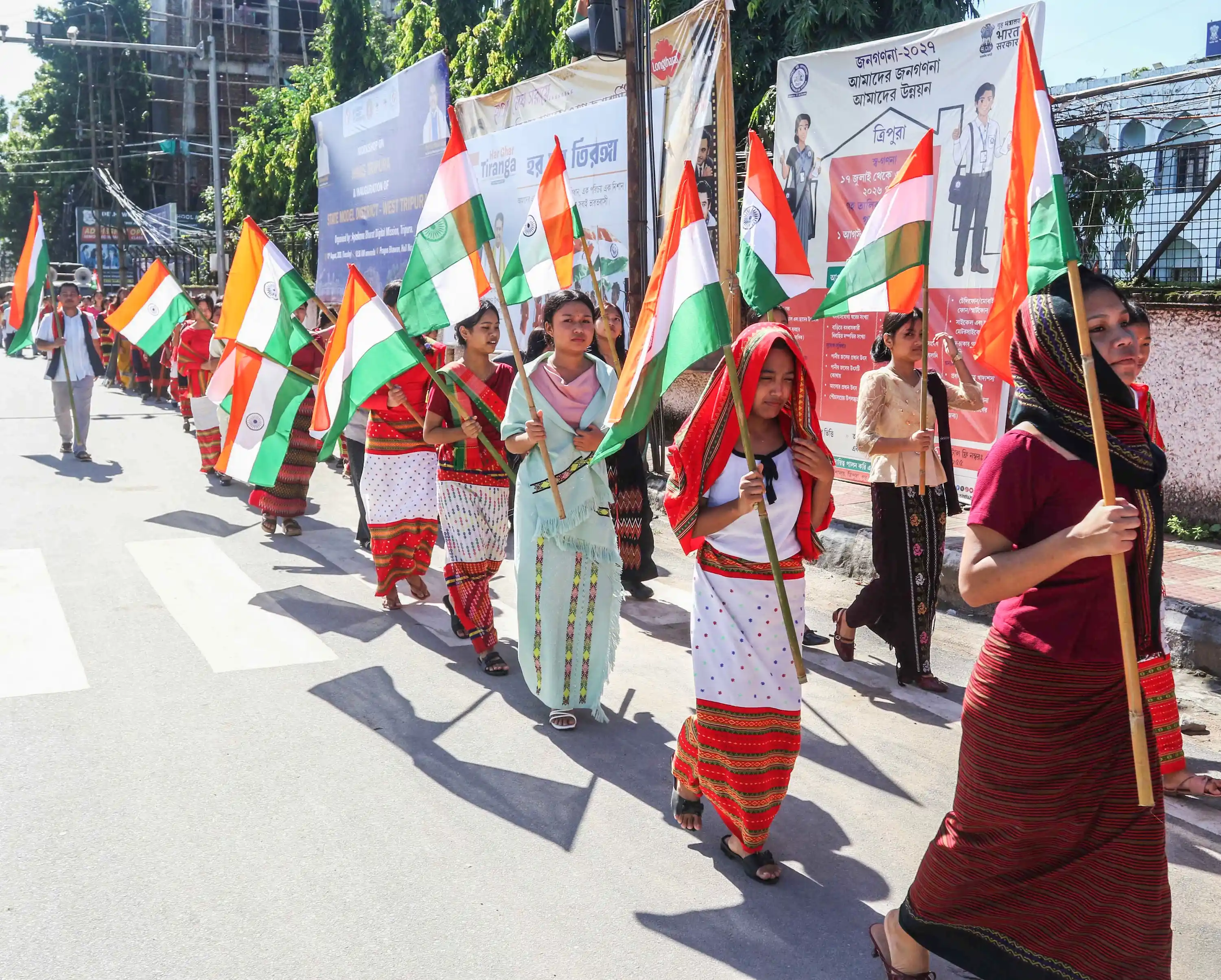
More than 1,500 Delhi-based citizens originally belonging to different States and Union Territories have been invited to attend in traditional attire. Together, they are intended to create a microcosm of India within the Red Fort complex.
It is an old Indian idea expressed through a contemporary ceremony: that unity need not require sameness.
Languages change every few hundred kilometres. Food, textiles, music and customs transform across regions. Yet on Independence Day these distinctions do not disappear; they assemble.
Even the seating enclosures carry a geographical imagination. After being named for Indian rivers during Republic Day 2026, the enclosures for Independence Day have been named after the country’s major lakes — bringing India’s natural heritage symbolically into the architecture of the celebration.
Children imagining India at 100
If Vande Mataram represents inherited memory, perhaps the most interesting questions about India’s future have been placed before its children.
In the weeks preceding Independence Day, students participated in competitions built around subjects that span India’s constitutional, historical and technological journey.
They were asked to write about the role artificial intelligence could play in building a developed India by 2047 and to paint “India 1947 vs India 2047.”
Quizzes took them through fundamental rights and duties, the makers of the Constitution, women in India’s freedom movement, technological progress, space exploration and nuclear science.
Around 600 winners will attend the Red Fort celebrations.
There is a compelling idea contained in that exercise. The India of 2047 does not yet exist. For today’s children, therefore, the centenary of independence is not history. It is imagination.
Many of them will be adults in the prime of their lives when the country reaches that milestone. The India they draw today may, in some measure, become the India they are responsible for building tomorrow.
Freedom as duty
Another thread running through the 2026 celebration is seva — service.
This year’s invitation cards feature Seva Teerth, invoking the ideals of duty, compassion, public service and “Nation First”. The Dharm Chakra on the invitation serves as a symbol of righteous duty and continuous selfless action.
That idea will continue even after the speeches are over and the crowds begin to leave.
NCC cadets and MY Bharat volunteers will participate in a post-event cleanliness campaign at the Red Fort, undertaking plogging and waste removal so that the monument can reopen to visitors after the ceremony.
It may appear a small detail beside helicopters, military bands and the ceremonial hoisting of the Tricolour. Yet culturally, it completes an important circle.
Patriotism expressed in song and spectacle acquires another dimension when translated into responsibility for a shared space.
Between remembrance and becoming
The Red Fort has watched India change.
From its ramparts have come some of the republic’s most remembered words. Beneath its walls, generations have gathered every August to watch the Tricolour rise.
This year, another layer of memory will be added.
Vande Mataram will be heard there in its 150th year — a song that belonged to generations who dreamed of a free India.
But surrounding it will be young scientists, innovators, students, workers, artisans, entrepreneurs and volunteers representing a country asking a different question: what should India do with the freedom it inherited?
That may ultimately be the deeper cultural resonance of Independence Day 2026.
Nations require memory because memory tells them where they came from. But nations also require imagination because imagination tells them where they might go.
On August 15, at the Red Fort, the two will briefly occupy the same space.
One will speak in the language of 1876:
Vande Mataram.
The other will look towards 2047.
And between them stands India — remembering, building and becoming.

