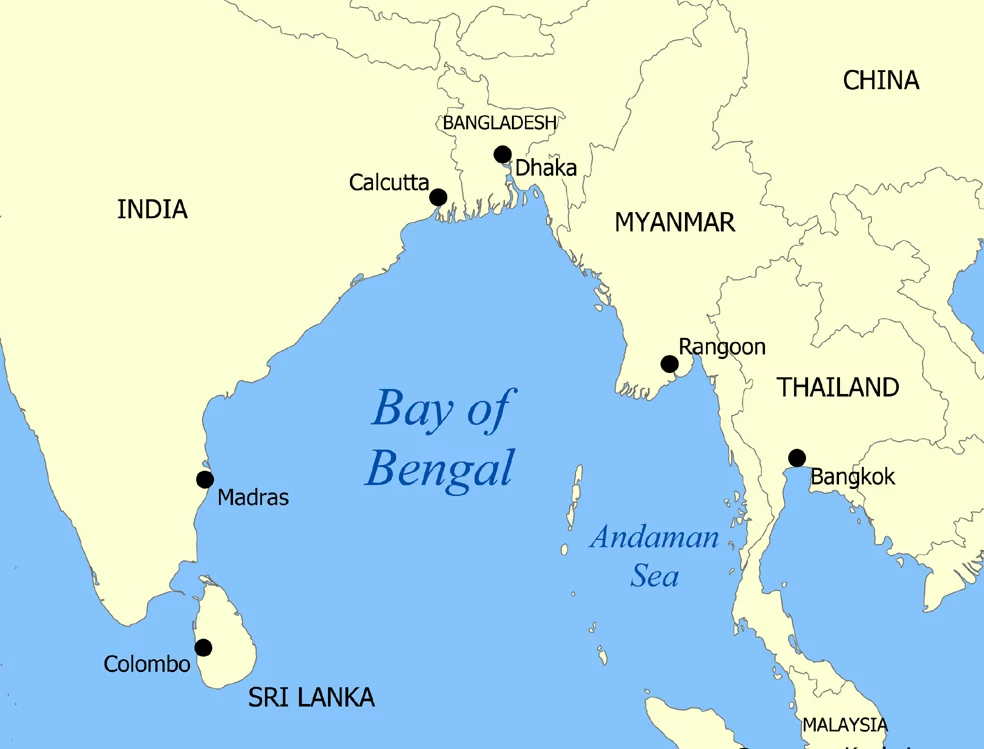
India and Bangladesh are often understood through the anxieties of their land border. While concerns like Migration, smuggling, fencing, border violence and political suspicion have dominated the public discussion; they are too narrow to define a relationship that is central to India’s eastern strategy, the development of the Northeast and the future of the Bay of Bengal.
The more consequential question asks: Can India transform its geographical proximity to Bangladesh into durable regional leadership?
For India, the answer lies in shifting the centre of gravity from the border to the Bay of Bengal. There is no doubt that the border must be managed, but the Bay must be developed, connected and strategically imagined. A maritime-centred relationship would enable India to combine security with connectivity, national interest with regional public goods, and strategic competition with economic opportunity.
Bangladesh is not simply a neighbouring state across India’s eastern frontier. It is a gateway to the sea, a bridge to the Northeast and a vital partner in India’s attempt to become a more influential power in the Indo-Pacific.
The Limits of a Border-Centred Relationship
India shares a long and densely populated border with Bangladesh and therefore there are legitimate security concerns. Cross-border smuggling, trafficking, irregular migration and other forms of organised crime require serious attention.
However, when bilateral relations are viewed primarily through these concerns, India’s policy becomes reactive. Bangladesh then is seen mainly as a source of security challenge rather than as a country with which India can shape a larger regional future.
This approach also limits India’s own strategic imagination. It encourages New Delhi to look eastward through the lens of containment instead of opportunity. It gives disproportionate importance to short-term political controversies while neglecting the long-term value of maritime connectivity, energy cooperation, trade and climate resilience. India must therefore retain a firm approach to border security while placing the border inside a much larger strategic framework. That framework should be the Bay of Bengal.
The Bay of Bengal as India’s Eastern Gateway
The Bay of Bengal is increasingly becoming a central arena of India’s economic and strategic interests. It connects India’s eastern coast with Bangladesh, Myanmar, Sri Lanka, the Andaman and Nicobar Islands and Southeast Asia.
India’s geography gives it a natural advantage in this maritime space. Its eastern coastline, island territories, naval capabilities, ports and growing commercial networks provide the foundations for regional leadership. India is one of the region’s principal geographical and civilisational centres.
Bangladesh occupies a strategically important position at the northern end of the Bay. Its coastline and ports offer access to regional trade routes, while its location gives it importance for the integration of India’s Northeast with the wider maritime economy.
For India, a cooperative Bangladesh can help convert the eastern subcontinent from a fragmented space into an integrated economic corridor. The Bay of Bengal, therefore, is not merely a maritime issue. It is a framework for India’s national development, regional connectivity and strategic influence.
Connectivity as Indian Statecraft
Connectivity should be treated as one of India’s most important instruments of regional statecraft. Military power can deter threats, but connectivity creates long-term interdependence. India’s geographical advantage over distant powers is clear. It shares a border with Bangladesh, possesses a large market and has established historical, cultural and educational links. Yet geography alone does not guarantee influence. India must convert proximity into dependable infrastructure and practical economic benefits.
This requires faster implementation of roads, rail links, inland waterways, port connections and border haats. It requires simpler customs procedures, predictable regulations and improved coordination between national and state authorities. It also requires India to address delays that can undermine confidence in its promises.
Digital connectivity should also become part of the relationship. India’s experience in digital payments, public-service delivery, telecommunications and technology platforms creates possibilities for cooperation. Such cooperation must respect privacy, data protection and national sovereignty, but it can support new forms of economic integration.
For India, the goal should be to become the most reliable provider of regional connectivity. Reliability is often more influential than rhetoric.
The Blue Economy
The Bay of Bengal offers opportunities in fisheries, marine research, shipping, coastal tourism, renewable energy and port development. These activities form part of the emerging blue economy. India should take the lead in promoting a sustainable blue-economy partnership with Bangladesh. This would involve scientific cooperation, responsible fishing, marine environmental protection and the development of coastal industries.
India’s interests are directly involved. The health of the Bay affects its eastern coastline, ports, fisheries, island territories and maritime security. Pollution, overfishing, illegal fishing and climate change cannot be handled by one country alone.
India can contribute through research institutions, satellite monitoring, oceanographic data and maritime technology. It can also support capacity-building for Bangladesh’s coastal communities and maritime agencies.
India must promote development while protecting marine ecosystems. A sustainable maritime relationship would give India greater legitimacy in the region and reduce the risk of ecological conflict.
The China Factor
Bangladesh’s growing engagement with China is an important consideration for India. China has expanded its infrastructure, commercial and diplomatic presence across the Bay of Bengal. Bangladesh seeks investment, technology and development opportunities from multiple partners.
India should respond with strategic seriousness, but not with insecurity. Bangladesh will not accept a relationship based on exclusive alignment. It has its own national interests and will continue to engage with different powers.
India’s answer should be to improve its own performance. It should offer projects that are timely, transparent, financially viable and responsive to Bangladesh’s development needs. It should use its natural advantages i.e. proximity, market access, cultural links, energy connections and regional knowledge- to become the partner Bangladesh finds most useful.
India does not need to prevent every Bangladeshi engagement with another country. It needs to ensure that no external power can replace India’s overall relevance. This requires a shift from a zero-sum mentality to competitive cooperation. If India delivers better connectivity, more reliable energy, easier trade and stronger educational links, its position will remain secure even in a plural regional environment.
The Water and River Connection to Ecological Co-Custodianship
The Bay of Bengal cannot be separated from the rivers that flow into it. India and Bangladesh share shares 54 transboundary river systems whose waters affect agriculture, navigation, fisheries, flooding and coastal livelihoods.
The bilateral engagement must pivot towards three novel, actionable mechanisms.
1. Establishing the Joint Delta Governance Authority (JDGA)
While Bilateral Joint River Commissions (JRC) have historically been hobbled by legalism, bureaucratic inertia, and a narrow focus on water allocation ratios, South Asia requires an executive, scientific body modelled on modern basin conventions like the International Commission for the Protection of the Rhine (ICPR) or the Danube River Protection Convention: a Joint Delta Governance Authority (JDGA).
The JDGA should shift focus away from contentious volume extraction toward whole-basin ecological vitality:
- Siltation and Geomorphic Restoration: To prioritize sediment management and joint riverbed rehabilitation that can ensure that the delta’s natural land-building capacity is preserved.
- Unified Hydrological Telemetry and Open-Source Sensor Grids: A decentralized, real-time sensor network along the Ganges, Brahmaputra, and Meghna can drive information symmetry.
- Aquifer Recharge Regimes: Transboundary groundwater depletion along the Bengal Basin is accelerating at an alarming rate. The JDGA must create joint sub-surface monitoring zones to prevent irreversible sub-soil salinization in contiguous border districts.
2. A Sovereign- Neutral Sundarbans Biosphere Council
The Sundarbans stands as the primary biome shield protecting Kolkata and Dhaka from Bay of Bengal super-cyclones. Yet, it remains partitioned by a political line drawn across tidal mudflats, managed through separate, uncoordinated domestic conservation regimes.
We need a Sovereign-Neutral Sundarbans Biosphere Council (SBC) that would unify conservation strategies without requiring either nation to compromise territorial sovereignty:
- Single-Charter Conservation and Anti-Poaching: Standardized patrolling protocols, mutual hot-pursuit agreements for maritime poachers, and joint scientific baselines for the endangered Royal Bengal Tiger and Gangetic dolphin populations.
- Transboundary Carbon In setting and Blue Carbon Credits: The Sundarbans represents one of the world’s most dense blue-carbon sinks. Together, India and Bangladesh can aggregate the biosphere’s carbon sequestration capacity to issue sovereign-backed Blue Carbon bonds in international compliance markets, channelling billions in global climate finance directly into local climate-adaptation infrastructure.
- Ecological Livelihood Transition: The millions of inhabitants living in the Sundarbans impact zones on both sides of the border face chronic poverty and rising salinity. A joint regional trust fund can finance salt-tolerant aquaculture, mangrove-based ecotourism, and off-grid renewable microgrids, reducing human extraction pressure on the core forest.
3. Integrated Climate Shield Architecture
Disaster diplomacy between India and Bangladesh has traditionally been ad-hoc, kicking into gear only after devastating cyclones make landfall. A progressive sub-regional architecture must formalize an institutional safety net:
- Coordinated Cross-Border Early Warning Infrastructure: Integrating India’s advanced space-based earth observation assets (including the NISAR radar and Oceansat payloads) with Bangladesh’s grassroots cyclone preparedness networks creates an end-to-end regional storm defense shield.
- The “Green Corridor” Humanitarian Logistics Agreement: In the immediate wake of climate-induced disasters, bureaucratic customs procedures at terrestrial borders (such as Petrapole-Benapole or Ghojadanga-Bhomra) cost vital lives. A pre-ratified Green Corridor protocol would grant pre-cleared, automatic humanitarian transit for emergency personnel, mobile desalination plants, and disaster-relief materials across the border during state-declared emergencies
Therefore,India’s influence in Bangladesh cannot be sustained through government-to-government relations alone. It must also possess social legitimacy. A confident India should communicate with Bangladesh’s wider society. Scholarships, university partnerships, medical cooperation, professional exchanges, tourism, cultural programmes and media dialogue can help develop a more balanced relationship.
The border must be managed, but the Bay of Bengal must be imagined.