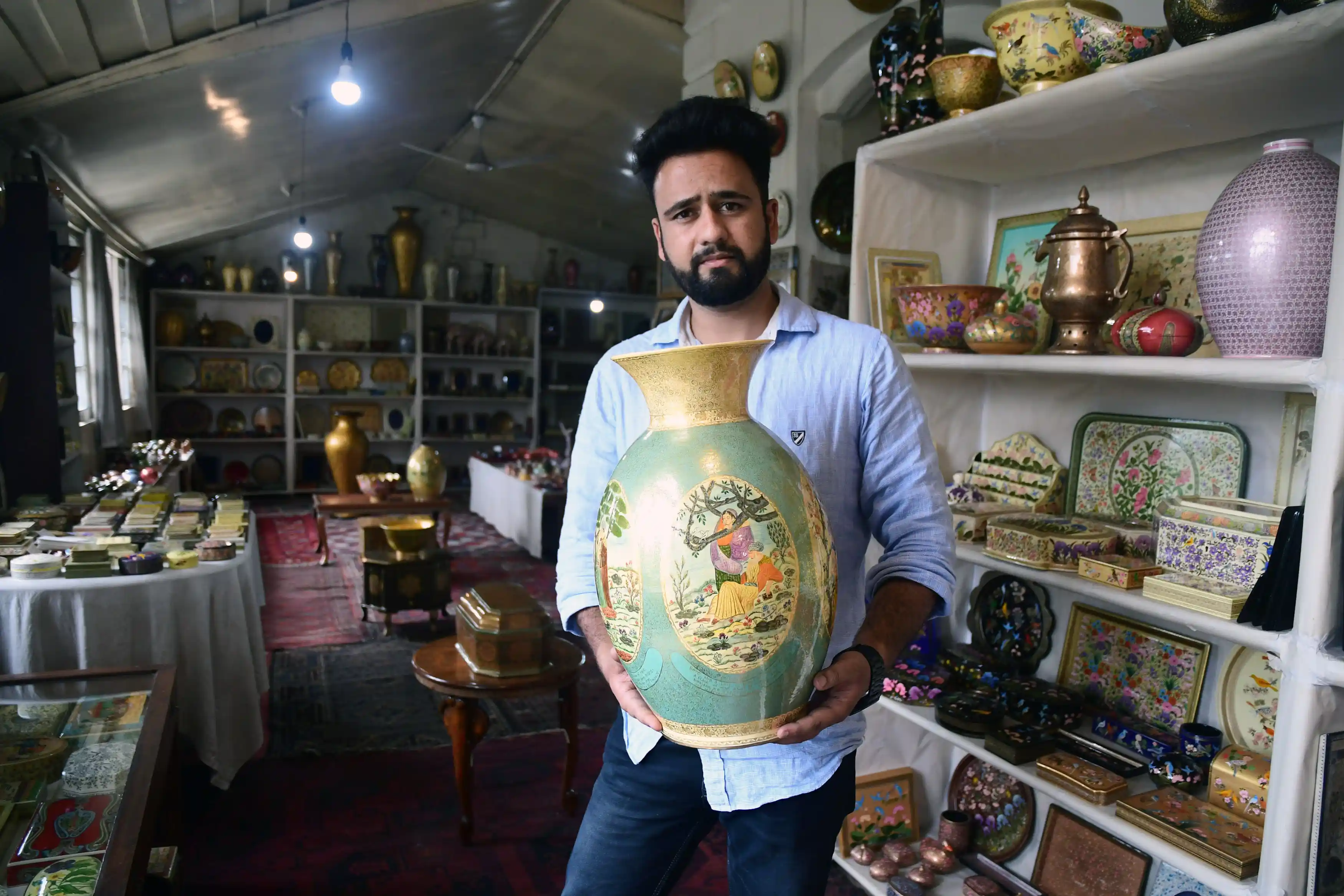
Kashmiri handicrafts need no introduction. It has long carried its artistic legacy far beyond the Valley as one of Kashmir’s most important traditional economic activities. Not only has it providedlivelihoods to hundreds of thousands of artisans, weavers, traders, and other workers, but it has long been part of the valley’s cultural identity.
For decades and centuries, Kashmiri artisans have preserved rich cultural heritage and legacy. With outstanding craftsmanship, intricate designs, and indigenous techniques, this export-rich handicraft industry also showcases its natural beauty, history, and diverse cultural influences.
The handicraft industry is indeed on a path to revival, moving beyond its turbulent times after a period of militancy and the Covid-19 pandemic. Many traditional artisans have found new markets within the country and also globally, bringing hopes for a new lease of life to the struggling sector.
“Kashmiri artisans now have a direct pathway to bulk buyers and high-end export markets by combining traditional craftsmanship with better materials, contemporary design, quality certification, and access to international showrooms. This is helping transform centuries-old craftsmanship into globally competitive products while preserving the skills, stories, and cultural heritage,” admits Gulam Sadiq, a third-generation skilled artisan at Baramula.
Kashmiri pashmina shawls are the finest expressions of the valley’s traditional heritage compared to Kashmiri carpets, especially hand-knotted ones with intricate floral designs, and Sozni embroidery, a delicate needlework on shawls and other fabrics, is the highest in demand. Pashmina shawls are known for exceptionally soft and warm fibres of the Himalayan Changthangi goat; these shawls are popular for their lightness, intricate craftsmanship, and timeless beauty.
The exquisite patterns such as paisley, floral motifs, and traditional Kashmiri designs reflect the region’s rich cultural history. The craftspeople have already gone in for new innovations, combining traditional craftsmanship with contemporary designs and quality standards.
The list of famous crafts in Kashmir also includes papier-mâché art, which produces beautifully decorated boxes, vases, ornaments, and other objects. Then there is walnut wood carving and Tilla embroidery, featuring metallic thread work, and Namdas of Kashmir, a highly decorative wool floor covering decorated. Gabba rugs, crewel embroidery, and basketry are also important parts of Kashmir’s craft tradition.
According to Noor Hasan, a Kashmiri trader, “Of late the Jammu and Kashmir government has also started giving a global push to the sector, setting out a target to expand handicraft exports, modernise traditional crafts, improve artisans’ skills, strengthen market access, and promote GI-certified products globally.”
The government has a policy that envisages export subsidies, marketing support, design development, and infrastructure, aiming to make J&K handicrafts more competitive in international markets while preserving traditional craftsmanship.
Some of the international markets explored are Dubai, London, Singapore, Paris, New York, Milan, and Tokyo, among the cities that could eventually be considered.
The government’s Rs 2,000-crore export target should therefore be regarded as a milestone rather than a destination.
The industry has shown a substantial recovery in exports.
According to the Jammu & Kashmir Economic Survey 2025–26, handicrafts and handloom are a significant part of the UT economy, supporting about 4.45 lakh artisans and craftsmen. The sector contributes significantly to J&K’s GSDP, while handicraft exports exceeded Rs 1,100 cr. The woollen shawls alone have a share of Rs 477.25 cr, while carpets have Rs 317 cr.
In 2025, the government trained about 11,000 people in carpet weaving as part of efforts to preserve and revive the craft.
The government is also strengthening quality-control mechanisms; in April 2026, J&K constituted a Handicrafts Quality Control Council, reflecting continuing efforts to protect the authenticity and reputation of Kashmiri crafts.
In 2020, the Jammu and Kashmir government announced its Handloom and Handicraft policy with major objectives to improve the income of the artisans, protect and preserve Kashmir’s cultural heritage, encourage entrepreneurship among artisans, and provide them wider access to national and international markets.
Further, the GI tagging of the products—known for their uniqueness and also to protect their authenticity—has brought a positive change to Kashmir’s handicraft sector.
It has immensely helped protect the originality and identity of traditional crafts like Pashmina shawls, Kani shawls, Sozni Craft, Papier-mâché, Walnut Wood Carving, Gabba, Willow bats, Kashmiri hand-knotted carpets, and half a dozen other products. Even Basohli Painting, Basohli Pashmina, Rajouri Chikri Wood Craft, and Ramban’s Sulai Honey and Udhampur Kaladi (a traditional dairy product) are GI-tagged,” says a senior official in the Jammu and Kashmir industries department.
With GI tags, buyers can better identify genuine Kashmiri handicrafts and trust their quality. This has helped artisans gain recognition and reach wider markets, both in India and abroad.